I normally don’t do primers for returning sets. But normally the returning sets are not my favourite set. Ikoria: Lair of Behemoths was for me the ultimate draft set, and I hope that I can convince you to give it a proper shot over the upcoming week. Why I love this set so much? It is a combination of many things. Firstly – this is the ultimate brewer’s set. It abandons the traditional concept of color defined archetypes to some extent and replaces them with broad themes.
Weirdly, IKO is a guild set. The enemy color pairs are much more supported than the friendly color pairs. But unlike most guild sets, this structure doesn’t mean it was limited to 5 archetypes. By far not. I could probably name 50 distinct archetypes in Ikoria and won’t extinguish the topic, but lots of them will be a one-in-a-hundred drafts experience. Among those broad themes you have a myriad of narrow mini themes and it is those mini-themes that drove my love to the format. Mini-themes allowed making each draft unique, trying tons of things, making each draft a unique experience. And once-in-a-hundred drafts experiences sound rare – but if there is dozens of them, you will end up in a unique deck all the time if you know where to find them.
But before we look at the niche, let’s take a look at the macro-synergy archetypes.
Mutate is the overarching theme of the set. A new mechanic, it allows you to stack multiple non-humans on top of each other, potentially accruing some bonuses in the process. So, for example, you can cast Essence Symbiote on turn 2, and mutate Migratory Greathorn on top of it on turn 3. As a result, you will get a 3/4 creature (you chose which power/toughness the mutated creature inherits, I assume you chose the larger statline), with a +1/+1 counter (Essence Symbiote trigger). You also gained 2 life and searched a basic land from your library into the battlefield.
If on a future turn you mutate on top of the Symbiote/Greathorn pile, you will again ramp, get the +1/+1 counter and get whatever bonus the new mutate thing grants you. In some games those mutate piles go out of control, creating excessive value as the stack of mutating creatures grows. But in some games it does little – problem with mutate is, building on top of a large creature was a recipe for disaster if opponent had removal. Your giant pile of creatures died to one spell and the value you got from piling the creatures was often not enough to compensate for that loss. One good thing about it, if opponent kills your mutate pile in response to you mutating another creature, your new creature doesn’t “fizzle” – it just comes into play all by itself, but you don’t get any mutate triggers.
Mutate was present in every color, but was focusing in the Sultai colors. This is the space where the best mutate deck existed, but you could go really off-piste with some other color themes if stars align – and that was the beautiful part of the format. Boros go-wide Mutate was not something you saw every day but it was possible, if you had those cards:
Izzet was not exactly a Mutate archetype, focusing on spells instead, but in a right build, putting a pocket of mutate was not a bad idea if it helped you with the main plan:
Those 4 represent the most value a GUx Mutate deck had to offer. Going wide, reducing opposing board, card draw and value – all you want in a greedy archetype.
In the end, mutate was not the strongest strategy but it was solid and to an extent – undervalued. Not a fun-police in a traditional way, but if you drafted a bit too greedily and didn’t eat your veg in the form of putting removal in your deck – Auspicious Starrix builds are going to demolish you, flooding the board to the point you can’t do anything. You have to build your decks in IKO respecting the existence of mutate decks.
Cycling
If there is one mechanic in Ikoria that everyone knows it is cycling, and this card:
Cycling in Ikoria is unique, in that in case of many cards, it only costs one colorless mana to cycle. And this is a huge change from the usual 2 – something you will realise quickly while playing with the cards. And players figured out the Zenith Flare is a plan in itself. Just draft all available 1 mana cyclers, Zenith Flare, some other cycling payoffs and you are good to go. Because cycling decks go rapidly through the library, some dedicated cycling decks played 12-13 lands – otherwise you flooded. And most spells in their deck were not even castable. You just needed them to be cycled for some value. And value there was. Zenith Flare of course the main reason, but there was plenty of other things too:
Those things allowed you to deal 8-10 damage over the course of the game. And later, but not much later, you usually dug deep enough to find your Zenith Flare and finish the game on the spot. In its original run, cycling was wide open for weeks allowing opportunistic players to farm wins with almost unbeatable piles of cycling cards. And that was not a fun play pattern. But ironically, since it is the thing most players remember, in the coming week cycling might be over-drafted.
You probably still should first-pick Zenith Flare. But I wouldn’t blindly force cycling decks – and not only because it is not fun. Times Ikoria returned to Arena, cycling was powerful but not unbeatable. It all depends on how highly do people pick the 1 mana cycling cards. And you should pick them relatively high. Some of them are just decent but situational cards that can be easily cycled if need be.
But apart from the WR cycling menace, there are other, more niche options for cycling decks available. One I particularly liked playing was UR cycling based around an under-appreciated common.
This one focused on spell synergies, cycling 1 spells and card draw. You could also put in some mutate creatures – upgrading your Wolverine into a 5/4 double striker on turn 4 using Cloudpiercer is a great plan. And blue and red cycling 1 spells are actually pretty castable in this shell:
You supported your deck with my favourite two card combo in the format in Forbidden Friendship and Of One Mind for a go wide plus card draw combo and using all those little pieces you were able to drown your opponents in card advantage.
Blue – red decks were diverse and sweet and if you ever have a chance – worth trying out. They have much more fun play patterns than Boros and maybe are not more powerful in their best version but are easier to get together as you will not compete with half of your pod for most of the cards. And while drafting UR, you actively make Boros decks at your pod weaker doing a nice service to the community.
There is a third cycling deck in the format – or maybe not as much of a deck as it is a pocket of synergy you can introduce into your deck. It works mostly in the mutate archetype. There are several really large creatures with cycling.
Those are so large, it actually makes sense to try and reanimate them – and the tools are there. Both Unbreakable Bond and Back for More a card you may know from the OTJ bonus sheet, are there and can be used to recur one of those monsters with some bonuses. If you get a couple of late reanimation spells, look around for those cards – putting a couple of them in your deck is a low cost for a potentially game ending combo.
Humans
The last overarching synergy in the set is humans. This one focuses on Mardu color wedge. It represents humans fighting against the nature on Ikoria, locked in their battle against the mutating monsters. And Mardu decks are probably the strongest strategy you can have in the set. WB, sometimes splashing Red is a powerful combination, relying on grindy attrition game. There are several cards in there that might be counterintuitive at first, but are absolute powerhouses. And the first one is Whisper Squad.
Ability to draw extra copies from the library straight onto the battlefield is more powerful than it seems. I love having 3-4 squads in my attrition Mardu deck. Cards that work well with it are a mixture of value, synergy and go wide strategy. Going wide will be easy with cards like:
All those cards are very playable – but Bastion and Weaponize are close to being bombs in the format. Against a good Mardu deck you will get to a moment when you are at 8 life and realise that across their 4 1/1s on board and some combination of those value cards, there is no realistic scenario you can win that game.
The deck is pretty good in generating value on board but it can also win through sheer card advantage. Courtesy of this amazing card:
It can’t be overstated how good this card is. And it can do much more than just sacrificing 1/1 tokens. In very long games you can build yourself a card draw engine with help of Durable Coilbug, and in more red-slanted versions of Mardu you can include a steal and sacrifice package using Tentative Connection with Poacher or any other sacrifice outlet.
There are many ways to build Human decks, or decks that lean onto human synergies – from the more ham-fisted approach of “I just put a lot of humans” through more subtle human based cycling decks to some humans + monster brews. And that is what is amazing about this format – there are seemingly infinite ways of building your decks. The three main synergies are only the tip of the iceberg. Apart from them you have a plethora of build rounds. And part of it is thanks to:
Companions
Companion is one of the most hated mechanics in Magic’s history. So undershot that it had to be nerfed, and despite a significant nerf, multiple companions still had to be banned across multiple formats. I completely understand why constructed players have issues with Companion, but in limited, it is just incredible. And was even better in the times before the nerf, paying extra 3 mana to draw your companion made some of them less desirable. For example Umori is not something you want to companion any more, while with old rules it was one of the most fun ones.
Still, even with limited choice, companion gives you a side quest during the draft: can I fulfil the companion requirements and have the free access to my companion? So what Companions are worth it?
Best of the lot. And yes – it is hard to draft, all your permanents need to cost 2 or less, but it is far from impossible. You can go the way of white Cycling aggro, using Flourishing Fox, Valiant Rescuer, Drannith Healer, and Drannith Stinger as your synergy pieces. Or you can go BR and build it around Weaponize the Monsters and Serrated Scorpion. Key cards you might not notice at first are Sleeper Dart – a recurring cantrip artifact with Lurrus and Corpse Churn – a way of both fuelling your graveyard and getting Lurrus back if need arises. Restriction on Lurrus is only referring to permanents so you still get access to more expensive spells if you want to.
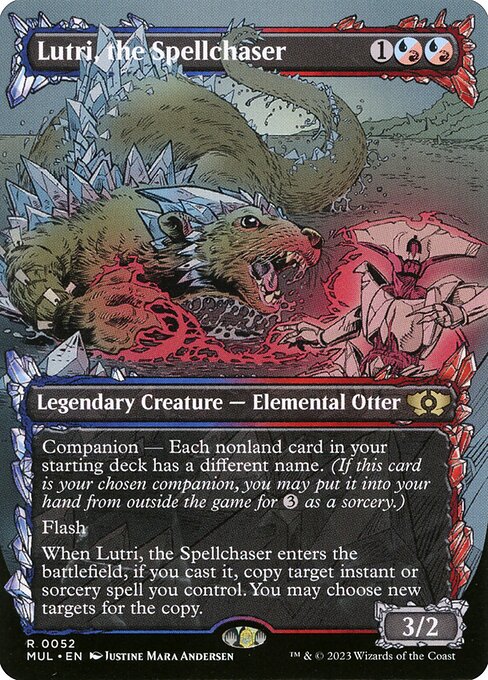
Very easy to companion, but you shouldn’t really sacrifice very good spells in your deck to be able to play it. Lutri is not even remotely close in power level as Lurrus is, but hey, a free card is a free card. And it is synergistic with what you want to be doing in UR anyway. Any UR tempo deck will be happy with a copy.
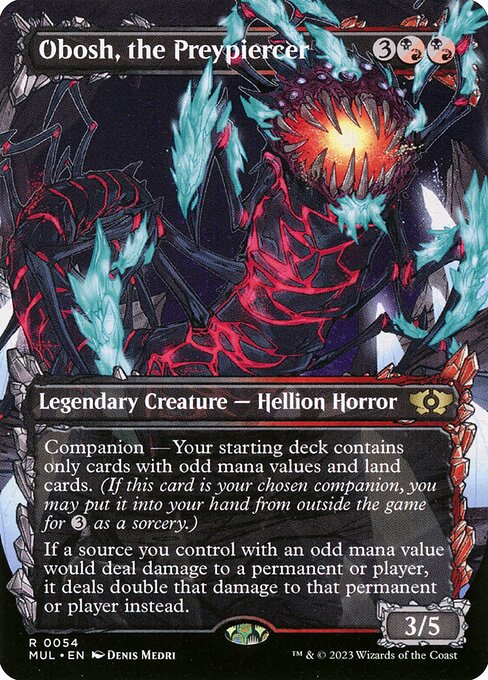
Tough to build but powerful in those scenarios. Doubling damage is no joke. Key cards for this one would be the Whisper squads as they let you use mana more efficiently in the even mana turns, Serrated Scorpions, which deal tons of damage with Obosh on board. Weaponize the Monsters also becomes a powerhouse. You will also have some powerful 3 and 5 drops in the format and combination of early starts and powerful late game can be hard to beat.
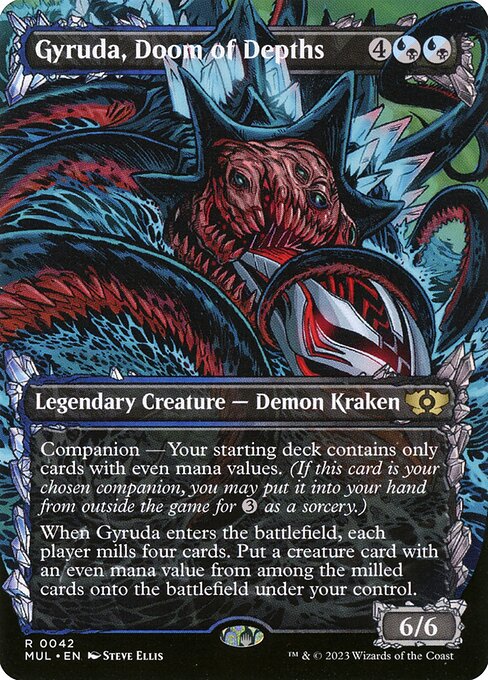
Gyruda costing 6 mana is excessive but because 2 of the set’s mana dorks cost 2 mana, you can somewhat improve your game by ramping to 4 mana on turn 3, playing another 2 drop and putting Gyruda into your hand on turn 4 and starting the shenanigans on turn 5. There are several good 6-drops in the set to help Gyruda out, my favourite being Honey Mammoth, the blueprint for the large green common that gains some life, a popular design in recent years.
But that was not the only thing you can be doing. Another way to play Gyruda is what I call “reverse mutate”. The idea for the deck is – you want to be ramping to 6 mana – which aligns with Gyruda plan. But your goal aside from the companion is to cast Wingfold Pteron – the only creature with Hexproof in the format. Once you get there – you can start mutating onto the Pteron, without the risk of losing your creature and gaining value through that.
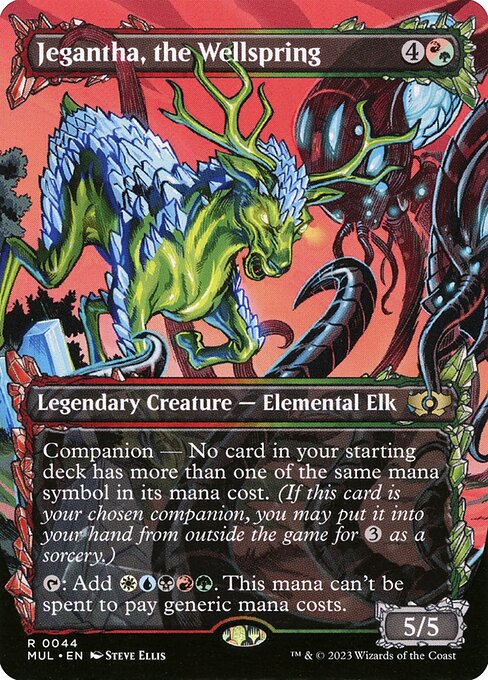
Simple to companion, well statted, Jegantha is an ok companion but unexciting at that. But if you don’t need to go out of your way – by all means companion it.
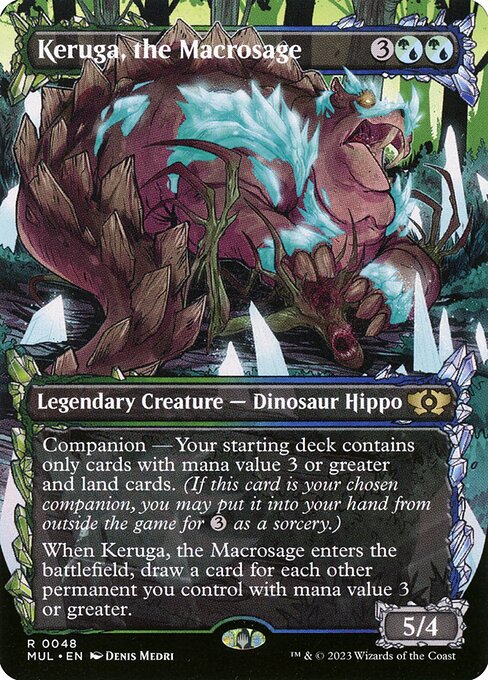
Keruga is tricky, but I have had trophy decks with it as a companion. Not being able to play stuff early means you really need to make sure you can take over a late game. Hopefully, you want to make sure you can recoup some of the life you lost in the early game. Things like Honey Mammoth or Alert Heedbonder package can go a long way.
Other companions are hard to companion, but not impossible. I would advise against trying to make a Yorion, Sky Nomad deck work – the size of it means, you are very unlikely to get there on playables, and even the mighty sky noodle won’t help if the rest of your deck is chaff.
Keyword Archetype
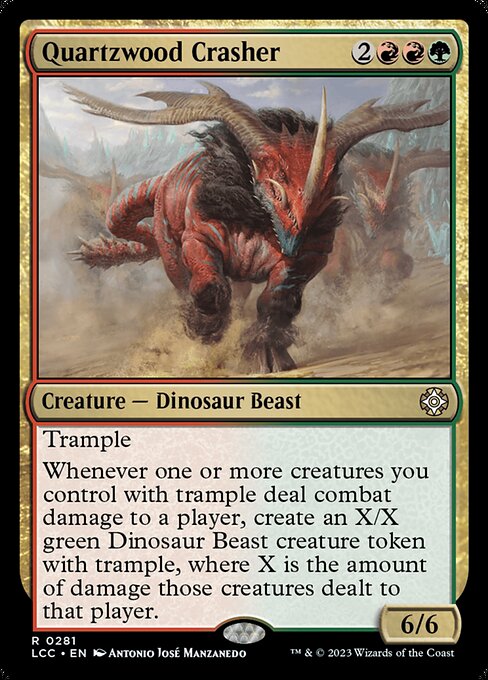
I told you that Ikoria is technically a guild set, meaning only 5 of the 10 color pairs are supported. But. There is some niche build around in the non-supported color pairs. Allied color pairs get two cycles: at rare they have a keyword lord, that gives all your creature with the selected ability some boost. For example, Frondland Felidar gives all your creatures with Vigilance an ability to tap creatures. Quartzwood Crasher makes blocking your trampling creatures a must.
At uncommon, there is a cycle of allied hybrid mana Humans, who give their loyal monsters some bonuses. Tribal Keywords will come up from time to time – as a pocket of synergy within the deck. One that did the best was Rakdos and its menace thing. This come on the shoulders of the best common in the set, Blood Curdle, and its menace token left behind. But also thanks to Tentative Connection, which is a Threaten effect that can cost only one mana if you control a menace creature. Tentative Connection deck is doesn’t need to lean on menace a lot, but adding some won’t hurt.
Felidar I mentioned earlier can also be a neat. Alert Heedbonder is a seriously powerful card and becomes even more so in the company of other vigilant creatures.
Conclusion
What I described here is just a tip of the iceberg. Drafting Ikoria, keep your eyes peeled for possibilities. Maybe you will find yet another pocket of synergy I missed? Maybe you will find a new use for a card no one is interested in. In Ikoria – it is possible. So don’t limit yourself to Zenith Flare – there is so much more than this in the format!
Premium
Enjoy our content? Wish to support our work? Join our Premium community, get access to exclusive content, remove all advertisements, and more!
No ads: Browse the entire website ad-free, both display and video.
Exclusive Content: Instant access to all exclusive articles only for Premium members, at your fingertips.
Support: All your contributions get directly reinvested into the website to increase your viewing experience!
Discord: Join our Discord server, claim your Premium role and gain access to exclusive channels where you can learn in real time!
Special offer: For a limited time, use coupon code L95WR9JOWV to get 50% off the Annual plan!
I am a limited player, who mainly skips playing in order to analyse the limited data using 17Lands.com. I run a podcast: Magic Numbers, where I try to use data to let you improve your limited game play, find out which heuristics work out and which common ideas are not well supported by data.