Hello! For this week’s article we’ll be taking a dive into the upcoming Lorwyn Eclipsed set releasing on arena on January 20th!
As always, new cards means new brews! I want to take you through all the cards and ideas that piqued my interested as I went through the card gallery, and show off some example brews or possible shells they might fit into.
Although this set doesn’t seem on par in terms of power level as some of our previous sets, it sure has a ton of interesting card designs that can lead to some unique and fun synergies. I’m excited to discuss all the new stuff here so let’s dive in!
Giants Return
Lorwyn Eclipsed brings Giants back, just not where we left them.
Instead of the old Izzet lean, we’re pushed into red-white, with cheaper bodies and utility-forward designs that finally give Giants something to do before turn four.
Cards like:
early Giants that protect other creatures,
midgame value engines tied to life gain,
and anthem-style payoffs that reward going wide and tall
Between the cards mentioned above, the core for a competitive Giant tribal list feels like its close on Arena. These new white additions might make it worth splashing for Phlage, Titan of Fire’s Fury or Realm-Cloaked Giant to round out the early game
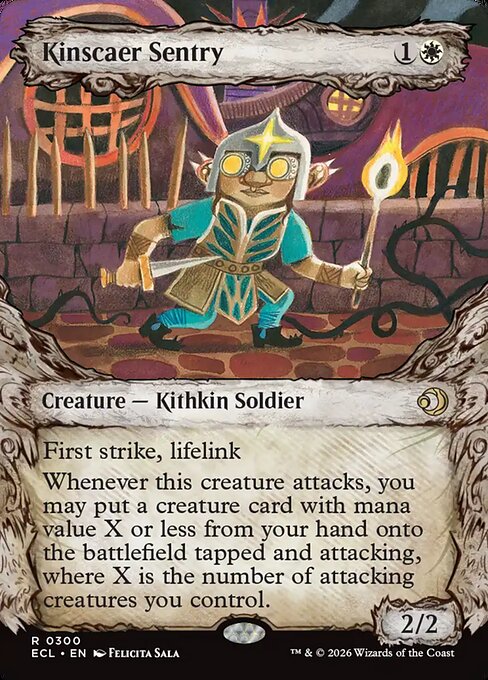
Kinscaer Sentry is one of the cards I’m most excited to paly with in this set.
Its a standout two-mana 2/2 with first strike and lifelink. Its real power lies in its attack trigger, which lets you put a creature from your hand onto the battlefield tapped and attacking based on your creature count.
The obvious homes:
Mono-White or Azorius Soldiers, cheating in lords mid-combat
fringe Winota-adjacent nonsense that stacks triggers in uncomfortable ways
It’s fragile. It dies to removal. But unanswered, it snowballs games in a way Historic is very bad at forgiving.
Here’s my first crack at a Winota list. Although she’s nerfed in Historic, slotting her and Sentry into a Boros shell feels like an obvious way to go. Cards like Stadium Headliner and Voice allow you to inflate your creature count for Sentry temporarily and put something way ahead of curve into play for free. This will probably be one of the first thinks we play on stream next week!
Rhys, the Evermore
Lorwyn Eclipsed leans hard into -1/-1 counters, persist, and removal of counters as a resource.
Rise the Evermore is a two-mana Elf Warrior with Flash that grants a creature persist until end of turn. Its second ability lets you tap it to remove counters from a creature at sorcery speed
The Combo: This is a repeatable Vampire Hexmage effect. Pairing this with Emperor of Bones allows you to adapt, reanimate a target (like Ulamog or Archon of Cruelty), and then remove the counters to do it all over again the next turn.
The persist ability is also quite interesting, both as a combat effect, and a way to scam things like the new evoke elementals. It is a tad bit expensive, but it feels like it could be some nice redundancy or addiotnal synergy in decks hat already play something like Phelia.
Loch Mare
A two-mana 4/5 serpent that enters with -1/-1 counters. You can pay mana to remove those counters to draw cards or stun opposing creatures. This slots right into the Omen Hawker and Training Grounds shell we’ve played in the past. Once you have Training Grounds effects out, Lochmere becomes a one-mana “draw a card” engine that eventually leaves behind a massive 4/5 beater.
The notable thing about this card is that it’s abilities are not -1/-1 counter focused. You can remove any counters to activate them. Including ones placed on it by Wizard Class or Eidetic Memory.
In a shell like this, it can provide long term value over the course of the game with card draw, creature interaction, and a decent clock.
Omni-Changeling
This is isn’t anything splashy but I did want to mention this little dude. A “free” clone seems pretty cool, I’m just not sure what kind of deck would want it. I Could see some sort of Mono-U devotion style list where we cast Master of Waves, then use the elemtnal tokens it creates to copy it for free with this dude.
Cute and interesting.
Rimefire Torque
Another card that a little more skewed towards commander, but has a notable synergy. It plays quite well with Kozilek's Command. Making 3+ tokens immediately puts three counters on this bad boy, allowing you to copy your nest instant or sorcery spell (maybe another K-Command?).
Is it good enough for current Eldrazi builds? No way, but this is Fun & Jank, and this is fun & jank. I’m sure there’s some other tribes that could make use of it too, but this is jsut the first one that popped into my mind that would be worth it.
Sunderflock
This bad boy is a massive blue Elemental that doubles as a high-flying threat and a powerful tempo blowout. While its base cost of 7UU is steep, it is designed to be cheated out in specific Elemental-themed shells.
In a traditional aggressive shell with Thunderkin Awakener, this might still cost you five or six mana—which is simply too slow for Historic or Timeless. To make this card competitive, you have to play the Mana Value Game.
In this example build, I’m using other elementals like Eddymurk Crab and Hearth elemental, which are much easier to get on the board early, in order to make Sunderflock cost 2-3 mana consistently. Sunderflock is more like insurance here, allowing us to clear the board of non-elemental creatures and swing freely.
The other route I think could go is just a traditional Omnath build. If you can get two landfall triggers with Omanth, Locus of Creation out, Sunderflock only costs 1 mana to play. Which should be pretty easy to do with ramp and cards like Risen Reef.
This card seems like a big stabilizer to me, but a 5/5 is nothing to scoff at, and can end games pretty quick.
Bitterbloom Bearer
This is another card that I feel could make faeries a strong archetype. At two mana, this 1/1 Faerie Rogue provides a recurring source of value that mirrors the legendary Bitterblossom, but with the added flexibility of Flash.
(note: Bearer is a rogue, but unlike Bitterblossom, the tokens it makes are not.)
The Tokens: Every turn, you’re generating a 1/1 blue and black Faerie creature token with flying. This provides constant fuel for “Champion a Faerie” triggers (like Mistbind Clique) or sacrifice outlets.
Tempoo: Being able to hold up mana for a Counterspell or Spellstutter and then flashing this in on your opponent’s end step is exactly where Dimir wants to be. It forces the opponent to play into your interaction or face a snowballing board state.
We also happen to have a lot of faeries that don’t see play right now.
This card, along with Bitterblossom, can generate a very fast clock with Obyra and Oona’s Blackguard, and there’s plenty of interesting creatures and spells to back it up.
Bitterblossom might be a tad too slow for historic, but giving it flash and a body might make it good enough.
Dawnhand Dissident
This one-mana 1/2 Elf Warlock is the definitive “glue” card for any black-based midrange or graveyard deck looking to exploit the new Blight mechanic.
The real “wow” factor is the passive ability. During your turn, you can cast creature spells that were exiled with the Dissident by removing three counters from among creatures you control (in addition to paying their mana cost).
This is the perfect pairing for cards like Loch Mare or Moon Shadow. Those cards enter with a pile of -1/-1 counters that you want gone; Dawnhand Dissident lets you strip those counters off to re-cast a heavy hitter you exiled earlier in the game. It even plays well with Emperor of Bones to reset the adapt ability.
However, theres another cool interaction I found: Luminous Broodmoth.
The “cast from exile” ability only care about counters among your creatures. Meaning you can use it to remove the flying counters from your creatures after they die and Broodmooth brings them back, meaning they can die and come back again and again.
It’s a little slow, sure. But it could set up an incredibly grindy BW midrange shell that has creatures that are nearly impossible to kill.
Moonshadow
If you enjoy playing with cards like Death’s Shadow or Vantress Gargoyle, Moonshadow is going to be your new favorite brew. It’s a one-mana 7/7 that enters the battlefield with six -1/-1 counters on it. On its own, it’s a humble 1/1, but its ability to shed those counters whenever permanents hit the graveyard makes it grow rather quickly. Plus, theres a lot of ways to get gimmicky with it.
Waiting for six permanents to hit the bin is for fair decks. In Historic and Timeless, we have much faster ways to turn this into a turn-two 7/7 Menace threat:
Vampire Hexmage: This is the most direct route. Casting Vampire Hexmage on turn two and sacrificing it allows you to strip all six counters off Moonshadow instantly. You end up with a massive 7/7 attacker before your opponent has even set up their board.
Dress Down: One of the most powerful “cheat” cards in the format. If you have Dress Down on the field or flash it in before Moonshadow resolves, it enters without its “enters with counters” ability. When Dress Down leaves at the end of the turn, you’re left with a pure 7/7 for a single black mana.
Mesmeric Orb & Milling: Since Moonshadow triggers “whenever one or more permanent cards are put into your graveyard,” Mesmeric Orb is a rather quick engine. Because the Orb triggers for each individual permanent untapped, it can strip multiple counters in a single turn just by you playing the game.
Unlike other “big mana” one-drops, Moonshadow has Menace. This is critical because it prevents your opponent from just chump-blocking with a stray token.
A lot of people seem excited to build around this one, me included.
Mornsong Aria
This card is probably the other shell I’m most excited to brew with. If you’ve ever played with the old-school Maralen of the Mornsong, you know how dangerous—and fragile—a symmetrical tutor effect can be
The enchantment stops all card draw and life gain for every player. In exchange, during each player’s draw step, they lose 3 life and search their library for any card to put into their hand. While giving your opponent a free tutor sounds like a recipe for disaster, the real magic happens when you pair this with specific “search hate”:
Opposition Agent: This is the most brutal synergy. With Opposition Agent on the board, your opponent’s draw step becomes your draw step. They lose 3 life, search their deck, and you take the card they find. They effectively never see a new card for the rest of the game while you tutor whatever you need to win.
Aven Mindcensor: If you’re playing white, the Mindcensor limits their search to just the top four cards. Between the 3 life loss and the high probability of “whiffing” on their search, you can quickly bleed an opponent out while they struggle to find an answer.
Mornsong Aria is a high-risk, high-reward engine. You noted in the video that it’s essentially a “solve the puzzle” card—if you can protect your hate pieces like Opposition Agent, the game is over the moment this hits the table. It’s the perfect top-end for a Dimir or Orzhov control shell that wants to force the opponent into a “lose-lose” scenario.
Twilight Diviner
If you’ve been looking for a reason to dust off your Abzan or Golgari reanimation shells, Twilight Diviner is the high-value engine you’ve been waiting for. This three-mana 3/3 Elf Cleric doesn’t just fill your graveyard, it doubles your impact every time you pull something out of it.
God there’s so many fun things to do with this. Besides the obvious, reanimate a big thing, get one free. It seems like theres a ton of play power it provides to small value based shell.
It pairs well with Bloodghast and Timeline Culler. Since these creatures jump back into play for free (or cheap), they trigger the Diviner without you having to spend a card, giving you a steady stream of extra 2/1s or 2/2s every turn. But even more so, its sweet with cards like Unearth. Using cheap recursion becomes even more efficient. For one mana, you’re not just getting your creature back—you’re getting a permanent token copy to go with it, making it incredibly difficult for your opponent to keep your board clear. Imagine Reanimating an Oculus and getting two instead!
Its definitely a removal magnet, but its a super sweet and powerful engine if it sticks around. And you’ll more than likely be playing it in a shell that make it easy to recur.
Meek Attack
If you’re a fan of high-risk, high-reward combat tricks, Meek Attack is the next spicy addition to your red-based aggro or combo decks. This three-mana enchantment acts as a repeatable “sneak attack” for creatures that might seem small on the surface but pack a massive punch upon entry.
While a “total of 5” sounds restrictive, the broad Historic card pool is full of creatures that “cheat” their stats:
Marionette Master: On its own, it’s a 1/3 (total of 4). When it enters, you can fabricate three 1/1 servos. If you have a way to sacrifice those artifacts immediately, your opponent is taking a lethal amount of life loss before the end-step sacrifice trigger even hits.
Hornet Queen: A 2/2 (total of 4) that brings four 1/1 deathtouch flyers with it. Cheating this in for two mana mid-combat provides an instant impenetrable defense or a surprise aerial assault.
Threefold Thunderhulk: This enters as a 0/0 but creates Gnome tokens based on its power. Since its base stats are non-existent, it slips right under the Meek Attack requirement, allowing you to flood the board with artifacts for a fraction of its mana cost.
Meek Attack is a card that rewards “stat-masking” and enter-the-battlefield triggers. It’s a fantastic tool for decks that want to skip the high mana costs of their utility creatures and go straight to the payoff. Seems like it a card that will only get better with time.
Bristlebane Battler
The Battler features Trample and Ward 2, making it a nightmare to block or target once it reaches its full potential. Its key ability allows it to remove a -1/-1 counter whenever another creature you control enters the battlefield.
This is another card that cantake advantage of the wide card options we have in Historic. Similar to Moonshadow, you’ll most likely want to play this alongside ways to cheat its abilty.
I can easily see it in a GBx shell that abuses both Vampire Hexmage and the new Rhys to remove counters and grow your threats quickly. Moonshadow, Overlord of the Balemurk, and Invasion of Ikoria can all grow into giant threats via Hexmage, and this feels like another clean addition to that build.
The built in protection is what makes this not-worthy in my opinion. In the right shell its a fast clock thats hard to interact with.
Formidable Speaker
We finally have our hands on the World Champion card for Jean-Emmanuel Depraz, and it’s a powerhouse for any creature-based strategy. Formidable Speaker is a three-mana 2/4 Elf Druid that acts as both a consistent tutor and a high-utility engine.
When the Speaker enters the battlefield, you can discard a card to search your library for any creature card, reveal it, and put it into your hand.
Reliability: This provides incredible consistency. In a deck built around a specific combo piece (like Winota or Moonshadow), the Speaker ensures you find your threat while pitching cards you’d rather have in the graveyard (like Bloodghast or Timeline Culler).
Survival of the Fittest on a Stick: This ETB effect is reminiscent of powerful legacy tutors, allowing you to “toolbox” your library based on the current board state.
The extra ability to untap a Nykthos or a a big creature if you need to block with is gravy. Formidable Speaker is the kind of card that makes good decks great. It’s an Elf, meaning it slots into one of the most supported tribes in Magic’s history, but its utility is so broad that it will find a home in any green midrange or combo deck
Sapling Nursery
Ya know, I was a little weary of this card, but it actually seems sweet. Its quite reminiscent of Felidar Retreat. At eight mana, it seems out of reach, but thanks to Affinity for Forests, it can easily hit the board for just two green mana in the right shell.
I don’t think its bonkers, but Icetill Explorer, Six, and Yavimaya, Cradle of Growth seem like they could provide the right support here. In some sort of green-based shell this provides a powerful endgame so long as you can play more than one land a turn. This card provides the kind of inevitability that is very hard for midrange decks to overcome.
Abigale, Eloquent First-Year
A lot of people are excited for Abigale, me included!
When Abigale enters the battlefield, you can choose up to one other target creature to lose all its abilities. In exchange, that creature receives a permanent Flying counter, a First Strike counter, and a Lifelink counter.
This is the perfect companion for creatures that have massive power but crippling drawbacks. By having a creature “lose all abilities,” you’re essentially wiping away those drawbacks while granting them a suite of evasion and combat keywords. It turns Death’s Shadow, Monoist Sentry, and Rot-Curse Rakshasa into potent threats.
You can also use Abigale defensively in a pinch to strip the abilities of an opponent’s creature, though granting them Flying and Lifelink makes that a very specific, situational play.
Abigale, Eloquent First-Year is a build-around that rewards you for finding the biggest, “dumbest” creatures in the format and giving them a college education.
The Elemental Incarnations: Evoke Returns
One of the most exciting cycles in Lorwyn Eclipsed is the return of the Evoke mechanic on a new cycle of Elemental Incarnations. These cards offer a split-color twist on the classic evoke cycle, giving you powerful spell-like effects for a low evoke cost or a massive creature if you pay the full price.
The flexibility of these Incarnations makes them potential staples across multiple formats. Being able to “cycle” them early for a crucial land drop or a piece of interaction—only to have them as high-impact threats in the late game—is exactly the kind of modal power that competitive decks crave. Vibrance and Deceit, in particular, look like they could easily find homes in Tier 1 shells.
Tam, Mindful First-Year
To round things out, we have a unique Simic legendary that is a dream for “all-in” creature strategies. Tam, Mindful First-Year is a two-mana 2/2 Gorgon Wizard that turns your board into a technical nightmare for your opponent to interact with.
The cool part is this card provides both protection, like Mother of Runes, but that tap ability also creates cool synergies.
Leyline of the Guildpact: This is the most synergistic pairing. Since the Leyline makes all your nonland permanents all colors, Tam grants your entire board hexproof from all colors as long as they both remain on the battlefield.
Case of the Shattered Pact: Tam helps you “solve” this case quickly by shifting colors, and once solved, the Case provides your creatures with a massive suite of keywords (flying, double strike, vigilance) while Tam keeps them protected from removal.
Dragonfire Blade: Because this equipment gets a discount based on the color of the creature it targets, Tam can manipulate those costs mid-turn to ensure you’re equipping for a fraction of the price.
Tam, Mindful First-Year is a premier protection piece for Simic or multi-color midrange decks. She demands a specific answer, and if your opponent can’t remove her first, they’ll find it nearly impossible to touch the rest of your board.
Closing Thoughts
Lorwyn Eclipsed might not have the raw, face-smashing power of some recent Modern-horizons-tier sets, but for a brewer, it is an absolute gold mine. The set leans heavily into niche synergies and I’m excited to explore as many of them as I can.
What excites me most is how these cards don’t just stand alone; they breathe new life into existing Historic and Timeless favorites. We’re seeing:
Tribal Resurgence: Giants and Faeries finally getting the early-game tools they’ve desperately lacked.
Rule-Breaking Mechanics: New ways to “cheat” stats and costs that reward deep knowledge of the card pool.
Technical Complexity: Cards like Tam, Mindful First-Year and Formidable Speaker that reward players for tight, sequencing-heavy gameplay.
I’ll be taking several of these brews—starting with that Winota/Sentry list—straight into the queues on stream next week, so make sure to tune in!
That’s it for me!
Thanks for reading!
As always, feel free to comment and leave any questions you have below. And make sure to come back next week for even more Fun & Jank!
If you want to see these decks in action, come hang out with me on stream where we test, refine, and have a ton of fun together.
Happy Brewin’!
Premium
Enjoy our content? Wish to support our work? Join our Premium community, get access to exclusive content, remove all advertisements, and more!
No ads: Browse the entire website ad-free, both display and video.
Exclusive Content: Instant access to all exclusive articles only for Premium members, at your fingertips.
Support: All your contributions get directly reinvested into the website to increase your viewing experience!
Discord: Join our Discord server, claim your Premium role and gain access to exclusive channels where you can learn in real time!
Special offer: For a limited time, use coupon code L95WR9JOWV to get 50% off the Annual plan!
Plum is the creator of the Jank Tank.
He started playing at the ripe old age of 12 and immediately fell in love with the infinite possibilities that deck building could lead to.
He truly understands that jank is a mindset, and spends most of his free time brewing and concocting new and exciting deck lists to help inspire and promote creativity within the MTG community.