Hey all. Duskmourn: House of Horrors releases on September 24th on MTG Arena expanding the card pool for all formats, but especially Standard and Alchemy. Standard has continued to evolve over the course of Bloomburrow’s lifespan, so a whole new set of cards should continue to shake things up. As we peruse spoilers we have to keep in mind my usual card evaluation philosophy:
Card Evaluation Philosophy: When evaluating new cards there are three categories to keep in mind when trying to decide if they are going to see play or not:
1) Will this card be added to an existing deck,
2) Does this card create a new deck or revive an abandoned deck, and
3) Is this an impactful sideboard option?
(A quick note: These rules are mostly for evaluating cards from a competitive standpoint. When it comes to brewing, let your imagination run wild and try out any of the new cards that you think look awesome or seem fun!)
I think that a lot of cards from Duksmourn have a chance to make an impact on Standard so I’m going to highlight a variety of cards, more than any of my previous card reviews, so let’s dive in starting with the white cards.
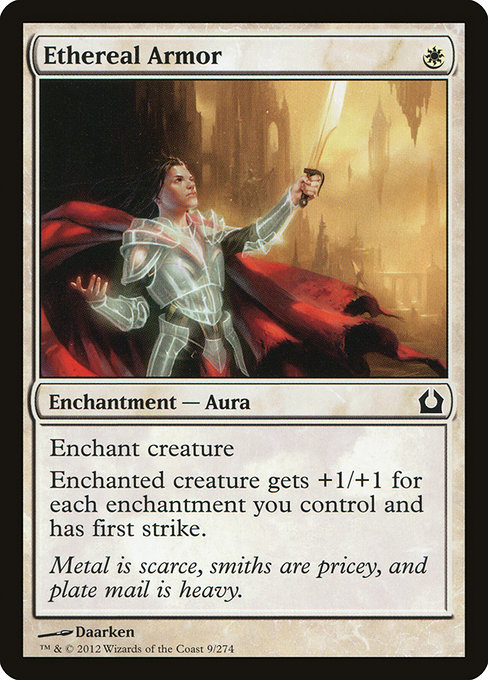
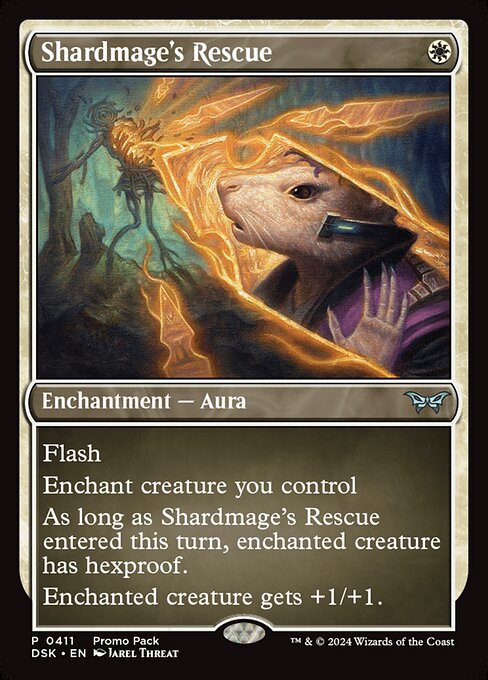
Kicking off white we have a pair of one mana white auras. Ethereal Armor, a reprint, is an awesome payoff for aggressive enchantment decks, growing a creature based off the number of enchantments you have and giving first strike making it good on offense and defense, and Shardmage’s Rescue gives us instant speed protection and a buff that sticks around.
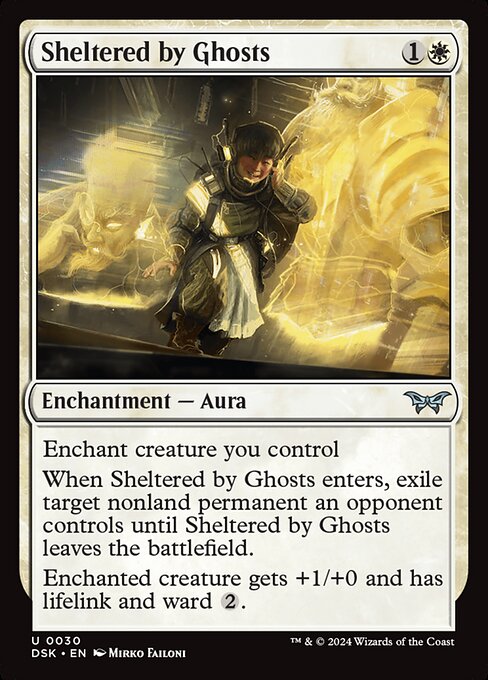
At two mana, we have Sheltered by Ghosts, which is a high risk – high reward aura. The general risk with auras is that if your creature dies, your aura also goes away, giving the opponent easy 2-for-1s. Sheltered by Ghosts ups that risk, giving you a removal spell, but if your creature is removed you are not only getting 2-for-1ed, but they also get their creature back.
However, why I like the card is the ward 2 that it grants to your creature, making it much harder for your opponent to remove, and lifelink can really help you race against the high number of aggro decks in the format.
These three cards all grouped together because they lead me to believe that there could be some sort of aura/enchantment aggro deck in standard, so look out for that decklist in my decklist article coming out next week.
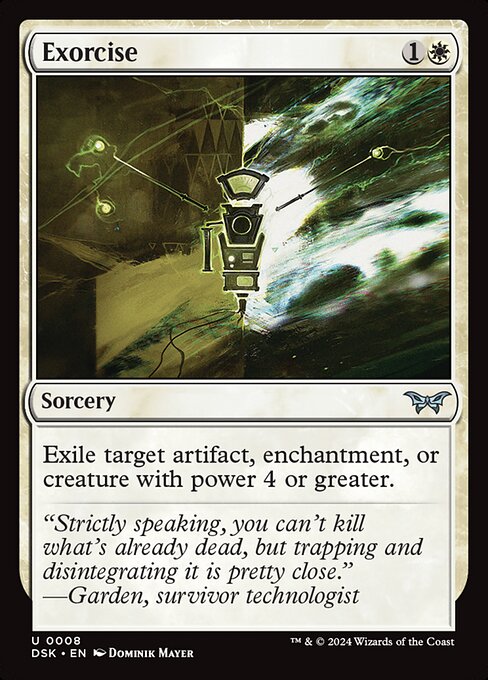
Exorcise is a great sideboard option for decks already playing Destroy Evil in their sideboards. While Destroy Evil is an instant, Exorcise can hit artifacts, which is very relevant with so many red decks sideboarding in Urabrask’s Forge these days. It also hits creatures with power four or greater, rather than toughness four or greater, which is only really relevant against Preacher of the Schism. So if you have Destroy Evil in your sideboard, consider Exorcise instead, and we’ll see which one ends up being the better choice.
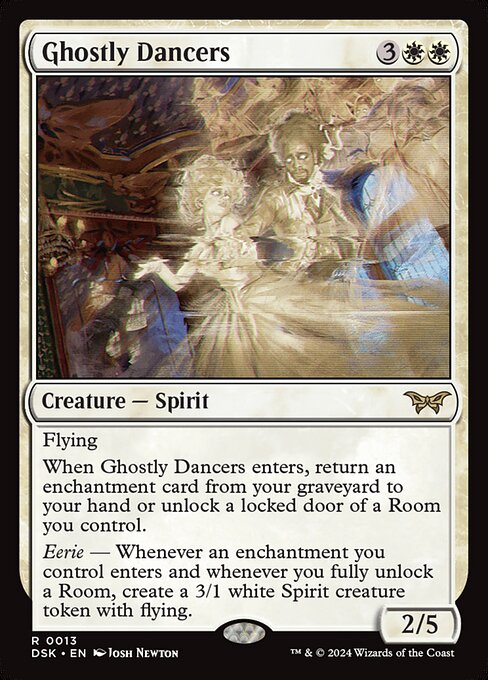
Ghostly Dancers is quite expensive, which is a hard sell in current standard, but I want to give it a shout-out just because it is a good way to unlock a room at a discount. Most room enchantments have a decently cheap side, and then a quite expensive side, so playing it early on the cheaper side and then using Ghostly Dancers to unlock the expensive side is pretty sweet, especially since you will also get a 3/1 token right away thanks to fully unlocking a room.
Will a dedicated room deck get there in Standard? Maybe. I’m going to give it a shot so check it out in my deck list article next week!
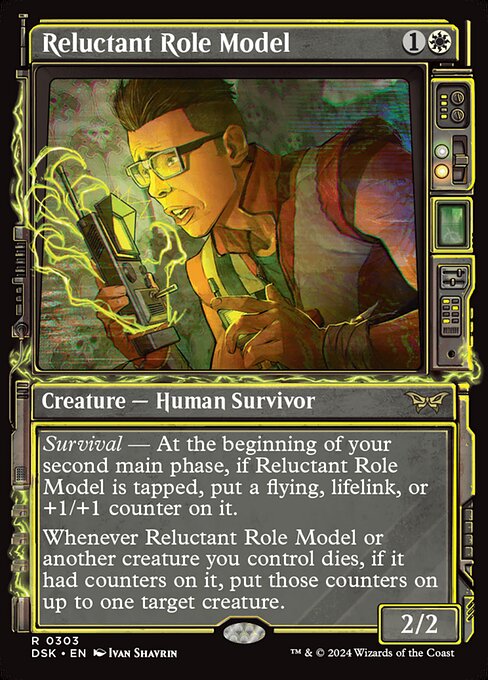
Reluctant Role Model is a nice aggressive creature featuring the new Survival mechanic, which gives you a bonus if that creature is tapped at the beginning of your second main phase. The goal with Reluctant Role Model should be to either put a +1/+1 counter on it with its first trigger to get it out of Cut Down range, or put a flying counter on it so it can more easily continue to attack and trigger each turn.
The other cool part of this card is the ability to move counters around when your creatures die. There are already a lot of cards in Standard that give out counters or care about counters, so I think that Reluctant Role Model could be an Arcbound Ravager style card for those decks.
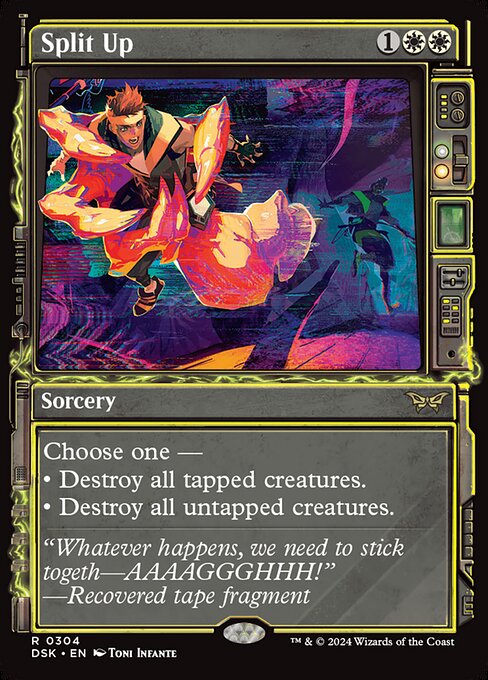
I know a lot of players will look at a sweeper like Split Up and think it is just for control decks, as extra copies of Temporary Lockdown against aggro decks, but there is a lot of interesting stuff going on in the Standard format that I think that Split Up is going to be a sideboard option for a variety of decks, even aggro decks.
The first and obvious example is in a board race when your opponent attacks all out, you take it or block some of it, and then cast Split Up on tapped creatures before combat and then make your own attacks. However, there are other cool ways to use this card.
Take Convoke decks for example. Tap all of your creatures to a Warden of the Inner Sky or to cast a Knight-Errant of Eos, and then cast Split Up on untapped creatures, wiping out your opponent’s board but saving all of your own.
New from Duskmourn we have a mechanic, Survival, that asks for your creature to be tapped at the beginning of your second main phase. The easiest way to do this is to attack, but sometimes you can’t attack without losing your creature. So these decks will want to have ways to tap their creature without attacking, such as crewing a vehicle (more on that below) or saddling a mount. In these decks, they can tap their creatures to crew or saddle and then cast Split Up on untapped to wipe their opponent’s board.
There are a lot of interesting ways to use this card, and I think that it is much more than just a tool in control player’s toolboxes.
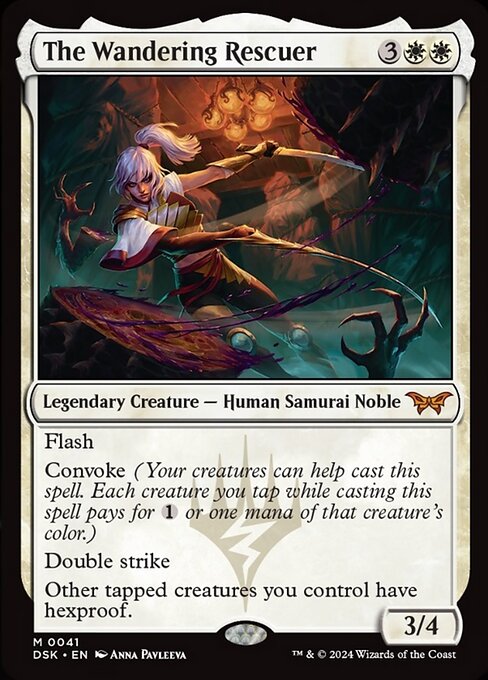
A perfect follow up to our discussion around Split Up, The Wandering Rescuer is awesome as both a surprise blocker, a way to protect a creature from a removal spell, or just an end of turn threat. Current Convoke lists are very tight, they really need a certain amount of all of their effects to execute their gameplan, but I think that The Wandering Rescuer can find its way in small numbers into the main or at least into the sideboard of those decks.
At 3/4 it doesn’t die to Glistening Deluge, making it a great cast in response to the common sideboard sweeper, and thanks to its high mana cost it doesn’t get swept up by Temporary Lockdown, so I think it is a great way for Convoke decks to keep the pressure on in response to sweepers, and also as a way to protect key creatures from spot removal.
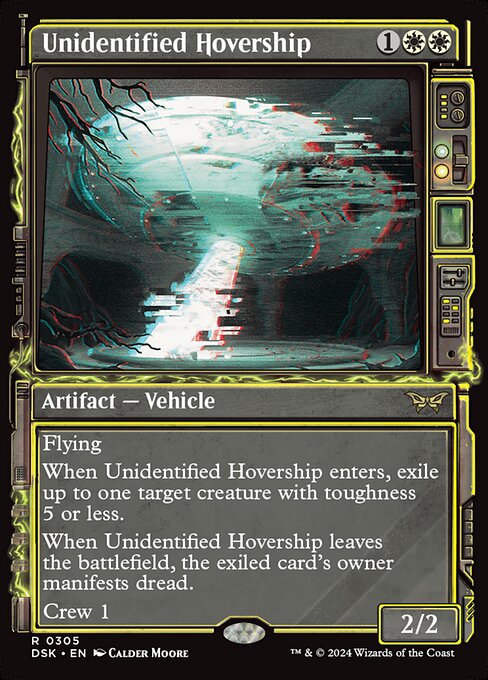
Of course it is limited by toughness, it can’t take out Atraxa, Grand Unfier, but it is great on curve at clearing out an opposing creature and at crew 1, is going to give aggressive white decks a nice way to get some points in thanks to flying.
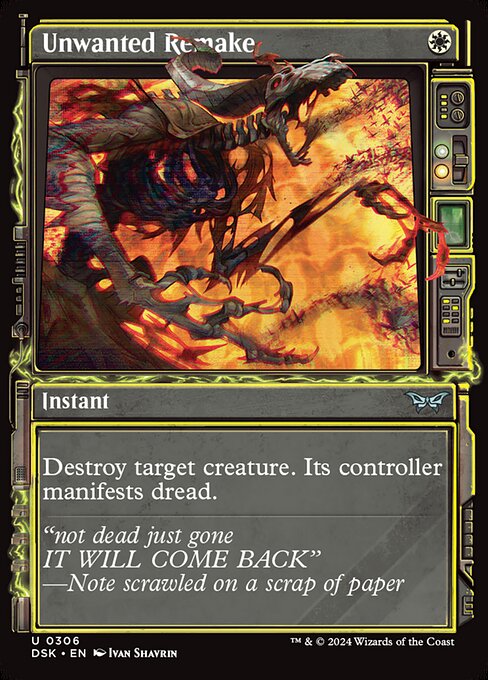
Okay I wanted to mention this one not because I think it is a winner, but because I want to warn everyone about using this card. While one mana removal is always tempting, and frequently quite good such as Swords to Plowshares in Legacy, Path to Exile in Modern back in the day, and Fragment Reality in Historic, Unwanted Remake just isn’t on the same level as those spells.
The main goal of removal, especially cheap removal, is to remove an opponent’s early play to alleviate pressure. Your opponent is playing an aggressive deck, their one or two drop is causing you some trouble, so you remove it. The problem with Unwanted Remake is that it only alleviates pressure for that one turn, if it is used on an attacking creature, because they still have a 2/2 on the board that can attack, wear a Monstrous Rage, and be a real problem.
So I would advise an abundance of caution before you jam any copies of Unwanted Remake into your midrange or control decks, thinking that they are going to help you against aggro decks because it is so cheap. You are going to be disappointed with the results.
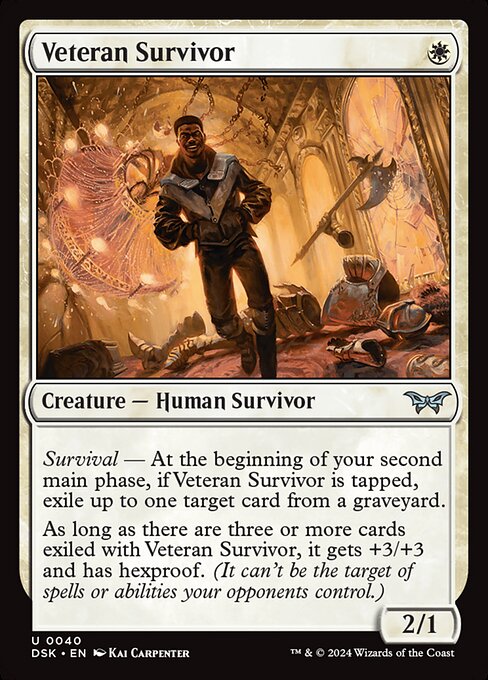
I feel like every set we have an In Memoriam for Savannah Lions, but wow have we come a long long way from the 2/1 with no text. Veteran Survivor will be a key player in a dedicated Survival deck, but can also just find a home in white aggressive decks. I would definitely want other ways to tap this outside of just attacking, and if you are able to tap it every turn, it won’t take long before you have a 5/4 with hexproof. The graveyard exile is nice too, so don’t sleep on this veteran.
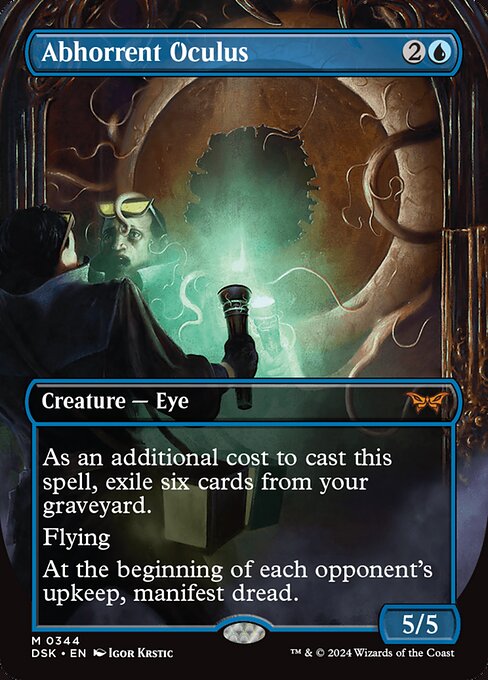
Let’s talk about the upside of Abhorrent Oculus before we talk about the downside. A 5/5 flying for three mana is insanely above the curve, and the fact that it makes a 2/2 on your opponent’s upkeep means that you are going to get at least one 2/2 out of it unless they have a removal spell on your end step.
The downside is a pretty big one: this thing is hard to cast. Exiling six cards from your graveyard is a lot. So much so that it is hard to think of Abhorrent Oculus as a turn three play and more likely a turn four or five play. That said, the upside is so good that I think we have to consider the best ways to get this card into play, and I think there are two possible routes to do so.
Both ways involve some amount of self-mill. The first way is in a dedicated self-mill deck, featuring cards like Picklock Prankster, Cruel Somnophage, Gnawing Vermin, etc. It is possible to cast Abhorrent Oculus on turn three with turn one Gnawing Vermin into turn two mill four, such as the adventure on Cruel Somnophage, giving us exactly six cards in our graveyard to cast our big scary eye. It is still unlikely to be able to cast this on turn three most games though.
The second option is a deck trying to make use of Helping Hand. We have seen this in the past, with Helping Hand getting back Monastery Mentor or Haughty Djinn, and Abhorrent Oculus could slot into this type of deck quite nicely. Picklock Prankster is the main way to self-mill in that deck, but you could also play cards that let you draw and discard, to dump copies of the oculus into the yard and then bring it back. This style of deck also just plays a lot of cheap spells, meaning that the graveyard is likely to be full enough to exile six cards to hard cast this card.
This is a card worth building around, so I look forward to trying both methods to get Abhorrent Oculus into play as early and consistently as possible.
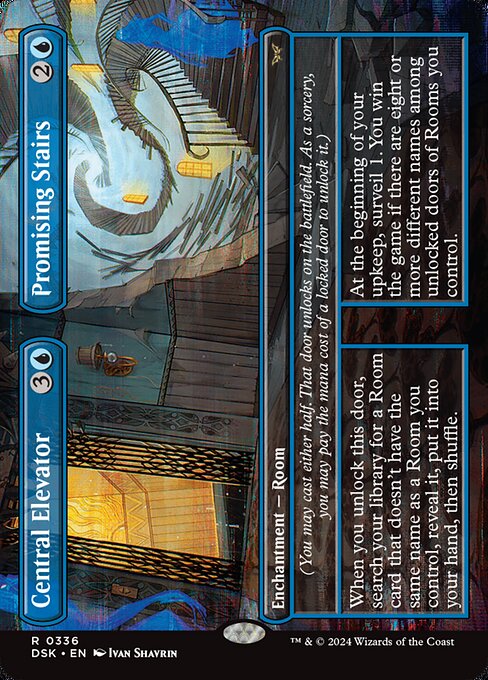
I’m just giving this card a shout out because I love weird alternative win conditions. I expect this to be included in a dedicated room deck, as Promising Stairs provides a win condition and Central Elevator helps find specific rooms that can help us manage the board or otherwise advance our gameplan.
Will it be good enough for Standard? Probably not. Three drops that don’t affect the board in some way are usually not competitive. However, I am excited to try.
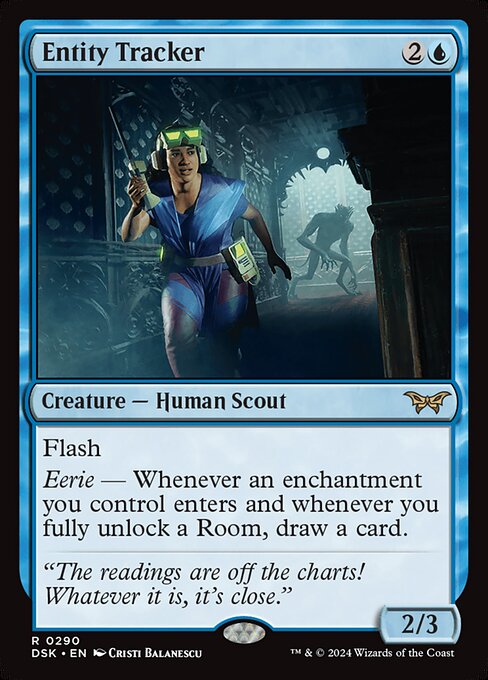
Dedicated enchantment decks get a great tool with Entity Tracker. While the best “enchantress” effects (named after Agrothian Enchantress) are two mana, Entity Tracker makes it up by having flash, letting you pick a spot to flash it in at the end of an opponent’s turn, and then untap and cast one or two enchantment spells and draw cards right away.
My only real concern with this card is that it dies to Cut Down, and with how popular aggro decks are, black decks are likely to have several copies of Cut Down in their main deck. But if you can draw a couple cards with Entity Tracker, it will be totally worth it.
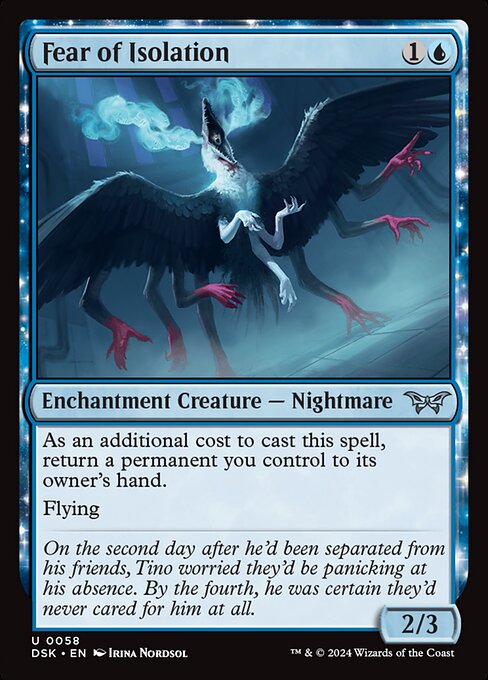
Fear of Isolation seems like it has a downside, but in the right deck bouncing a permanent to your hand is actually a big boon. Take the Orzhov Blink deck that I have featured in several of my weekly meta reports. That deck uses cards like Nurturing Pixie to return permanents with spell effects, such as Hopeless Nightmare or Tithing Blade, so they can recast them and get that effect again.
So I see the text on Fear of Isolation as all upside. Later in the game it can even bounce more impactful permanents, making it a good play early and late. I look forward to trying it out.
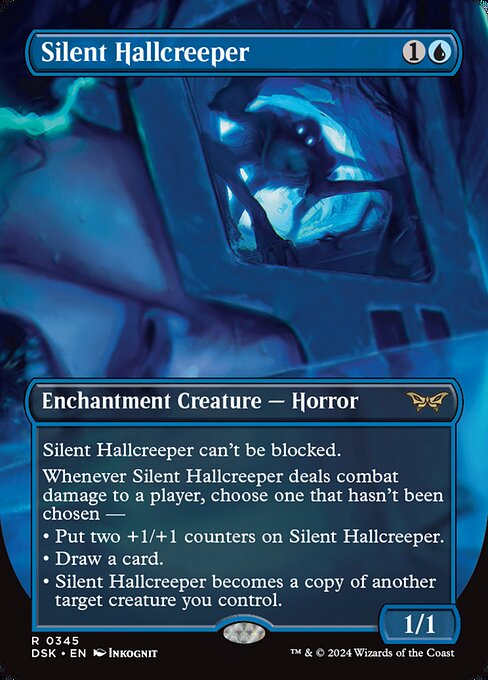
Silent Hallcreeper is just neat. The most common play pattern is going to be drawing a card with the first hit, buffing it up with the second hit, and then making it a copy of one of your creatures on its third hit. So in the end, it has replaced itself, gotten in for a good chunk of damage, and then continues on as a copy of your best creature.
We have seen how powerful Mockingbird from Bloomburrow has been, and Silent Hallcreeper provides another way to cheaply copy a creature on your side. For example, you can even cast Silent Hallcreeper on turn two, play a Preacher of the Schism on turn three and immediately copy it with Silent Hallcreeper, giving you two must answer threats. Or follow up the hallcreeper with Gix, Yawgmoth Praetor, and get in with your unblockable creeper to draw even more cards.
The possibilities with this card are very high, making me think it is at least worth a look in Dimir Midrange decks.
Cynical Loner has a really powerful effect for several different decks. My first thought is in a Delirium deck (more on that below) as a way to put more and more card types into your graveyard to achieve Delirium. My second thought is some sort of reanimator deck, where Cynical Loner can find your big creatures. My third and final thought is in an Insidious Roots deck, as a way to find creatures that can self exile to trigger the roots.
Now getting Survival to trigger can be tough, since Cynical Loner has only one toughness it is easily blocked and traded with, so you will have to invest in other ways to tap it, such as vehicles. I’m excited to try it with Hedge Shredder (again, more on that below) as a way to crew the vehicle and then search for a land card into the graveyard that will go into play thanks to Hedge Shredder.
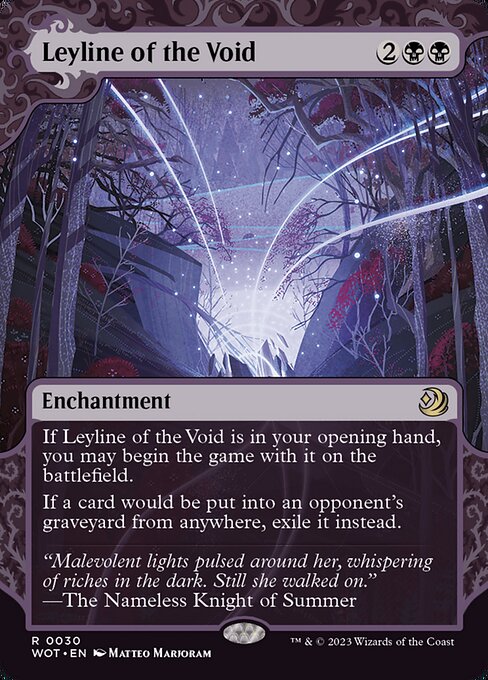
Alright, I just talked about a cool graveyard card now it is time to talk about the fun police. Between Leyline of the Void, Rest in Peace, and Soul-Guide Lantern, almost all of the best graveyard hate in the history of magic are going to be legal in Standard.
All leylines are a mix of risk and reward. When it is in your opening hand it is awesome, and when it isn’t it feels really bad. Leyline of the Void does not exile graveyards when it enters, like Rest in Peace does, so it only feels really impactful when you can put it into play at the start of the game, but it can still help you when you hard cast it on turn four. While you can play this card in non-black decks, you had better be prepared to mulligan for it, as you won’t be able to cast it when you draw it later.
Good sideboard options are always welcome, so I am happy to have Leyline of the Void back in Standard, even if fun graveyard decks have to suffer.
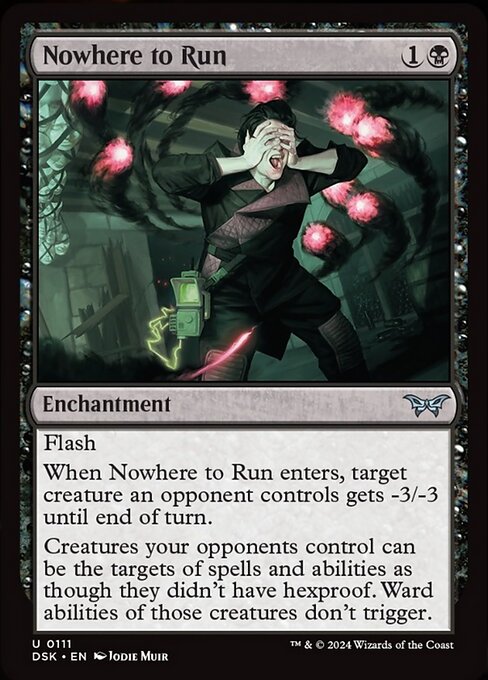
Two mana to give -3/-3 is usually fine, but will feel bad against some creatures in the format. However, Nowhere to Run has a couple of other reasons that make it worth playing.
First, it removes ward and hexproof from your opponent’s creatures, making even the most pesky of creatures vulnerable to your removal spells. Second, this being an enchantment is a huge boon. It can be picked up by Fear of Isolation or Nurturing Pixie to be cast again, and in Delirium decks it is an enchantment thus diversifying your card types as you fill up your graveyard.
While a lot of decks won’t want Nowhere to Run, the decks that will want it are happy to have it.
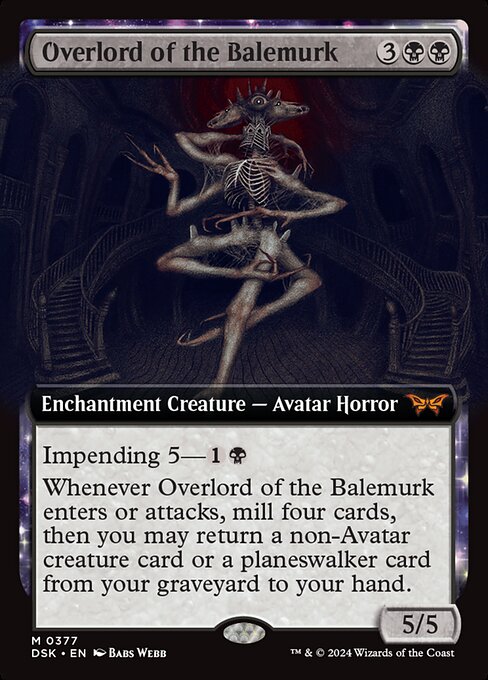
Overlord of the Balemurk introduces us to another new mechanic: Impending. You can cast the overlord for its Impending cost, if you do it enters as an enchantment, not a creature, and loses a time counter at each of your end steps. When the last one is removed it becomes a creature.
Overlord of the Balemurk is nice because it can be cast for its Impending cost on turn two, and is likely to replace itself if you mill a creature or planeswalker within those four cards. The main home for this card is in the various self-mill decks that we’ve already talked about, as a self-mill engine that is a threat later in the game.
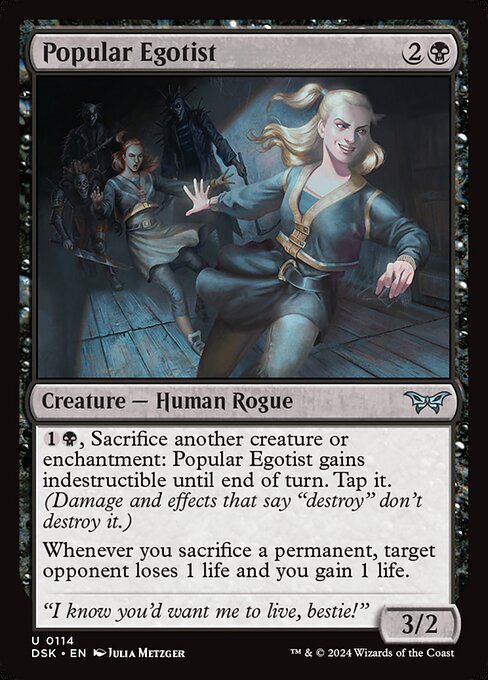
Popular Egotist is a good payoff for a sacrifice deck, although it may need to wait until Foundations comes out in a couple of months to see play, just because we are getting Blood Artist in that set to really amp up sacrifice decks.
On its own though, Popular Egotist gives you a drain each time you sacrifice something, and gives you a way to sacrifice something and protect it in the process. However, two mana is very expensive so you won’t want it to be your main sacrifice outlet, but it is a good back up, and being able to protect your drain engine from a variety of removal is also very nice.
So we’ll see if sacrifice decks are able to form now or have to wait for Blood Artist, but either way I expect Popular Egotist to be a part of those decks.
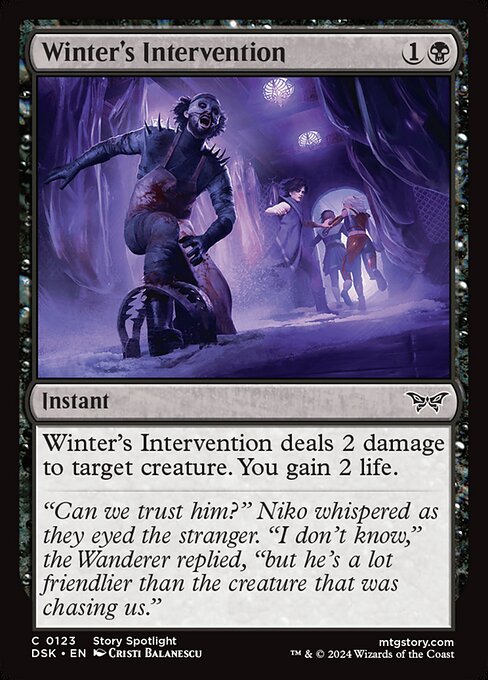
Winter’s Intervention deserves a shout-out just because of how much aggro there is in the current Standard metagame. If you are really struggling against aggro, Winter’s Intervention is a nice way to kill a threat and gain some life back, hopefully buying you enough time to further stabilize the board.
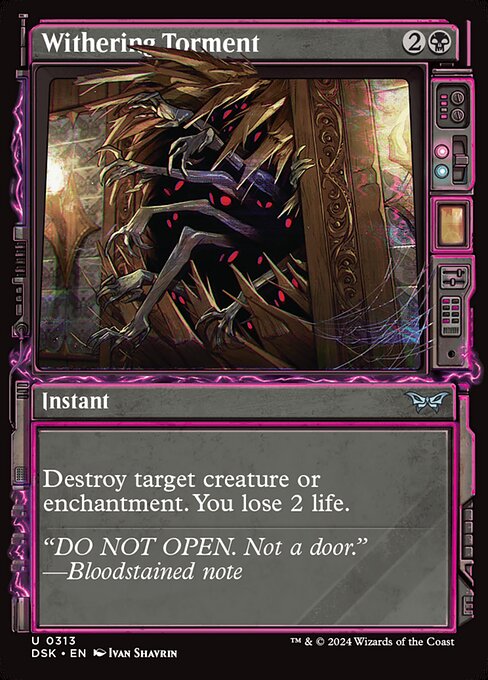
Withering Torment also deserves a shout-out because it is more Black Enchantment removal. When Wizards first decided to give Black Enchantment removal it was a big controversy, but I think most players are used to it now. If you are a black deck looking to remove cards like Caretaker’s Talent from the table, Withering Torment is a good sideboard option that can also take out creatures when there are no enchantments around.
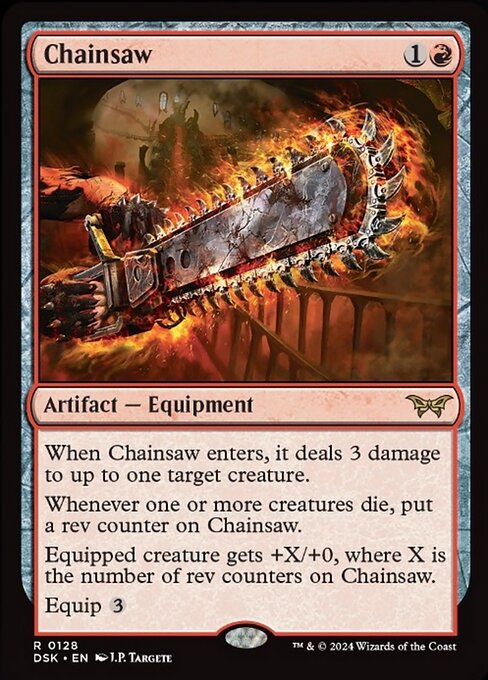
I like Chainsaw for a variety of reasons, first and foremost, it is very silly. But really, it is a solid removal spell that provides some value later in the game, buffing up one of your creatures to close the game faster. Oath of Chandra saw plenty of play in its Standard format, and the second paragraph on that card hardly ever came up.
Now those value blink decks haven’t ventured into red, and they may not need to, but if they wanted to, Chainsaw would probably be a big reason to do so.
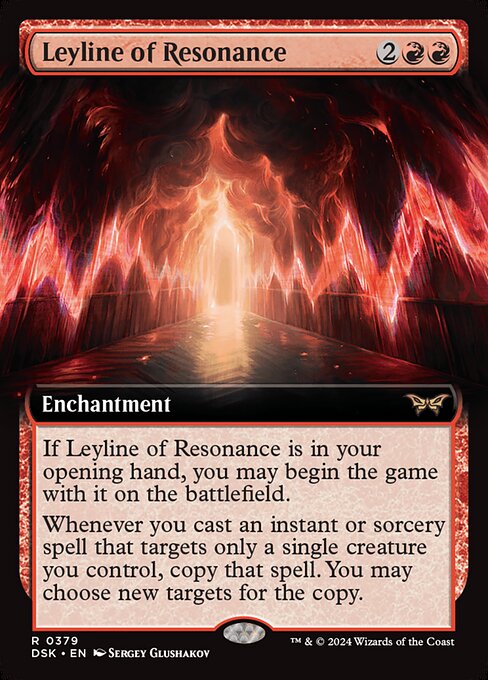
I’m sure most of you have already seen the buzz around Leyline of Resonance, but I wanted to mention it for those who haven’t. Basically, this card enables turn two kills in Standard.
There are two main ways, first is get this into play at the start of the game, cast turn one Heartfire Hero, on turn two cast a pump spell like Mostrous Rage or Turn Inside Out (new from Duksmourn), which is doubled thanks to the leyline, swing in for 7 (Monstrous Rage) or 8 (Turn Inside Out), and then use your other mana to cast the adventure side of Callous Sell-Sword, so the opponent takes another 7 or 8 from the adventure, and then another 7 or 8 from the Heartfire Hero’s dies trigger, dealing 21 or 24 on turn 2.
The other turn two kill involves playing Cacophony Scamp on turn one, cast two pump spells such as two Turn Inside Out, two Monstrous Rage, or one of each, on it on turn two, giving you a 10 power or above scamp, hit for 10 or more, sacrifice it and hit them again for 10 or more.
This is going to be most scary in Best of 1, especially when the red player is on the play, giving very little room to interact. But I have good news about everyone afraid of this taking over Standard or Standard Bo1. It is very inconsistent and very easy to interact with.
A full combo involves the leyline, a specific creature, two spells, and two lands, which is six cards. If they are on the play they have only seen eight cards, and maybe even less if they took a mulligan or two to try to find Leyline of Resonance.
This combo is also very easy to interact with, even at one mana. Cut Down and Shock are going to be your best friends at stopping this, casting them in response to the first pump spell to kill the creature and get a 2-for-1. Elspeth’s Smite is also an option, since the creature will never have more than three toughness, and on top of that exiles the creature preventing the death trigger. At that point the aggro player is probably so low on cards that they can’t reasonably kill you before you establish your own game plan.
So when the set first comes out you are going to see this all over the ladder, especially in Bo1, as players try to make their own highlight reels of silly turn two kills. But if you come prepared you are going to be crushing their dreams pretty quickly.
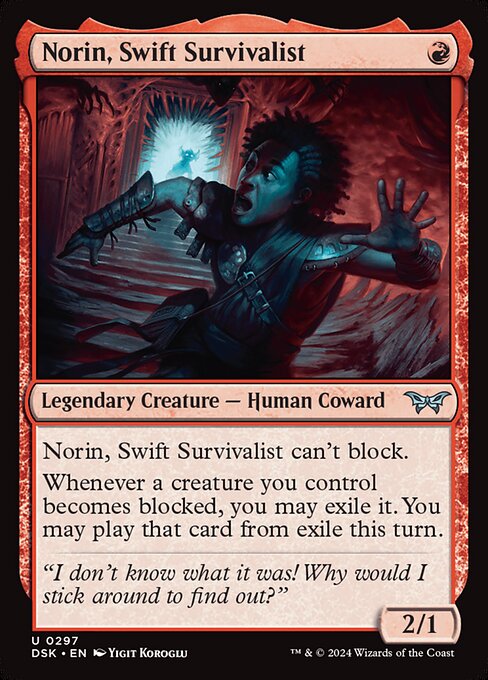
Norin, Swift Survivalist is awesome in the right kind of aggro deck. The decks described above aren’t going to want him, but decks relying on putting a large number of small-ish creatures into play and attacking are going to be very happy when instead of dying, those creatures get exiled and let you recast them. All the while you are building up cards in hand because you just keep recasting the same creatures over and over, giving you a ton of card advantage over the opponent.
I could see Norin, Swift Survivalist having a home in Convoke decks, forcing the opponent to make difficult decisions when you attack with your Knight-Errant of Eos or even Novice Inspector, either forcing them to take the damage or give you some value.
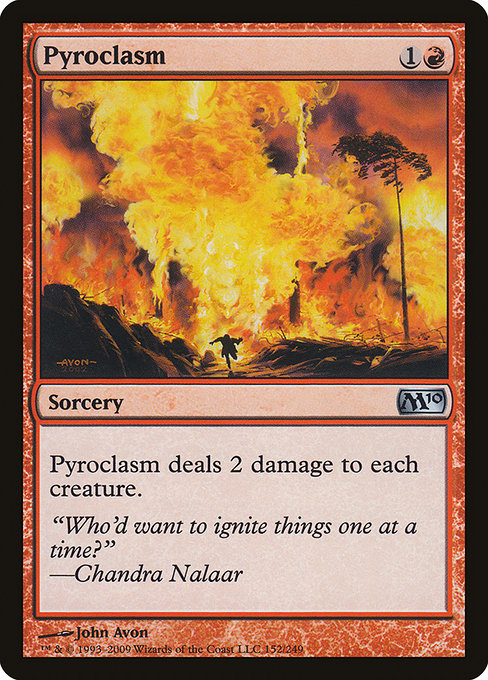
Well, I just talked about Convoke decks and Pyroclasm is here to make me stop talking about Convoke decks. Pyroclasm isn’t just a small creature sweeper, it is the small creature sweeper, and it opens up sweeping small creatures to a whole new type of deck. Previously, your best bets were Temporary Lockdown, Glistening Deluge, or Pest Control to slow down decks like Convoke or Rakdos Lizards. So really it was only white and black decks that had access to a good early game sweeper.
Now that we have Pyroclasm, red decks can also slow down those aggro decks. We can play something like Temur, or Izzet, and still have a good sideboard plan against go-wide aggro decks. One of things holding back a deck like Temur Ramp, was that it didn’t have a good response to all of the aggro decks in the meta. Thanks to Pyroclasm, those decks could have a chance moving forward.
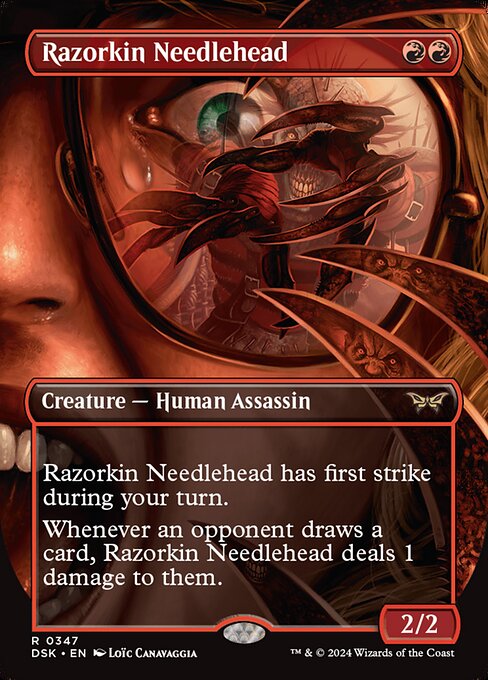
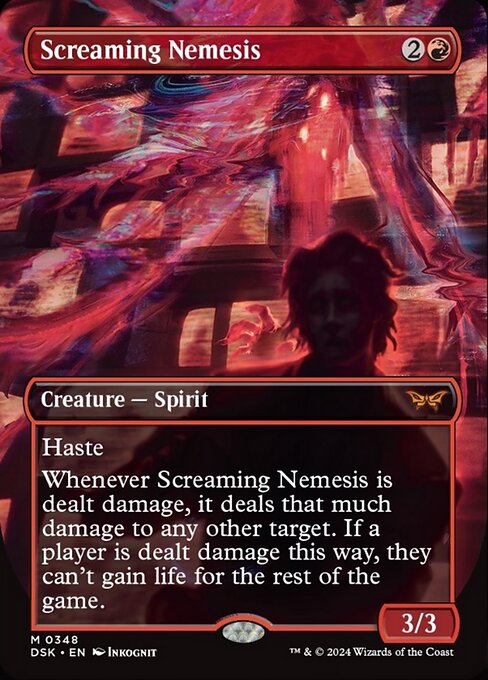
I’ve grouped Razorkin Needlehead and Screaming Nemesis together for one reason: they are really sweet aggro cards that I’m not sure are good enough to see play. Let me explain.
Razorkin Needlehead is an awesome two drop with a great ability. First Strike on your turn means it can safely attack into a lot of creatures, and with cards like Monstrous Rage can even take down a Sheoldred, the Apocalypse or Beza, the Bounding Spring, without dying. Its ability pinging your opponent for each card they draw starts adding up right away, and can absolutely help you finish out the game.
However, the two drop slot in current red aggro decks are either about synergy, such as Gev, Scaled Scorch or Manifold Mouse, or haste such as Emberheart Challenger or Slickshot Show-Off. I’m just not sure there is room for a two drop that doesn’t have haste in the current Standard aggro decks, even if it does ping your opponent right away when they untap and draw a card.
Screaming Nemesis is a sweet design, again forcing your opponent to make a tough choice of blocking it and still taking damage or just letting it through. If they do block it, or if you do something like cast Shock on it to get two damage from its ability, they aren’t going to be able to gain life the rest of the game, making it easier to whittle them down and take them out.
However, most of the red decks in the format either don’t want to go up to three mana on the curve, or are focused on synergy creatures like Laughing Jasper Flint. So I’m not sure that Screaming Nemesis is going to find a home either.
I could be totally wrong, and aggro players find room for one or both of these cards, but with how low to the ground, fast, and synergistic most of the current aggro decks are, I suspect that these two maybe be on the bench for some time.
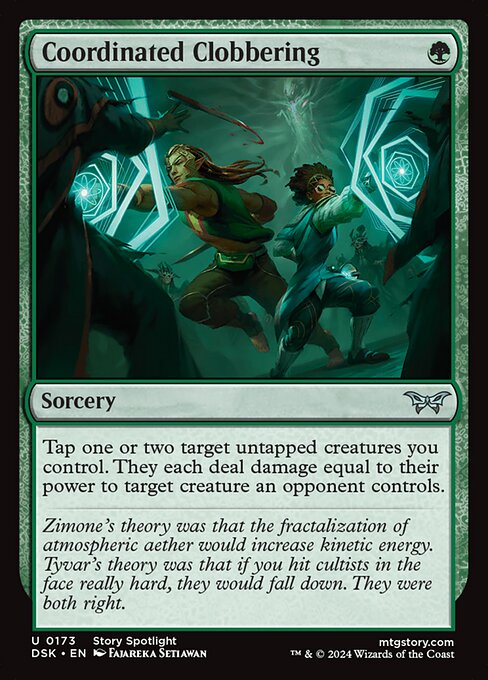
I want to discuss Coordinated Clobbering in the context of decks built around the Survival mechanic. At a base, there are better removal spells in green, such as Hard-Hitting Question, that don’t tap down your creature so it can still attack or block. However, in a dedicated Survival deck, where you are trying to find ways to tap your creatures without necessarily attacking, this can use one or two of your creatures to take out an opposing creature and then trigger both of their Survival abilities.
If a Survival deck exists, Coordinated Clobbering is going to absolutely be in it, but I would turn to other options if I didn’t have a high number of Survival creatures in my deck.
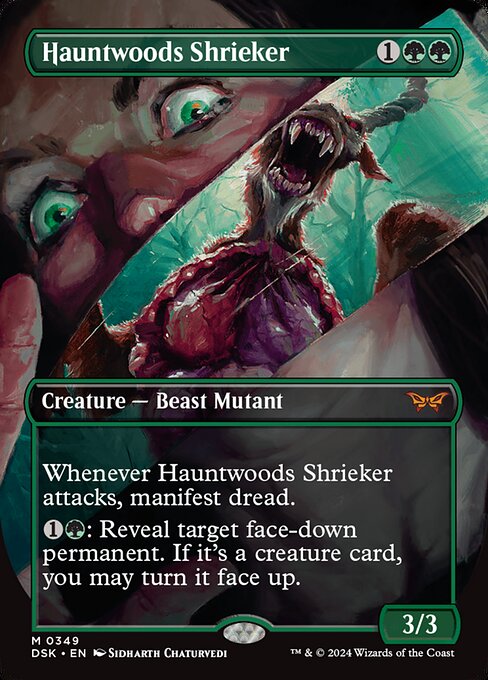
I want to discuss Hauntwoods Shrieker as mostly a warning of what is to come. On rate, a 3/3 for three that makes a 2/2 when it attacks is pretty sweet. It can be tough to attack with a 3/3 and expect it to live in current Standard, but you will at least get a 2/2 out of the deal. If you manage to Manifest Dread into a creature that costs more than two mana, then the Shrieker’s second ability is going to be great, turning up that creature for just two mana, and even at instant speed.
I am skeptical of Hauntwoods Shrieker seeing play, as there isn’t really a deck that wants it, but I do think it serves as a warning sign to remind us: Llanowar Elves is coming. In Foundations coming later this year Llanowar Elves is confirmed to be in the set. That means that every green three drop, such as Hauntwoods Shrieker, or really any three drop that has only one non-green mana symbol will all have to be re-evaluated once Llanowar Elves is here.
While Hauntwoods Shrieker doesn’t seem impressive now, when it comes down on turn two thanks to a turn one Llanowar Elves, it can easily take over the game just by itself. So keep your eye out for all of the three drops. We will have to re-evaluate all of them in just a couple of months.
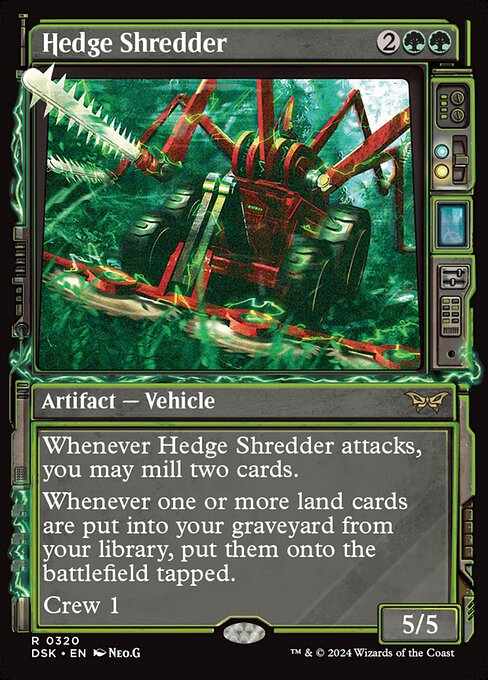
Hedge Shredder might be my favorite card from all of Duskmourn. As a Blossoming Tortoise enthusiast, anything that self-mills and returns lands from the graveyard to the battlefield has my eye as a potential new toy.
Hedge Shredder is okay on rate. A 5/5 vehicle with crew 1 for four is pretty solid, it can attack into almost anything and block almost anything. However, if you have Hedge Shredder in your deck it is going to be because of the second ability, putting any lands that make their way into your graveyard right into play.
Turning self-mill into ramp is really powerful, especially since there are so many easy ways to self mill for quite cheap, making ramping into a big Doppelgang, or big creature much easier than if you were using traditional ramp spells or mana creatures.
Will this deck be competitive? Maybe not. But I love it too much not to try, so check out my decklist article next week, where I will definitely have Hedge Shredder in a deck or two.
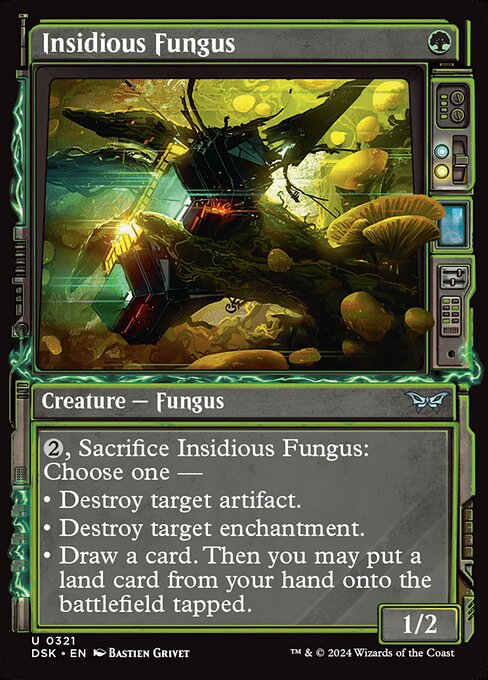
Insidious Fungus is cheap and flexible. What more could you want from a card? Decks that want to ramp are going to love running this guy out on turn one, and then sacrificing him on turn two to Explore. Later in the game when you don’t need to ramp, it can take out problematic artifacts and enchantments, or just cycle to draw a card. No matter how you slice it, Insidious Fungus has the legs and umami flavor to be an option for green ramp decks in Standard.
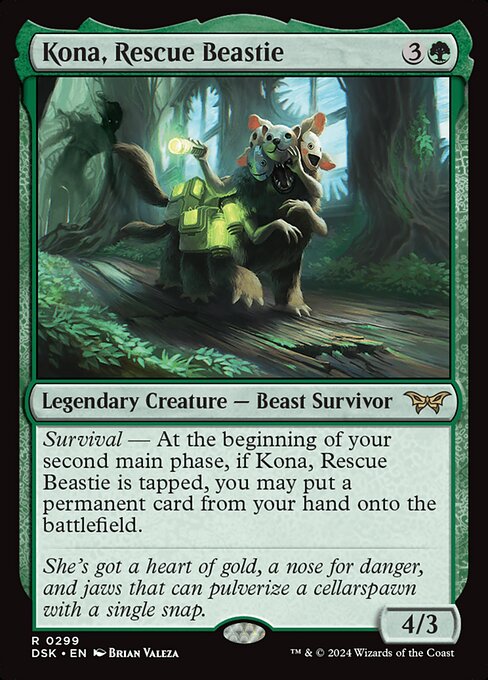
Kona, Rescue Beastie is an easy way to cheat big stuff into play. Okay it isn’t that easy, but it is very doable. The main goal here is going to be to get a vehicle or mount creature into play on the first three turns of the game, and then on turn four, cast Kona, tap it to crew a vehicle or saddle a mount, and then pass to our second main phase to put something big into play.
There is a lot of potential for Kona, Rescue Beastie, so you had better be prepared when your opponent casually plays a vehicle or mount on turn three in a green deck.
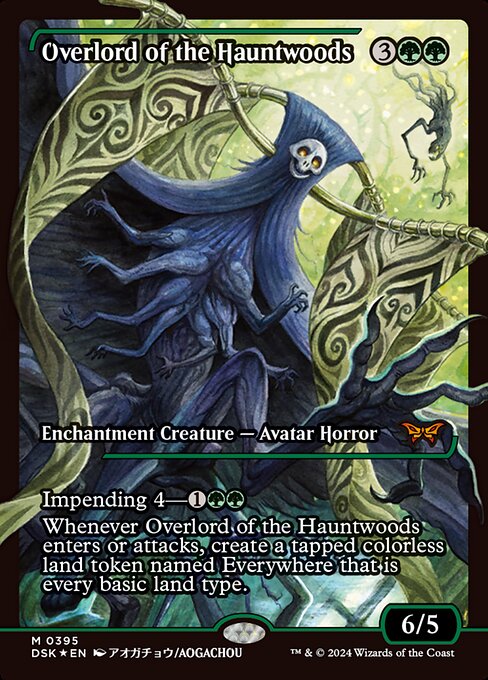
Topiary Stomper, is that you? Overlord of the Hauntwoods is the new Topiary Stomper for Domain decks. Thanks to Impending, it can come down on turn three, and it makes a land token that has every land type, instantly turning on full domain. Just like Topiary Stomper, it isn’t able to attack or block right away, but later in the game it is a real threat.
The best part of this card in Domain decks is that it triggers Up the Beanstalk, as even if you cast it for its Impending cost, it still has a mana value of five, drawing you a card thanks to beanstalk.
I fully expect this card to replace Heaped Harvest in Domain decks moving forward. While Heaped Harvest has the benefit of later gaining a bit of life and ramping again, Overlord of the Hauntwoods does the same ramping on turn three but is a game winning threat in itself later.
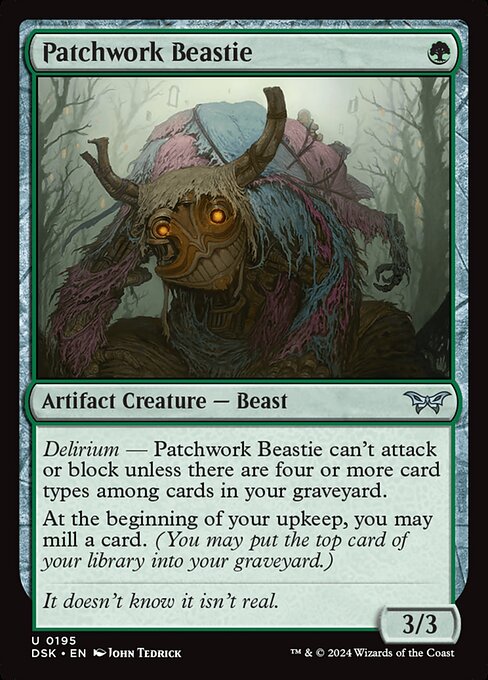
Patchwork Beastie is just what a Delirium deck will need to be competitive. This beastie does two awesome things in Delirium decks. The first is it mills a card every turn, helping you achieve Delirium, but it itself is both an artifact and a creature, meaning that when it ends up in your graveyard, either through self-mill, or being discarded, or just dying, it gives you two types for Delirium.
And then once it is turned on, you have a 3/3 for one mana, and as someone whose profile picture on this website is Wild Nacatl, boy do I love a 3/3 for one mana.
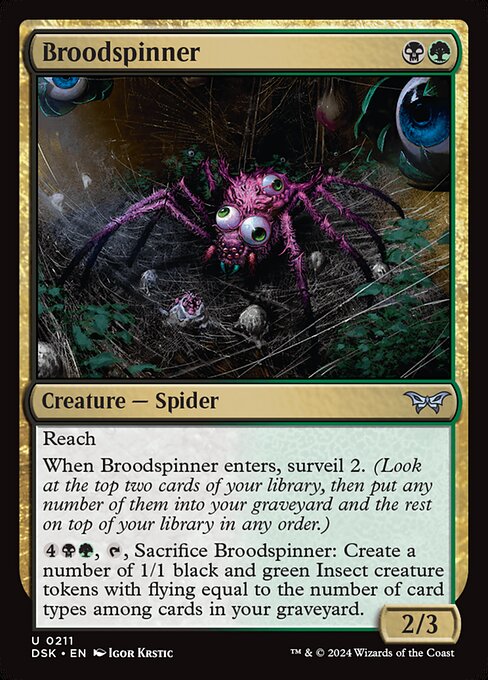
Let’s keep talking about Delirium decks. Broodspinner helps you enable Delirium, as surveil 2 can help you get missing card types into your graveyard, and it blocks very well as a 2/3 reach. Later in the game it turns into a Delirium payoff, sacrificing to give you a whole host of flying insects.
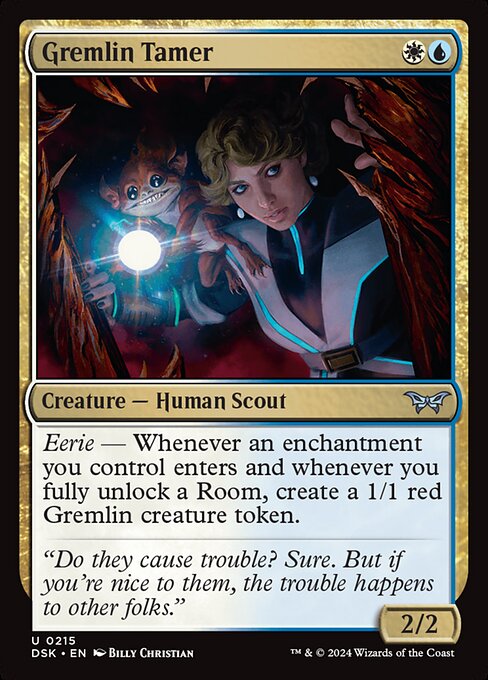
Eerie decks have a good chance in Standard, and it is thanks to the combo of Gremlin Tamer and Inquisitive Glimmer. Gremlin Tamer gives you a win condition, kind of like Young Pyromancer, that will make several tokens over the course of the game, helping slow down aggro decks with chump blocks, or slowly taking down slower opponents.
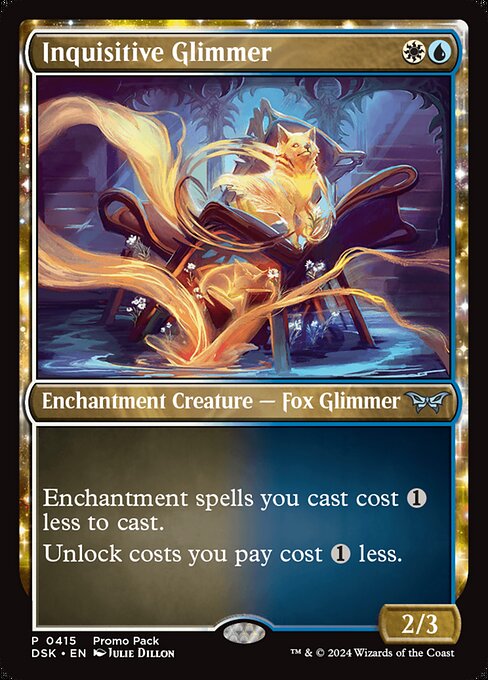
Meanwhile, Inquisitive Glimmer triggers Eerie itself, and then makes it much easier to have turns where you are casting two or three enchantments thanks to the discount it provides to your enchantments.
Between these two and Entity Tracker discussed above, Eerie has a real shot of being competitive in Standard. I look forward to putting it together and giving it a shot.
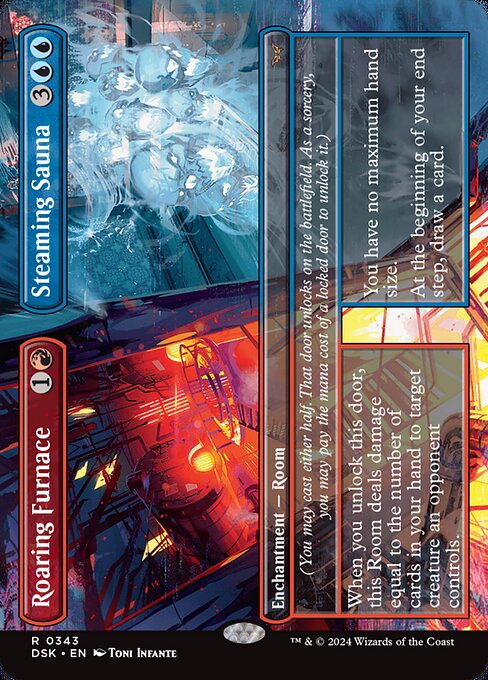
If a dedicated room deck is going to exist, Roaring Furnace // Steaming Sauna is going to be a key part of it. A slow synergy deck, that the room deck is 100% going to be, needs cards that can serve as removal while still being part of the synergy in order to survive long enough to execute their gameplan. Roaring Furnace // Steaming Sauna helps in that regard, giving early game removal as well as card advantage later in the game.
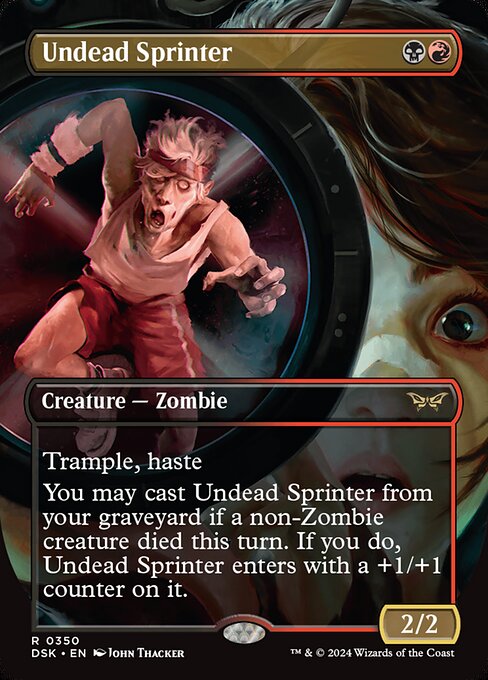
Undead Sprinter is the type of creature that sacrifice decks need if they are going to be competitive. You will eventually run out of creatures to sacrifice unless you have creatures that can be sacrificed over and over again.
We see this in Pioneer/Explorer with Cauldron Familiar, and while Undead Sprinter is by no means Cauldron Familiar, it can fill a similar role, as an aggressive creature early that can get in a few points, and then act as perfect sacrifice fodder. On a turn where you sacrifice a non-Zombie creature, you can recast Undead Sprinter, sacrifice it, and then recast it again.
Every turn you are going to be able to get anywhere from one to three sacrifices out of this one creature, depending on how much mana you have, making it a great tool in sacrifice decks.
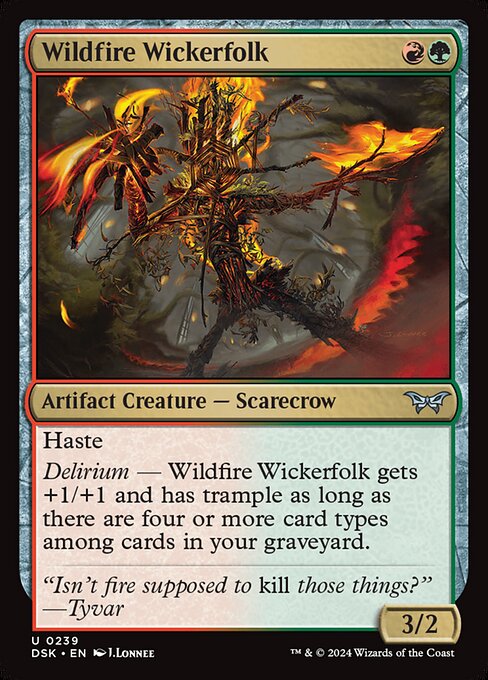
A 3/2 haste for two mana is pretty nice, as most two mana haste creatures only attack for two. If you have Delirium, which is possible in this type of deck if you are playing cards like Patchwork Beastie, you are getting a 4/3 with trample and haste, which is scary at any point in the game.
If Delirium aggro exists, or if Gruul Prowess wants another two drop threat, Wildfire Wickerfolk is going to be a good tool for those decks.
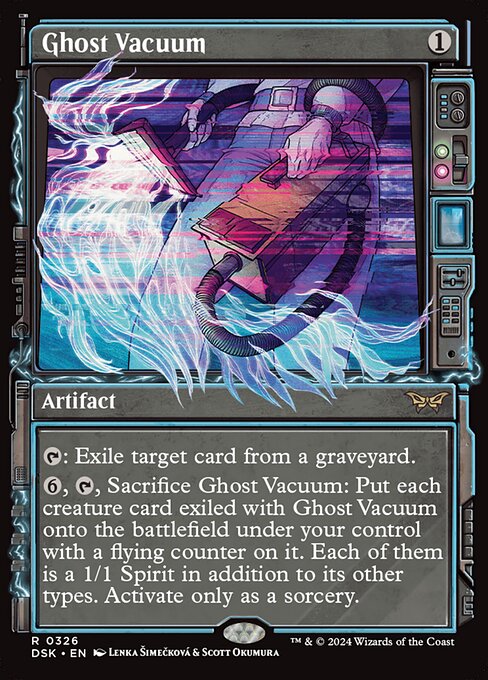
More graveyard hate and a Ghostbuster reference? Sign me up. Ghost Vacuum isn’t the most efficient graveyard hate, slowly pecking away at your opponent’s graveyard, but it does have the upside of being a late game threat, creating a whole host of tokens when you sacrifice it.
There are a lot of good graveyard hate options in Standard right now, and Ghost Vacuum likely losses out to most of them, but Ghost Vacuum can also be used in a self-mill deck, for example, exiling creatures from your own graveyard and then cashing it in to get all of the enters effects from those creatures in token form. So I think it is worth considering.
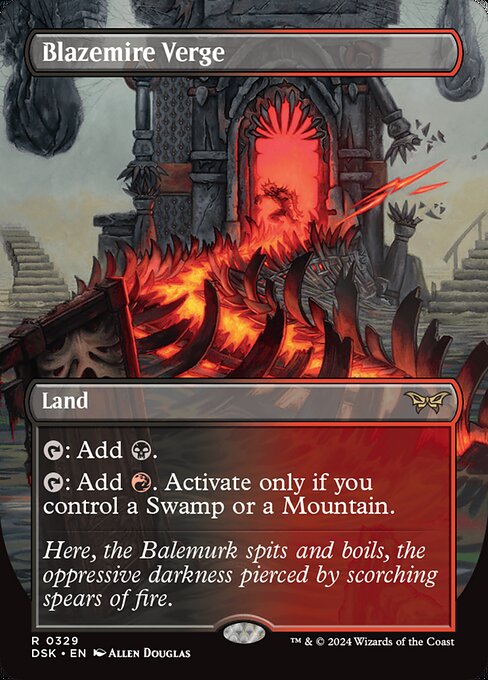
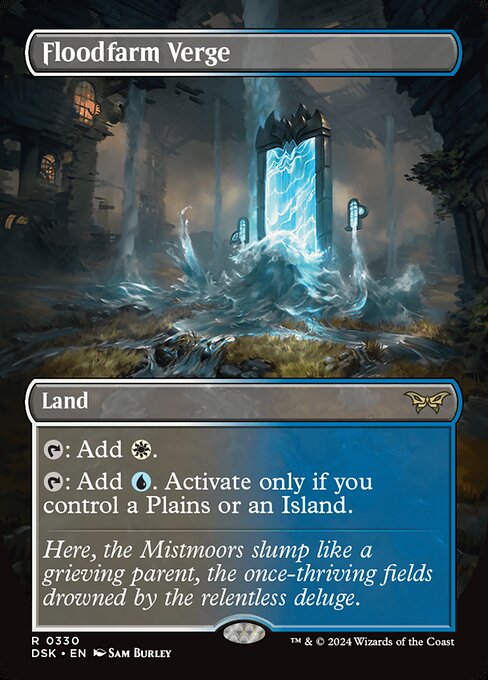
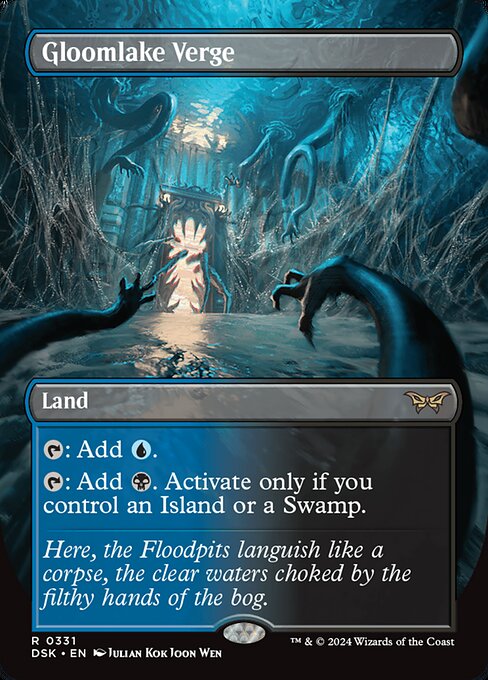
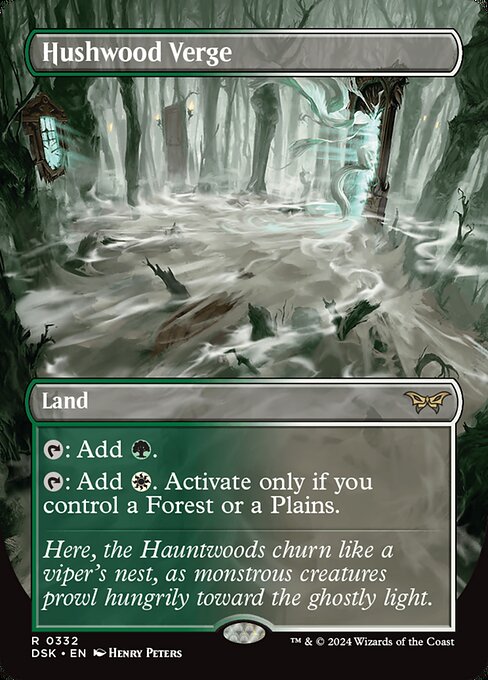
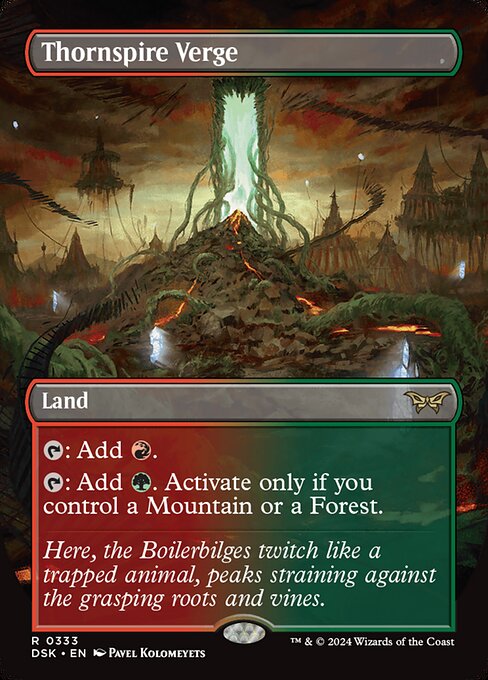
The five verge lands are really sweet because they require a bit of deck building for them to be dual lands. You should think of these lands first and foremost as just a land that taps for whatever its main color is. For example Hushwood Verge can cast Llanowar Elves on turn one but Thornspire Verge can’t.
But with some good deck building they can easily be a dual land on turn two or three, making them awesome Standard dual lands.
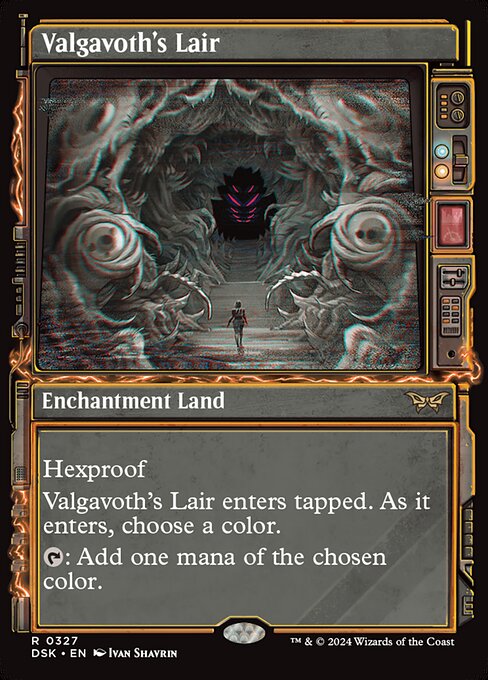
Valgavoth’s Lair gets a shout-out just because it is two card types, land and enchantment, that are usually a bit difficult to get into your graveyard for the purposes of Delirium. So when you mill (or tutor with Cynical Loner) Valgavoth’s Lair into your graveyard you are already half-way to Delirium.
The hexproof is just to prevent cheap enchantment removal from turning into land destruction, but if you are feeling cheeky you can bring in Pick Your Poison to make your opponent sacrifice their land.
Wrapping Up
All right, that ended up being way longer than I thought it was going to be, but there are just so many awesome cards in this set, and I honestly didn’t even get to all of them. I can’t wait to show you all the various decks I’ve brewed up featuring these cards, so look out for that article next week!
Until then, best of luck in your games and have fun brewing with Duskmourn cards!
Premium
Enjoy our content? Wish to support our work? Join our Premium community, get access to exclusive content, remove all advertisements, and more!
No ads: Browse the entire website ad-free, both display and video.
Exclusive Content: Instant access to all exclusive articles only for Premium members, at your fingertips.
Support: All your contributions get directly reinvested into the website to increase your viewing experience!
Discord: Join our Discord server, claim your Premium role and gain access to exclusive channels where you can learn in real time!
Special offer: For a limited time, use coupon code L95WR9JOWV to get 50% off the Annual plan!