Before the arrival of Alchemy: Innistrad, there were exactly 400 legal legendary creatures in Historic. That’s quite a few, especially considering that most of them never lived up to their supertype. Some have fallen off from the meta (Kenrith, Returned King), some have gone completely unnoticed (Dalakos, Crafter of Wonders), and some are only cast by nostalgic players of Standards past (Nicol Bolas, the Ravager). Fortunately, some legendary creatures are still making a big impact on Historic, and they are most definitely worthy of their status.
As for every Top 10, we’re taking into consideration a card’s popularity in the metagame, its flexibility, and its raw power.
Here is our Top 10 Legendary Creatures in Historic!
Honorable Mentions
These creatures just missed out on a spot in the Top 10, but are still good enough to be mentioned.
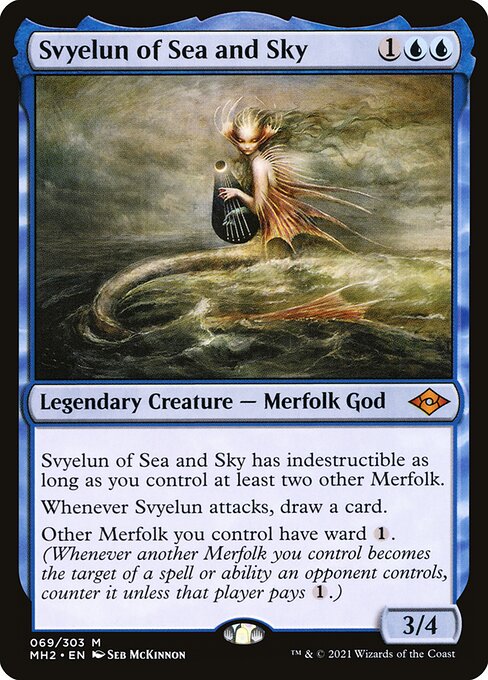
Svyelun was introduced to Historic with Jumpstart 2021, and it’s the main reason why Merfolk climbed all the way to the top in a meta dominated by Jeskai Control.
If the 4 toughness wasn’t enough to make it hard to deal with in an era defined by Lightning Helix and Anger of the Gods, Svyelun also happens to be very often indestructible, give ward to its fellow fish, and also draw you a card on attack, just for good measure.
All of these factors, combined with the fact that the card can be put into play via Collected Company, made Svyelun into a terror for any archetype counting on spot removal and damage-based wraths.
Due to the recent demise of those lists that Merfolk was preying on, the deck has declined in popularity, and so has Svyelun’s success.
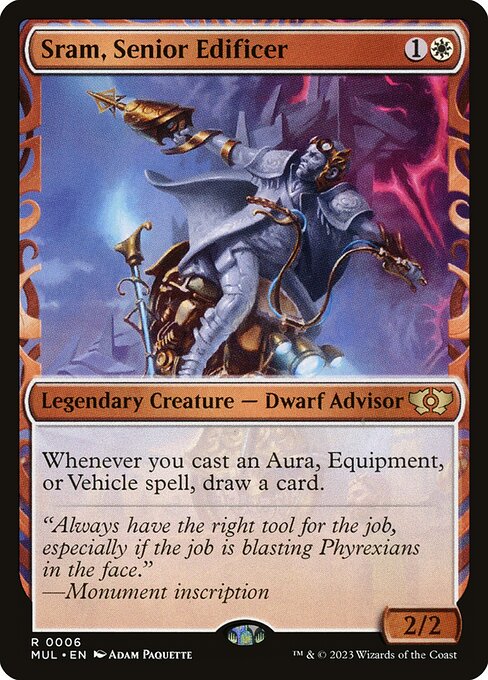
Together with its partner Kor Spiritdancer, Sram has been a pillar of Auras decks since its addition in Kaladesh Remastered. Its powerful triggered ability makes it so the deck never runs out of gas, and quickly turns this 2/2 into a deadly threat that must be dealt with.
While very impressive, Sram’s ability is certainly not unique, and more cards with similar or better variations of it exist in the current format. Furthermore, it is far from a game winning effect on its own, and requires several deck building restrictions to take full advantage of it.
While Azorius and Orzhov Auras have existed in the meta since the advent of Jumpstart in 2020, neither deck has ever had considerable competitive success, and neither has ever dominated a meta. In today’s world, Sram is often blocked by countless Cauldron Familiar, or easily dealt with by the ever popular Unholy Heat and Fatal Push.
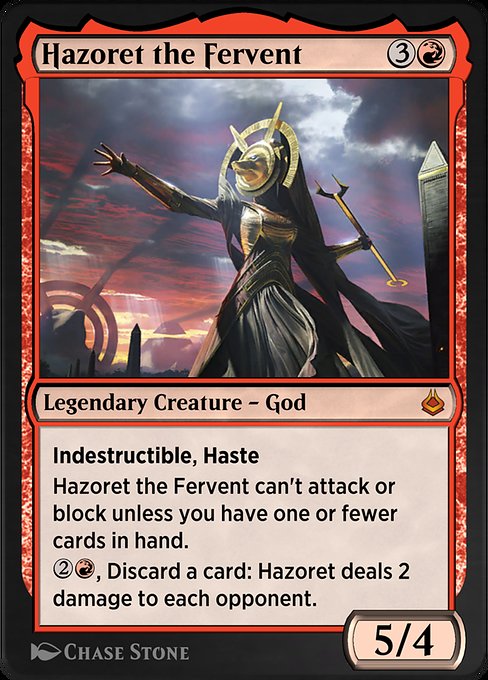
Few things are as impactful and game winning as a Hazoret on an empty board.
The sole reason why the card doesn’t make it into the Top 10, is its very low popularity in the current meta. The most successful decks running Red at the moment are Phoenix and Jund, and both lists have one thing in common: they rarely ever find themselves empty handed.
Hazoret shines in aggro decks that can quickly dump their hand and swing with the Goddess as soon as she comes into play, ideally on turn 4 or 5. Unfortunately, the archetype is completely absent in today’s meta, and even decks like Rakdos Arcanist generally opt for different options. As a result, Hazoret’s popularity has gone down drastically.
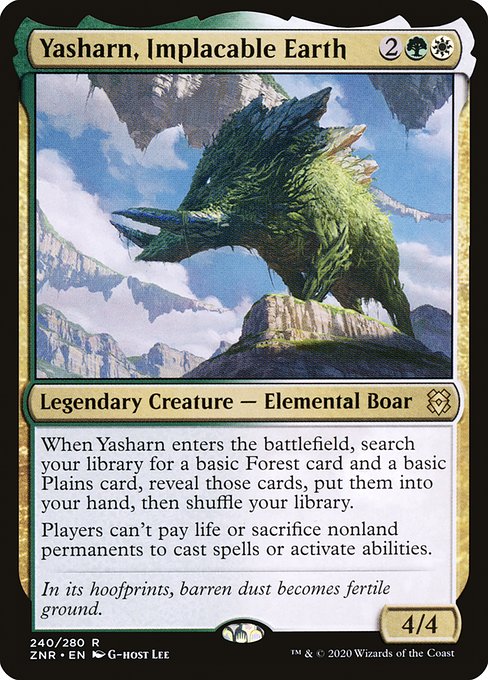
Is it time for Mr. Pig to make a comeback yet? The meta would suggest so, yet the Selesnya lists that are running him in their sideboards are still struggling massively.
Yasharn is the true silver bullet against sacrifice decks: not only does it throw a wrench in their gears, it is also very difficult to remove due to its 4 toughness (relevant against red removal) and its 4 mana value (relevant against Fatal Push).
Much like many other cards, Yasharn lives and dies by the meta surrounding it, and it ranges from incredible to barely playable. With the recent success of Golgari and Jund Food decks, I wouldn’t be surprised if it made a big comeback as a main deckable option, and helped Selesnya decks rise to the top.
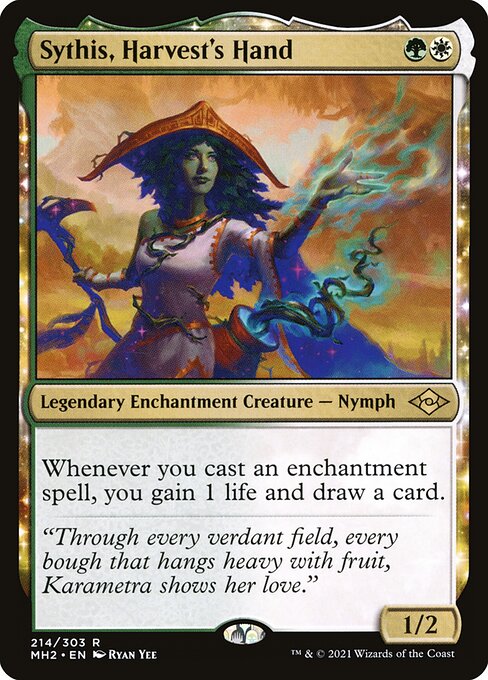
Sythis was added to Historic through J21, and together with Enchantress's Presence and Sterling Grove it gave birth to a new deck that wreaked havoc in the meta for a few weeks. While the deck is still incredibly potent, other archetypes have adapted and now most lists run some sort of answer to the Nine Lives – Solemnity lock.
While it shares a similar effect to Sram, Sythis has two major upsides in the shell it’s played in: it gains life and it’s an enchantment. The former is very important against aggro decks trying to race the lock, as well as against life loss effects caused by Cauldron Familiar. The latter is relevant because Sterling Grove grants the creature shroud, and because additional copies of Sythis can simply be cycled for more gas.
Speaking of Sram, Sythis has also made rounds in the new Abzan Auras deck that can play up to 12 Kor Spiritdancer creatures making it an even somewhat versatile option!
Overall, Sythis has contributed massively in the success of Enchantress decks during the past few months solely on it’s strength as a card.
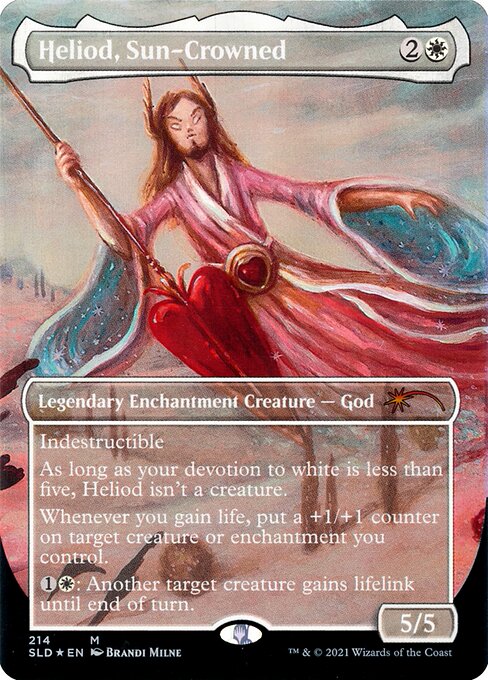
At number 9 we meet the first of many Theros legends on this list: Heliod, Sun-Crowned.
Being indestructible and rarely being a creature, makes this permanent incredibly hard to remove in the current meta. The only common viable answers to it are Vanishing Verse and Skyclave Apparition, and even those might not be enough, considering the lists running Heliod.
Played almost exclusively in lifegain decks, Heliod gave birth to a new combo when Scurry Oak was introduced to Historic. While the archetype is still heavily reliant on lifegain and ETB triggers, it can now win games through its plan A (the combo) or its solid plan B (beatdown with huge creatures). As a result the deck has become one of the strongest options for the current Historic meta.
Heliod’s ability to generate value even without going for the combo, makes it an incredibly strong and durable threat. In those cases where you also get to turn the powerful enchantment into a creature, your opponent is going to have a horrible time.
It’s white, it’s a 3-drop, it’s a human, and it makes more humans. What more could we ask from a creature?
Personally I would ask it to have 4 toughness.
Apparently, someone at WOTC wasn’t afraid of pushing this creature a bit more, so Adeline also comes with vigilance, just in case!
Very difficult to remove due to its high toughness, Adeline took Humans by storm when the meta was being defined by Anger of the Gods and Lightning Helix, and even in an era where those two cards aren’t as prevalent as before, it still consolidated itself as one of the best 3-drops for white aggro decks.
Generating extra human tokens every attack, while also pumping its own power, makes Adeline an incredible threat that demands an immediate answer. While going wide, the tokens can also be key for buffing Thalia's Lieutenant, and push through those last points of damage.
I wasn’t sure where to rank Muxus, so I rolled a D6 and somehow hit a 7.
While not as popular as it once was, Goblins is still a very real deck and the main reason for its viability lies within Muxus and it’s game-winning effect. Although it might occasionally whiff, the roll of the dice is often game ending, with little to no chance for the opponent to react.
Albeit Goblins’ beatdown plan is viable and might win some games, it’s certainly not good enough for the format at large: the individual cards are often unexciting, but the combination of ramp, haste, tutor, and tokens, comes together for a deadly payoff when Muxus finally hits the board.
Unfortunately for the deck, several of its cards only really work when other goblins are also around, effectively restricting its flexibility and adaptability to different matchups. Due to an ever-changing meta that requires plenty of different answers, Goblins has therefore dropped in popularity, and so has its marquee card.
Despite its recent lack of success, Muxus remains a pillar of Historic, and his raw power is hard to match for any other card.
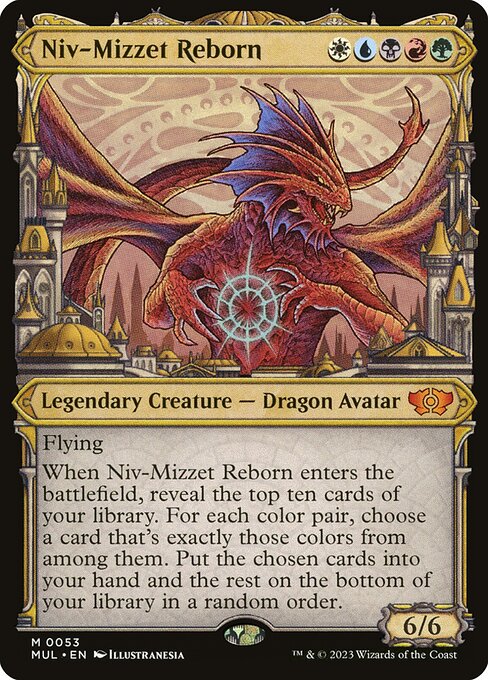
Although technically hard to cast, the quality of today’s lands makes the process of getting 5 colors pretty trivial, especially when fueled by the card selection provided by Expressive Iteration and Prismari Command. At this point, Niv-Mizzet becomes a 5 mana 6/6 flier with one of the most powerful ETB triggers ever printed.
The multicolor restrictions that Niv-Mizzet’s ability poses can’t even really be considered as such, when the cards that you are “forced” to play are Iteration, Helix, Pulse, Command, and more. Many midrange decks would love to be able to play all of them, and 5C Niv does just that.
In this dedicated shell, Niv-Mizzet is capable of drawing upwards of 3-4 cards pretty frequently, while also presenting itself as a deadly threat that demands an immediate answer. The card advantage generated by the dragon and the other spells in the deck, is often enough to overwhelm its opponents.
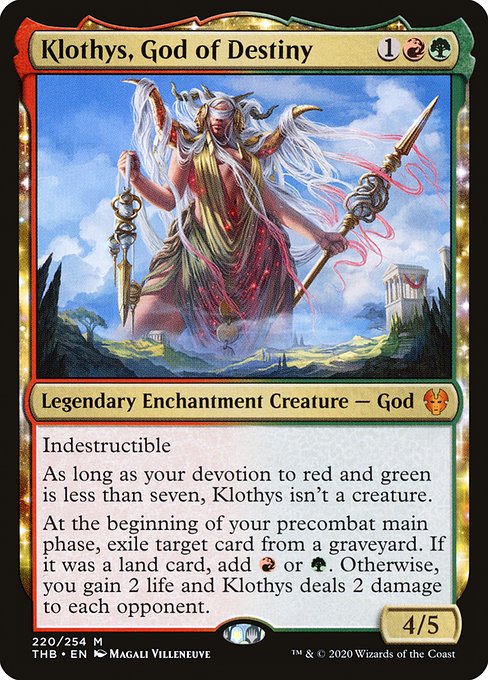
Graveyard hate, drain, and ramp on a single card: Klothys, God of Destiny earns the first spot into our Top 5.
While taking your turn 3 off may not be too appealing, the value that Klothys generates in just a few turns is hard to match. Even in those matchups where graveyard hate isn’t relevant, the 4-point life swing every turn is tough to overcome, even for the most tested decks of the format.
Occasionally, Klothys can also exile a land to help you ramp and set up for a big turn, and further deny delirium from the ever popular Dragon's Rage Channeler and Unholy Heat.
To top it all off, Klothys is incredibly hard to remove, as the only viable permanent answers are Skyclave Apparition, Mystic Repeal, and counterspells. Bounce spells like Brazen Borrower and Aether Gust can buy a turn or two, but outside of blue and white, there is nearly no way of removing the mighty Theros God.
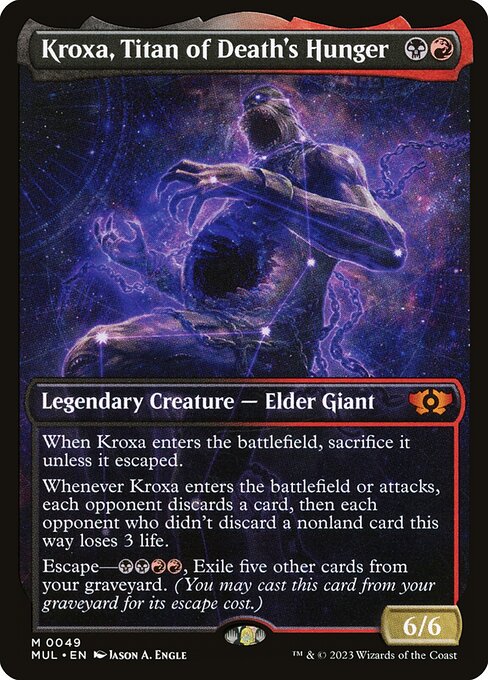
Once a format-defining card, Kroxa’s popularity died out when control was ruling the metagame. Thanks to recent developments, the titan has escaped its graveyard and made a real comeback in the format, earning the number 4 spot in our Top 10.
Kroxa cemented itself as a staple of Rakdos Midrange decks the moment it was released, as it plays right into the strategy of those lists: deprive the opponent of resources, trade 1-for-1, and take over the game with sheer card quality and recursive threats.
While Kroxa is not a particularly exciting turn 2 play, the longer the game goes, the better the titan becomes. The pure power provided by Kroxa, forces its opponents to board in graveyard hate, even now that Rakdos decks have started relying less and less on it.
Overall, Kroxa is a looming threat that is hard to remove and even harder to permanently deal with, and can single-handedly carry games to victory.
Historic Decks with Kroxa, Titan of Death’s Hunger:
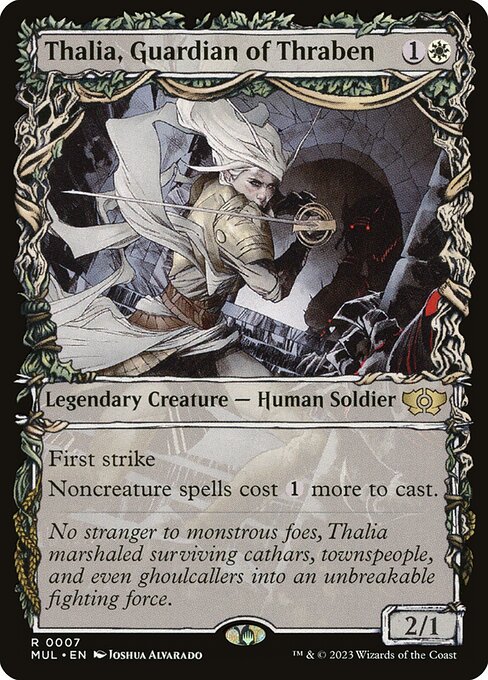
In this world nothing can be said to be certain, except death, taxes, and your opponent having Thalia on turn 2.
Benjamin Franklin, 1789, while ranking Thalia at number 3.
Few cards are as universally impactful as Thalia, Guardian of Thraben: Whether you’re playing Legacy, Modern, Historic or Standard, you want to cast spells, and you certainly don’t like overpaying for them.
Typically played in go-wide creature decks, Thalia’s taxing effect is back-breaking for all those decks that heavily rely on their non-creature spells. Whether those decks want to cast their card draw, spot removal or wrath, they’re going to spend more mana than they wanted to, and they will probably be forced to do it a turn later than planned.
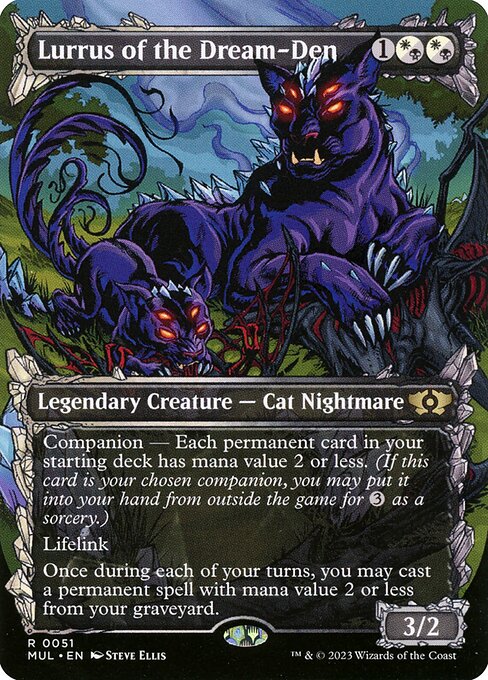
Despite the companion nerfs, and despite its deck building restrictions, Lurrus of the Dream-Den is still a dominant force in today’s Historic. It fully earns its spot at number 2.
Mainly played in Golgari Food and Auras (and occasionally in Rakdos Arcanist), Lurrus is by far the best companion of the bunch, and is a must-answer threat capable of generating endless value.
Very much like Kroxa, but to an even greater extent, Lurrus often forces its opponents to board in graveyard hate, even in those matchups (like Auras) where it generally wouldn’t be a primary concern.
Lurrus’s ability to undo all of the hard work its opponents put into removing permanents, makes it a stellar choice for grindy decks relying on cheap cards.
While not its main features, Lurrus’s stats are nothing to scoff at, and in the closing stages of a game, a 3/2 lifelinker can make the difference between winning or losing in a racing situation.
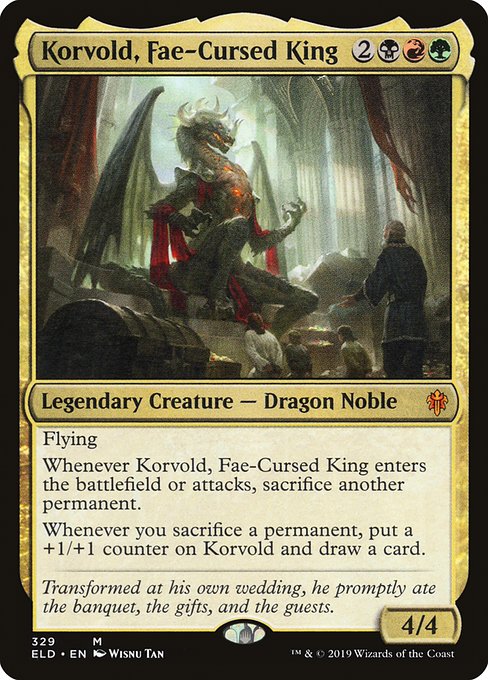
“Untapping with Korvold” is often used as a synonym for “winning”. It is only fair to rank the noble at number 1.
Even on its own, Korvold is an incredible creature, capable of turning dead draws into more gas, while also buffing itself and presenting a deadly clock. In a dedicated shell like Jund Food, where sacrificing permanents is no longer a drawback, the dragon becomes an unstoppable force.
With a single Cauldron Familiar – Witch's Oven combo in play, Korvold goes from incredible to overwhelming, both in terms of the card advantage acquired, as well as in terms of power and toughness, possibly ending the game the turn after it came into play.
Even in dire situations, where you might only have a single out, Korvold is THE card that will get you out of it, that together with Trail of Crumbs will keep digging through your entire deck until you find your answer.
In short, Korvold is a payoff and an engine stapled onto a flying dragon. It doesn’t get much better than that.
As always, plenty of very strong cards didn’t make the list, but that doesn’t make them bad!
Maybe the meta is just not in their favor right now (Questing Beast), or they may simply be a niche sideboard card (Nezahal, Primal Tide).
Certain creatures that got cut fit better in their own shell than all of the cards on this list, so keep in mind that context is also key when evaluating what to play in your decks.
What are your thoughts on our Top 10? Who would you have liked to see, and who would you remove? Let us know!
Premium
Enjoy our content? Wish to support our work? Join our Premium community, get access to exclusive content, remove all advertisements, and more!
No ads: Browse the entire website ad-free, both display and video.
Exclusive Content: Instant access to all exclusive articles only for Premium members, at your fingertips.
Support: All your contributions get directly reinvested into the website to increase your viewing experience!
Discord: Join our Discord server, claim your Premium role and gain access to exclusive channels where you can learn in real time!
Special offer: For a limited time, use coupon code L95WR9JOWV to get 50% off the Annual plan!
Red mage since the early 2000's, Reto loves aggro and midrange, with the occasional sprinkle of combo here and there. After taking a long break from competitive, Arena has reignited his spark as he tries to find the next big thing in Historic. For suggestions or just a quick chat, feel free to reach him on Twitter.