Hello and welcome to Fun & Jank! My name is Plum, and today we’ll be looking at the upcoming set Through the Omenpaths, which hits Arena on September 23rd. Now, this is isn’t really a set review. I’ve never been one to go card by card giving bad takes about Limited picks or predicting what will be Tier 1 next season. I’m not here to do a comprehensive set review.
Instead, think of this week’s edition as a highlight reel. I’m approaching OM1 with my Big Brewer’s Brain™, focusing on the cards that caught my attention and made me start sketching shells. I’ll walk through why I think they’re interesting, where they might find a home, and what kind of potential they could have in the Historic format.
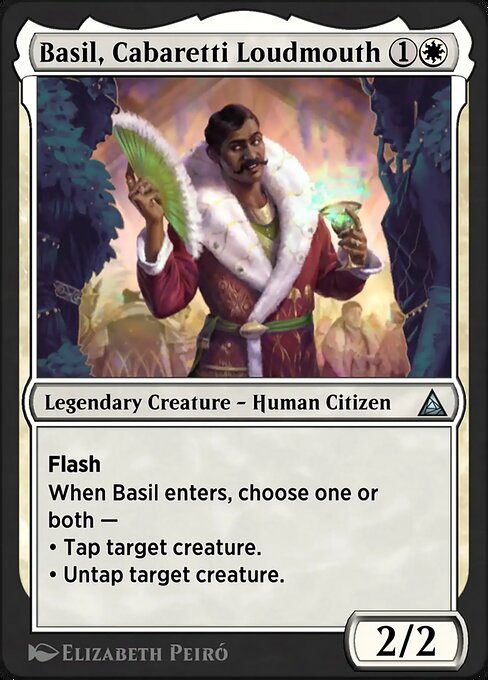
A two-mana 2/2 with flash that taps or untaps on entry doesn’t sound like much, but this citizen immediately set off combo alarms in my head. The ability to untap creatures slots neatly into a previous shell we built around Combat Celebrant and Reflection of Kiki-Jiki.
The legendary clause is a problem — you can’t just spam copies off Kiki — but there are ways around it. Dedicated Dollmaker strips the legendary tag, and Mirror Box turns the legend rule into a non-issue. With those in play, suddenly Basil becomes pestermite-lite in this discount Splinter Twin combo.
Even outside combos, flash is real utility. Playing Basil at the opponent’s end step to untap your board or set up a swing is a subtle line that makes this more than just a combo piece. It’s cheap, flexible, and worth exploring albeit the combos it can be used in require 3+ cards in total to set up.
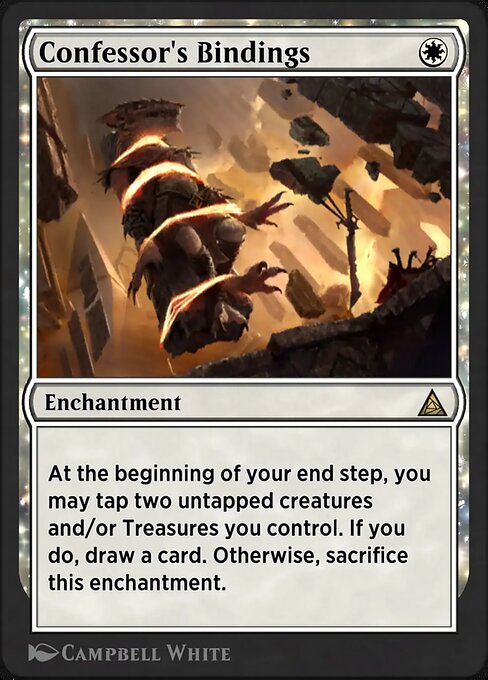
One mana enchantments that generate repeatable card advantage are always worth a look, and Confessor’s Bindings is no exception. It fits naturally into shells that already want to flood the board with cheap creatures or tokens — think Ornithopter, Thraben Inspector or the Gleeful Demolition builds that Historic has seen pop up.
The tax is simple: tap two creatures or treasures at your end step. In the kinds of decks that are already producing fodder, that’s barely a cost. The reward is consistent gas, exactly what these swarming convoke style decks need to keep up pressure without stalling out.
Where this really gets interesting is pairing it with Throne of the God-Pharaoh, a card that we’ve played plenty of times in the past. Now every tap does double duty: draw cards and draining the opponent’s life. That turns the simple act of tapping Ornithopters into a win condition. I’ve played sVenerated Loxodon shells on stream before, and this feels like the missing glue to make a white-based version grind as hard as the red ones.
It’s not flashy, but Historic doesn’t always reward flashy. Sometimes “draw one card a turn for one mana” is enough to carry an archetype.
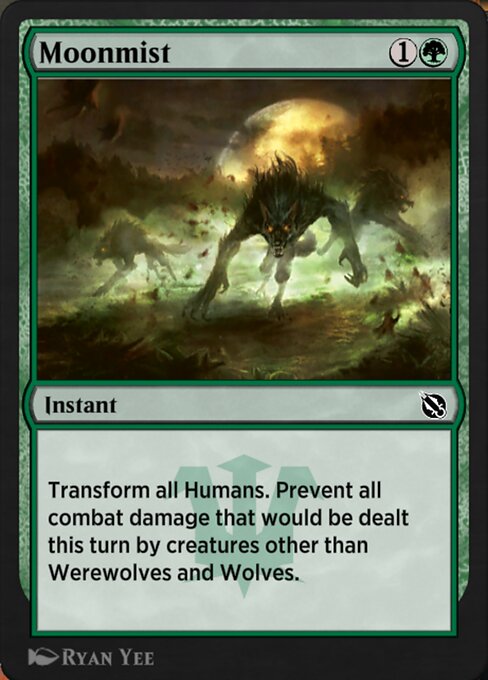
This card has lived most of it’s life as a werewolf enabler, but thanks to the new rules update for modal double-faced cards, I think Moonmist suddenly matters in Historic. It can now transform MDFCs even if they don’t explicitly have a “transform” clause, and that change lines up perfectly with the new Spider-Hero cycle from OM1.
Cards like Viggo, Enforcer of Ig's Crossing, Nia Sky Sail Storyteller, and Cren, Undercity Dreamer all come down as solid two or three drops with useful abilities, but with Moonmist they suddenly flip into oversized beaters with haste, lifelink, or built-in protection. That turns a casual curve of “turn three Vigo, turn four Moonmist” into a real board-swinging line.
The big problem with Moonmist decks I’ve brewed in the past was that the front sides of your creatures were just vanilla bodies waiting to flip. Final fantasy gave us Sephiroth and Cecil, but they didn’t for a coherent plan with older cards. Now, the Spider-Heroes offer enough standalone value that you aren’t embarrassed when Moonmist doesn’t show up. They do something on the way in, they curve cleanly, and Moonmist just happens to supercharge them.
And that’s not even counting the spice: with the right setup (Leyline of Transformation, for example), you could even turn something like Esika, the Prismatic Bridge into a “human” and flip it off Moonmist. That’s janky, sure, but it’s exactly the kind of nonsense this card invites.
Historic might not be ready for a full-blown Moonmist deck yet, but the pieces are stacking up. And every new transformable body makes the brew a little more coherent.
Verilax, The Havenskin
Five white pips is a steep ask, but Verilax pays you back in some wild ways. On entry, it reanimates any creature from your graveyard. And once it’s on the board, every point of damage that would hit it instead becomes +1/+1 counters. It’s giving biiiiiiig Stormwild Capridor energy.
In my mind, this screams white devotion. Nykthos, Shrine to Nyx curves perfectly into this, and once you’re already in that lane, follow-up plays like Sun Titan become backbreaking. Verilax revives a Titan, the Titan revives your value creatures, and suddenly your board snowballs.
There’s also a sweet interaction with Pariah, which has some redundancy in the form of Phyrexian Vindicator. Stick Pariah on Verilax, and all damage that would hit you instead goes to the symbiote. It won’t take any of it, it’ll just get bigger. Against burn or creature-based decks, that’s a “you can’t win” button. Add in tricks like Selfless Savior to protect the setup, and suddenly you’ve got a lock.
It’s more fragile than the Solemnity lock, sure, removal that exiles or bounces ruins your day. But I think it can give a lot of power and redundancy to some sort of creature based prison shell if we can fine the right pieces.
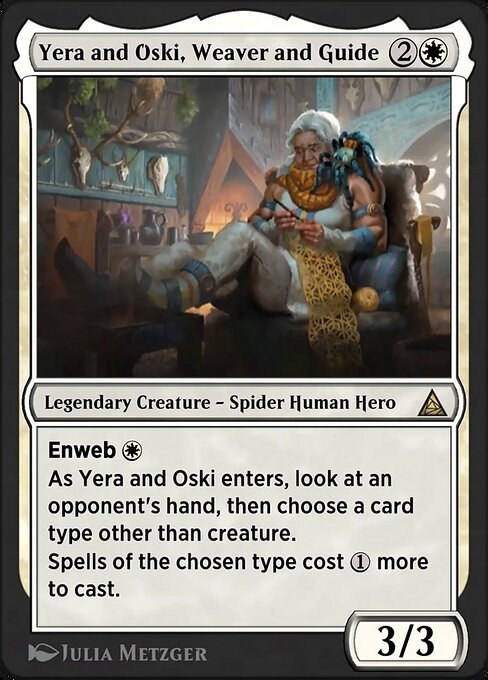
This three-mana 3/3 legend with enweb feels like a great taxes piece to me, but Yera and Oski, Weaver and Guide has some notable depth. The enweb cost lets you bounce a tapped creature back to your hand as part of casting it — which means you can replay ETB effects or reuse utility creatures while also dropping a sizable body.
When it enters, you peek at your opponent’s hand and tax a noncreature card type by one mana. That immediately puts it in the same family as Thalia, Guardian of Thraben, Thorn of Amethyst, and Lodestone Golem. We don’t quite has a traditional taxes style list in the format, but I’m hoping this helps
The fun is in the synergies. Imagine curving White Orchid Phantom into Yera and Oski. You swing with Phantom, then bounce it with the enweb cost, replay it for one mana, and blow up a second land while also taxing their hand. That’s brutal mana denial paired with tempo pressure.
It’s also a human, which means the usual Historic human synergies apply: Thalia’s Lieutenant, Adeline, Resplendent Cathar, and the rest of the squad will play well with it. Toss in Mox Amber for extra value and you’ve got a disruptive shell that punishes noncreature decks while still swinging efficiently.
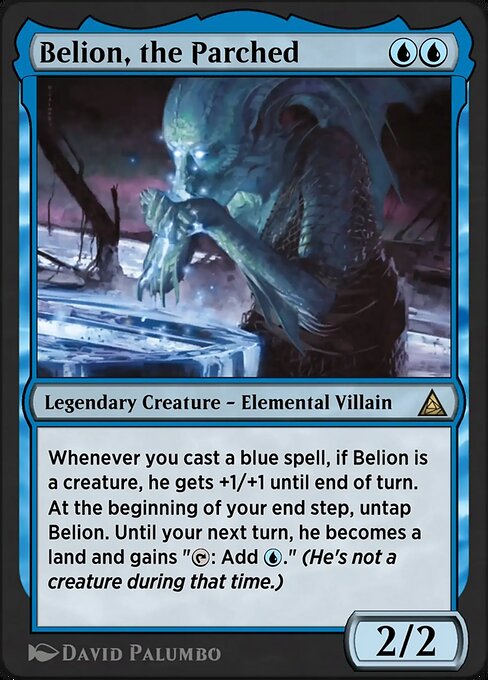
Belion, the Parched is a curious little elemental: a two-mana 2/2 legend that grows whenever you cast a blue spell, then untaps at the end of your turn and becomes a land until your next upkeep. That’s a lot of text, but it boils down to two things: it attacks as a scaling threat on your turn, and it “ramps” you on theirs.
The obvious upside is tempo. A creature that can safely dodge sorcery-speed removal by hiding as a land is already appealing. The growth trigger means even cheap spells like Opt or Consider can suddenly turn it into a respectable attacker.
But the bigger story here is devotion (can you tell I like devotion shells?). Being both blue and an elemental, Belion slots neatly into shells with Master of Waves, feeding pips while also getting buffed. It can swing well after chaining a few spells form Nykthos, but then lets you hold up Consign to Memory, Spell Pierce, or Spell Snare ont he opponent’s turn.
It is awkward in multiples, since it’s legendary, and the power boost only lasts until end of turn. Still, for a devotion variation that wants to flood the board, pile on devotion, and keep counterspells ready, I think Belion is worth experimenting with.
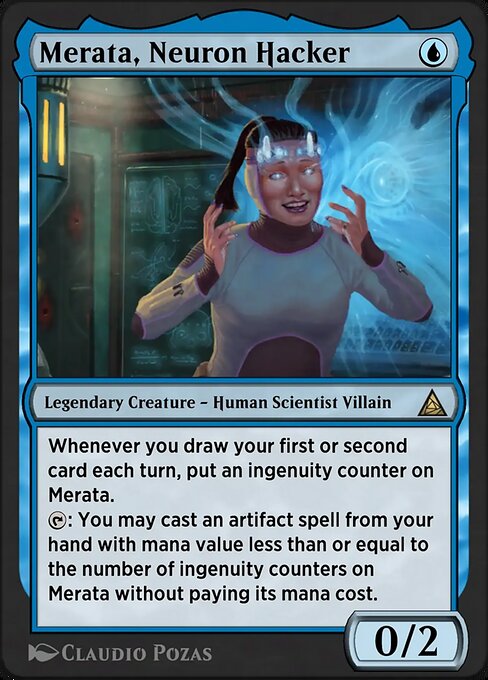
Merata, Neuron Hacker is basically a one-mana, reverse Aether Vial for artifacts. Every time you draw your first or second card in a turn, it gets a counter. Then you can tap it to cast an artifact from hand with mana value equal to or less than those counters, for free.
That’s already a recipe for abuse in Historic. Blue artifact shells naturally draw extra cards with Thought Monitor, Thoughtcast, and Emry, Lurker of the Loch loops. Feeding counters into Merata is the easy part. The payoff is dumping heavy hitters like Lodestone Golem, God-Pharaoh’s Statue, or even Wurmcoil Engine well ahead of schedule.
It’s worth noting that unlike Jhoira, Ageless Innovator, Merata makes you cast the card, which means your opponent can still counter it. But the mana savings are enormous, especially when paired with cheap card draw engines. There’s even combo potential: loop Corridor Monitor to untap Merata and keep spitting out more artifacts, though that line might be more cute than competitive.
At the very least, it’s another Mox Amber-friendly legend for blue-based artifact decks. Historic’s artifact toolbox is already deep, and Merata looks like the kind of glue piece that can push “Blue Steel” or affinity-style brews into new territory.
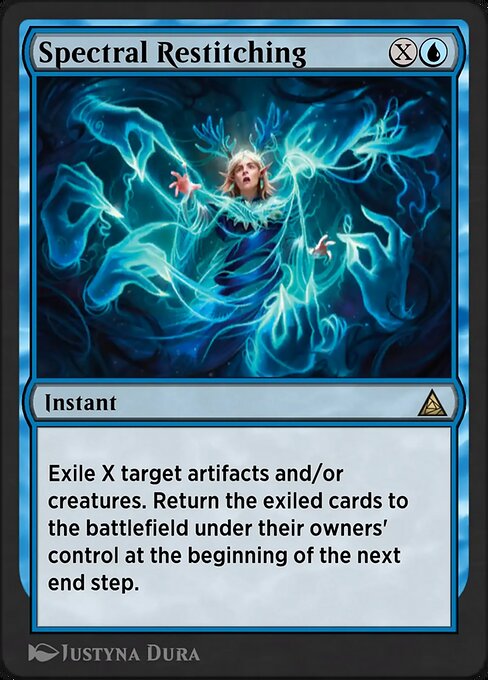
Spectral Restitching is an X-blink spell with real teeth. For X + U, you exile X creatures or artifacts, then return them at the beginning of the next end step. On its own, it’s flexible: it resets your own board for value, or it temporarily clears away blockers and artifacts to buy a turn.
But the fun begins when you bring in Containment Priest. With Priest on the battlefield, anything blinked by Restitching just never comes back. That turns it into a scalable exile sweeper for creatures, all at instant speed. Against Affinity-style decks, you can even target artifact lands and strand them off mana for a full turn.
In blink shells, this doubles as redundancy for Ephemerate. ETB creatures like Aether Channeler, White Orchid Phantom, or Skyclave Apparition suddenly become repeatable value engines. Exile them all at once, then get them back with fresh triggers on your opponent’s end step.
The combination of removal, protection, and combo potential is rare on a single card. It might not replace Ephemerate, but it feels like the kind of one- or two-of that rewards careful brewing in blue-white value decks. Historic Soulherder seems like a good for it.
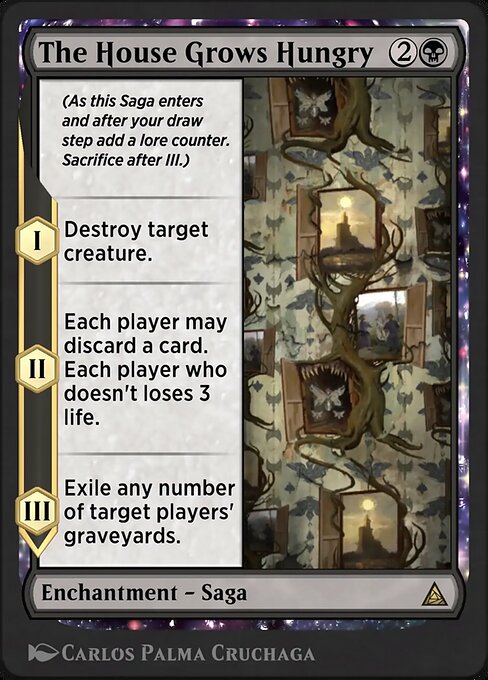
Sagas rarely look exciting at first glance, and to be honest this one is pretty plain-jane, but The House Grows Hungry has the right mix of value and disruption to make me pause.
Chapter I is straight removal — destroy a target creature, clean and simple.
Chapter II forces each player to either discard a card or lose 3 life. That’s pressure on both resources and life total, and Historic decks that like attrition will welcome it.
Chapter III exiles any number of target players’ graveyards, which is basically free hate stapled on top.
I don’t think it’s very splashy, but additinal value stapled to a Murder feels pretty good. It reminds me a lot of Eldest Reborn, but tuned down to a leaner three-mana package. It even overlaps with Elspeth’s Nightmare as another flexible black Saga that handles a creature, disrupts a hand, and attacks graveyards.
The real upside here is density. We’re creeping toward critical mass for a true “Sagas deck” in Historic. Pair this with Fable of the Mirror-Breaker, Michiko’s Reign of Truth, and even Satsuki, the Living Lore, and suddenly an Abzan or four-color Saga midrange shell starts to feel possible.
I think a few copies of this could easily slot into a GBx midrange shell, and the enchantment type is notable for Goyfs.
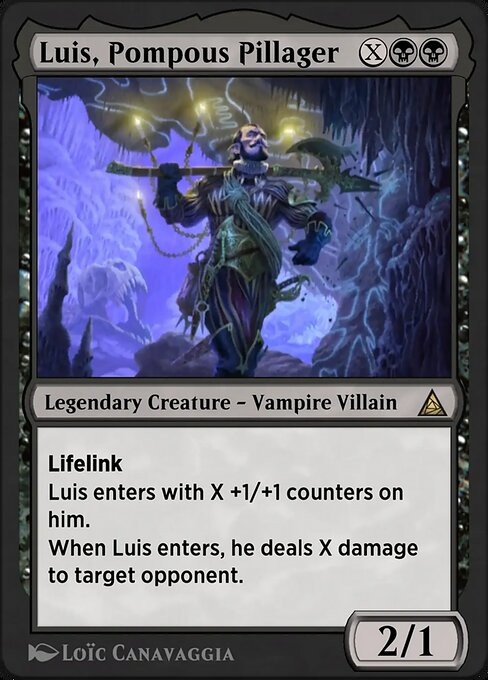
Lewis, Pompous Pillager is a vampire that scales directly with your mana. It enters with X +1/+1 counters, domes the opponent for X, and thanks to lifelink, gains you that much life right away.
The obvious home is Mono-Black Devotion. Between Nykthos, Shrine to Nyx and Cabal Stronghold, Historic already has ways to generate absurd amounts of black mana. Dropping Lewis for 5, 6, or 8 mana turns him into both a finisher and a stabilizer — a big body that chunks the opponent while padding your life total.
He also slots naturally alongside classics like Gray Merchant of Asphodel and Gifted Aetherborn, reinforcing the devotion count while supporting a grindy midrange plan. Even as a smaller play, a two- or three-mana Lewis can just be a solid lifelinker that pushes you further into the late game.
It’s not flashy combo fuel, but it does something Mono-Black often wants: bridges the gap between early attrition and late inevitability. And sometimes, “turn six, slam a lifelinking fireball on legs” is all you need to close the game. I like ’em
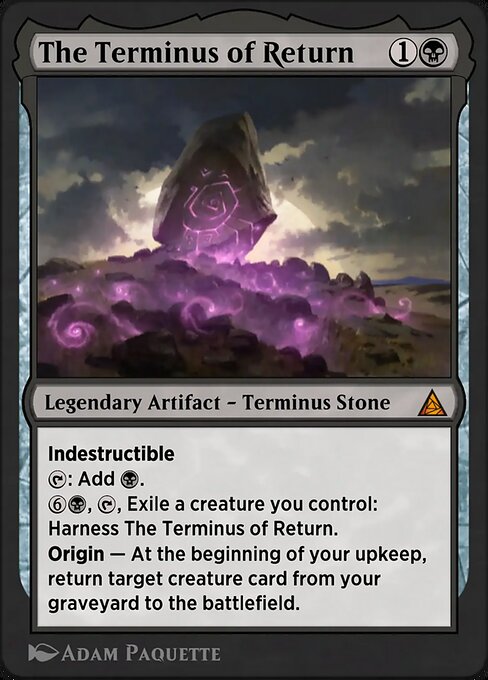
A repeatable, free reanimation engine stapled onto a mana source, although at a steep cost, feels like it could be strong. I just don’t know what Historic deck wants this.
The sticking point is speed. Seven mana is a huge ask in Historic, especially for decks that already have cleaner reanimation lines with Emperor of Bones or Unburial Rites. If your plan is to cheat fatties into play quickly, Terminus probably isn’t your first choice.
But in a grindier shell, the upside is absurd. Once harnessed it just keeps bringing something back every turn. Pair it with big hitters like Gray Merchant of Asphodel, Massacre Wurm, or even midrange value creatures, and suddenly your opponent can’t keep up.
It’s also worth noting that Omen Hawker can help pay for the seven-mana harness cost, which might open the door to a dedicated brew. Even if it doesn’t immediately slot into existing Historic archetypes, Terminus of Return is the kind of card you flag and revisit later, because engines like this tend to find a home eventually.
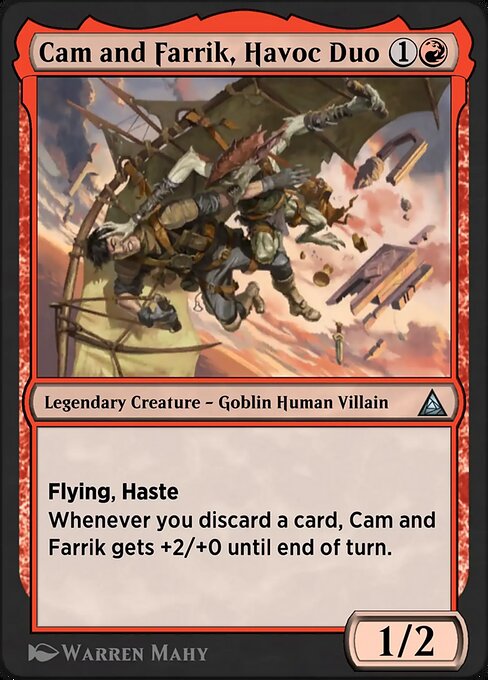
Cam & Farrik is a two-mana 1/2 flier with haste that gets +2/+0 whenever you discard a card. That alone makes it feel like a cousin to Flameblade Adept or Slickshot Show-Off. It’s cheap, evasive, and explosive when paired with the right discard outlets.
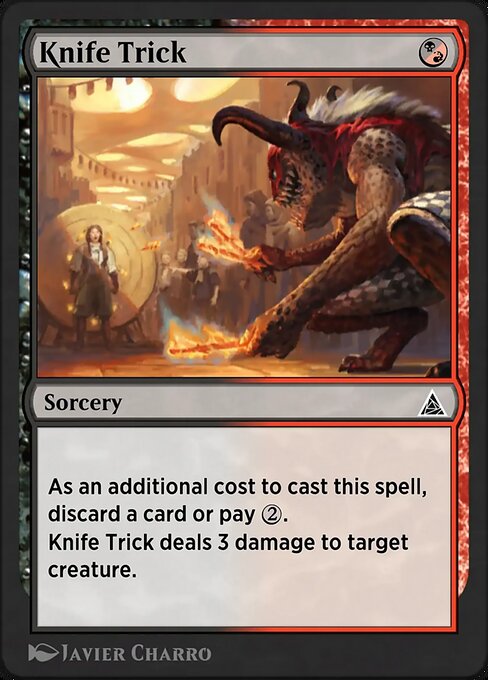
Enter Knife Trick, a red removal spell that also acts as a discard outlet. Normally that’s a downside, but in Historic decks that already want to pitch cards — Hollow One, Ox of Agonas, Detective’s Phoenix, or even cycling shells with Zenith Flare — it becomes upside. Removal plus fuel. Its just a common, but I think it’s interesting piece to have access to in a mono-red shell.
It’s not the fastest clock compared to Slickshot Show-Off, which can “plot” itself and go off in one turn. But having redundancy matters. Discard decks in Historic thrive on having enough payoffs to justify their enablers, and Cam & Farrik adds another cheap, evasive threat to the lineup.
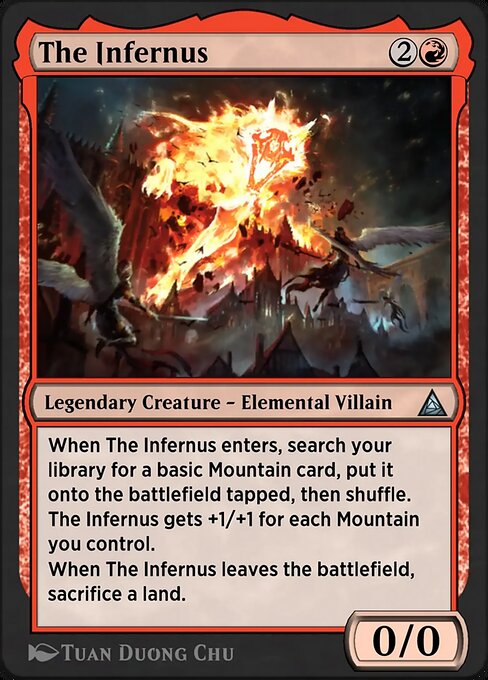
This is a strange one. The Infernusisn’t really anything special but has enough synergies with existing cards that I want to test it out anyways.
On the surface, that looks clunky. But in practice, it opens some interesting angles:
It’s an elemental, which means it works with Thunderkin Awakener. Awakener can bring it back, swing with it as a decent-sized body, then send it back to the graveyard while keeping your land count roughly even.
It curves naturally into Fire of Resistance”] or other mono-red “mountain matters” payoffs. Fetching a Mountain on ETB helps your ramp and devotion math.
In grindy red shells, it scales with every land drop, turning into a sizable threat over time.
Definitely not a slam dunk but for players who like the “ball lightning” family of cards and want more toys for Thunderkin Awakeneror elemental tribal it should be fun to test with!
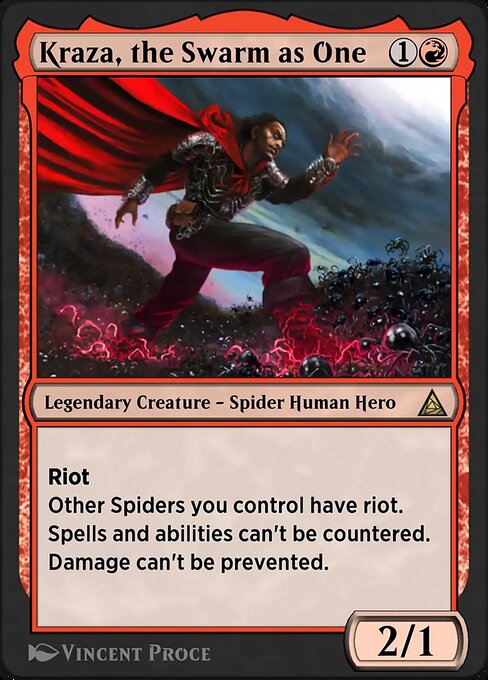
Kraza, the Swarm is a two-mana 2/1 with riot — either a 3/2 beater or a hasty 2/1. That baseline is fine, but the real text is what makes it interesting:
Other Spiders you control have riot. (Cute, but probably not the selling point.)
Spells and abilities you control can’t be countered.
Damage can’t be prevented.
That second and third line are where the card shines. Historic red decks already thrive on redundancy, and this gives them a sideboard-style hate piece built into a cheap body. No more counterspells, no more fogs, no more The One Ringdamage prevention. Burn decks, punisher shells, and even red “hatebears” (which I have yet to brew) lists suddenly have a way to push damage through the usual defenses.
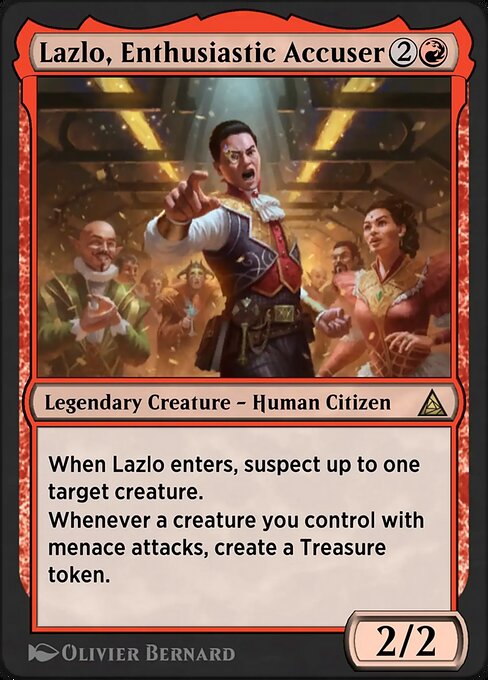
Labyrinth Raptor has a been on my “brew-around” list for a loooong time. Lazlo seems like pure gas for a menace-tribal brew. Historic already has Stormfist Crusader and Stalactite Stalker as cheap creatures with menace that pressure life totals and generate incidental value. Pair them with Lazlo, and suddenly every attack not only threatens damage but also ramps you into more spells.
Even better, Labyrinth Raptor turns blocking into a nightmare — opponents have to sacrifice creatures if they dare double-block your menace squad. Meanwhile, the Treasures you generate can fuel pump activations, removal, or just keep refilling the board. Stalactite Stalker even grows off the Treasures you sacrifice.
Not going to be meta breaking but I think this guy will help me check this brew off my list in the near future.
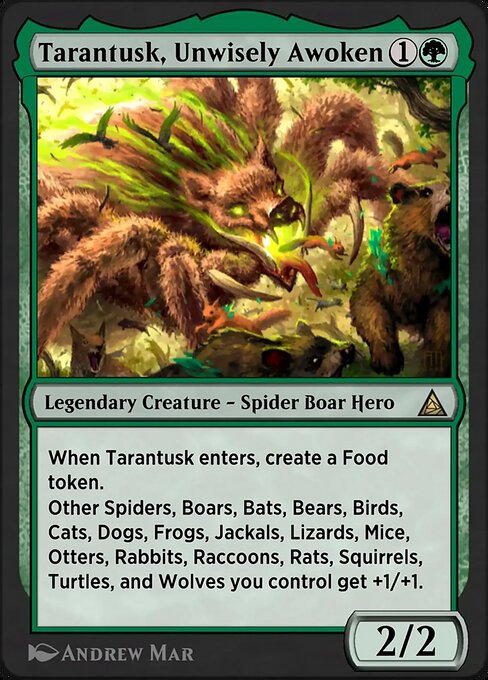
Tarantusk, the Unwisely Awoken is one of those cards that makes my inner brewer immediately say: oh no, they’re enabling me. It’s like the Noah’s Ark of lords. A two-mana 2/2 spider-boar-hero that gives +1/+1 to a whole zoo of creature types — spiders, boars, bats, bears, birds, cats, dogs, frogs, jackals, lizards, mice, otters, rabbits, raccoons, rats, squirrels, turtles, and wolves.
Most of those tribes aren’t anywhere close to competitive. But the one that caught my eye? Boars. Because YES!, this finally breathes life back into the “Three Little Pigs” package. e’ve tried it before on stream: cute, flavorful, occasionally functional, but mostly a meme. Tarantusk changes the math. It buffs your pigs, counts as a boar itself, and slots directly into the curve where you want a lord effect.
It doesn’t stop there. Frogs, squirrels, and even raccoons get the nod, which means all those half-finished brews I’ve had in my back pocket now have a reason for me to revisit them. Historic has a surprising number of oddball tribal support pieces.
This guys is very strong for Gruul aggro, but I think his ability can lead you down to paths when it comes to brewing.
Aggro curve-outs: Bounce something cheap like Ignoble Hierarch or Llanowar Elves, and suddenly you’ve got a five-power trampler on turn two. That’s a lot of stats for very little mana, and if you hit your land drops you can even replay the mana dork immediately.
Midrange value: Historic is full of ETB creatures worth reusing. Imagine bouncing a conjured 0-cost Flametongue Kavu from Mine Security or other ETB generators. Borys gets huge, and you replay the creature for more removal or value. I don’t think Gruul bounce was on my bingo cards but I’m always up for exploring the idea.
It also naturally slots into Bard Class shells. Being a red-green legend, it benefits from the cost reduction and grows into a monstrous attacker while fueling the deck’s legendary synergies. Either way, the card is sweet and I’m excited to jam it.
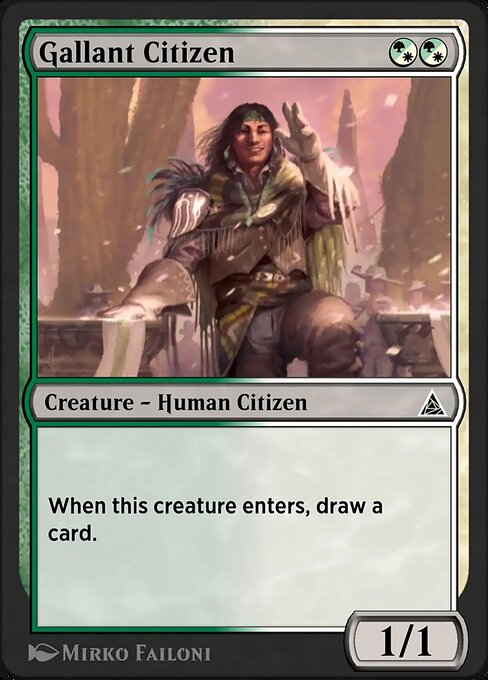
I know. It’s literally Elvish Visionary. But these kinds of cards are fantastic additions to the format in my opinion. A double pipped G/W creature that replaces itself is incredible redundancy for the decks that want it.
Historic already has the bones of old-school style Mono-Green Devotion: Burning-Tree Emissary, Voyaging Satyr, Nykthos, Shrine to Nyx. Adding redundancy with more cheap creatures that supply two green pips while drawing a card helps smooth out the archetype. Between this, Emissary, and Pond Prophet, we have a ton of ways to fuel a huge Nykthos turn.
And it’s not just green. Mono-white decks could also take advantage of the double-white version, though payoffs there are thinner outside of Verilax, the Havenskin or Sun Titan. Still, redundancy matters when you’re piecing together devotion engines. Gallant Citizen isn’t going to steal headlines, but in the right shell it’s exactly the kind of glue piece that makes the big plays happen. Sometimes the smallest creatures are the ones that keep the deck humming.
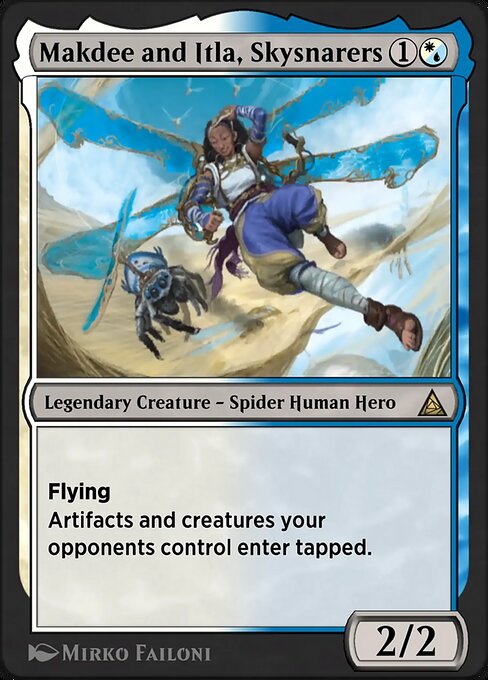
That’s a deceptively powerful line of text. Against aggro decks it buys you critical breathing room against fast starts. Against artifact decks, it slows down both mana rocks and creature-based engines, making it harder for them to curve smoothly.
The best comparison is Thalia, Heretic Cathar, but shifted into blue and with flying. You’re not taxing spells, but you are taxing tempo, and that’s just as punishing in the right matchup. Slowing down haste creatures, stalling Affinity’s board, and turning off surprise blockers makes this one of the cleaner creatures UW tempe has received in awhile.
I’m excited mainly for the flying-tribal aspect of this card. We have Judge;s familiar and Mausoleum Wanderer as early taxing creatures. Skycat Sovereign is an efficient beater, and the whole team can be pumped by Rally the Wings to close out games. We have a lot of random pieces for a flying-taxes deck that I think could be decently competitive in the right meta. This is one one first decks I look forward to brewing when the set drops.
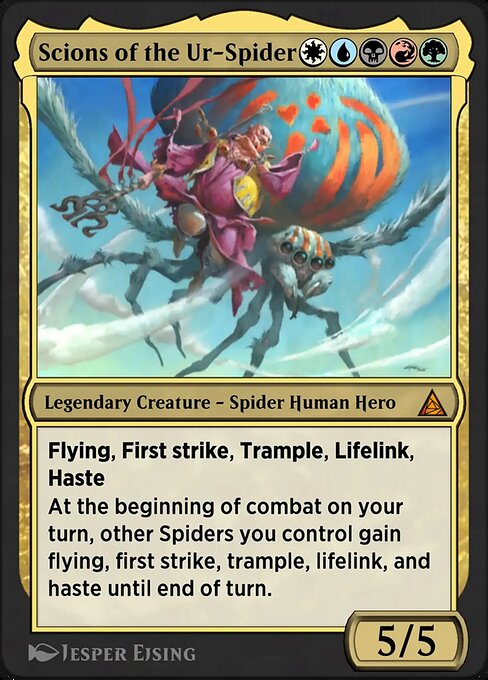
This is essentially Chromanticore #5–8. And if you’ve followed jank brewing in Historic, you know exactly where this goes: Soulflayer. Dump Scions into your graveyard, exile it to delve, and suddenly your six-mana flayer has every keyword under the sun. Hexproof and indestructible can come from other sources, but Scions alone gives you enough abilities to make Soulflayer lethal all by itself.
It also feeds Priest of Possibility, another card that loves keyword density. Flip over Scions with Priest, and you’ve suddenly got a two-mana evasive beater with lifelink and trample before the game even gets going.
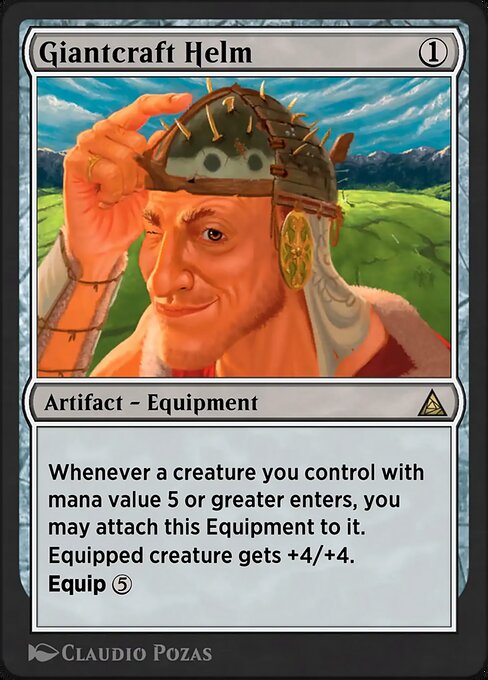
Giant Crafthelm is a one-mana equipment that gives +4/+4. That number alone demands attention — it’s basically a mini Colossus Hammer. The trade-off, of course, is the massive equip cost of five mana.
That sounds unplayable at first glance, but just like Hammer, the plan is never to pay full price. Historic already has ways to cheat equip costs — Sigarda’s Aid and Kemba's Outfitter are the most common. This card can be easily thown into that shell as a backup plan.
Again, I think it’s a card where a full 4 copies won’t see play, but a couple in your deck for Stoneforge Mystic to snag seems relevant.
Multiversal Passage This is the big one: a flexible shockland variant that also counts as the chosen land type. For brewers who love four- or five-color piles, this card smooths mana in a way Historic has been missing. Its a welcome addition for rainbow brews, domain strategies, or “good stuff” decks.
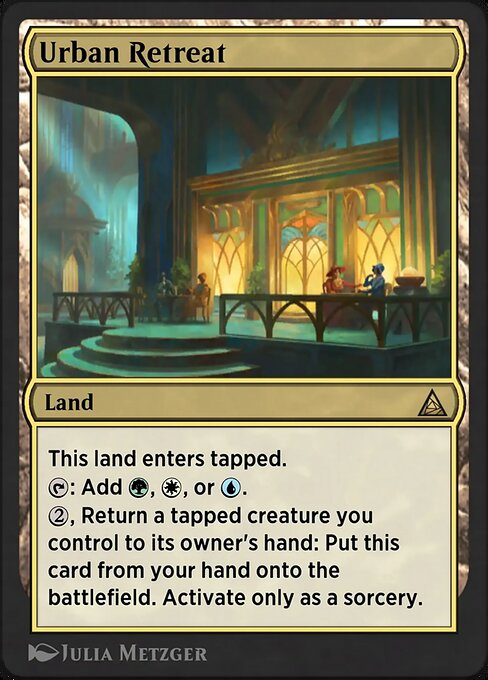
Urban Retreat At first glance, it’s just another tapped land. But the enweb synergy is what matters. You get ETB ramp by bouncing your own creatures, turning things like Thraben Inspector, Wall of Omens, or even Gallant Citizen into reusable card advantage. A single use boucne effect stapled to a land feels quite strong in any deck that wants it.
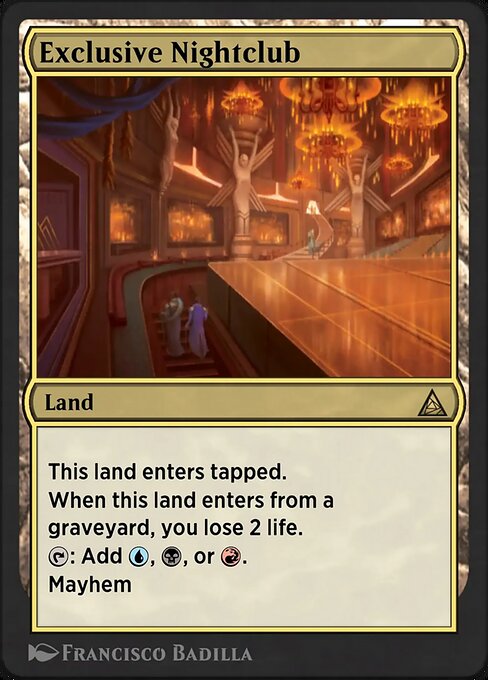
Exclusive Nightclub This one’s for the discard crowd. A Grixis-colored land that leans into pitching cards makes it tailor-made for Hollow One, Ox of Agonas, and cycling payoffs. It might not replace perfect mana, but for decks that actively want to discard, it’s a piece of tech that pulls double duty making sure you still hit your land drops while keeping the good stuff in hand.
Closing Thoughts
I’ll be honest: I’m not blown away by Through the Omenpaths as a whole. It doesn’t feel like a set that’s going to redefine Historic overnight. But honestly, that doesn’t matter. For me, every new set is about finding fresh toys to tinker with — and OM1 delivers plenty of those.
What excites me most here isn’t raw power, but redundancy. A lot of these cards slot into old shells, give fringe archetypes new legs, or open the door to weird new combos. That’s exactly the kind of design that keeps brewing interesting.
So no, OM1 might not be a “format warper.” But it’s still a fun set, and I’m looking forward to sleeving up these oddballs and seeing what kind of nonsense we can get away with once the cards hit Arena on September 23rd.
Thanks for reading.
As always feel free to comment and leave any questions you have below! Make sure to come back next week for even more Fun & Jank!
If you want to see these decks in action, come hang out with me on stream where we test, refine, and have a ton of fun together!
Happy Brewing!
Premium
Enjoy our content? Wish to support our work? Join our Premium community, get access to exclusive content, remove all advertisements, and more!
No ads: Browse the entire website ad-free, both display and video.
Exclusive Content: Instant access to all exclusive articles only for Premium members, at your fingertips.
Support: All your contributions get directly reinvested into the website to increase your viewing experience!
Discord: Join our Discord server, claim your Premium role and gain access to exclusive channels where you can learn in real time!
Special offer: For a limited time, use coupon code L95WR9JOWV to get 50% off the Annual plan!
Plum is the creator of the Jank Tank.
He started playing at the ripe old age of 12 and immediately fell in love with the infinite possibilities that deck building could lead to.
He truly understands that jank is a mindset, and spends most of his free time brewing and concocting new and exciting deck lists to help inspire and promote creativity within the MTG community.