Hello, my fellow Planeswalkers! I am The MTG Hero. Yet again, for better or worse, a new Standard Universes Beyond set means it’s time to figure out which cards are actually going to matter. [The Hobbit] is bringing Middle-earth back to Magic, but unlike The Lord of the Rings: Tales of Middle-earth, this time the cards are entering Standard.
That means we’re not just looking at these cards from a flavor perspective. We’re looking at them through the lens that matters most to competitive players. Where do these cards fit? Which existing decks get better? Can any of them create an entirely new archetype? And, most importantly, which cards are actually worth spending wildcards on?
After looking through the set, I don’t think The Hobbit is going to completely turn Standard upside down. However, there are several cards that I believe are going to see legitimate play, with a few that could become staples if the right decks develop around them. But there is one card in particular that immediately stood out to me.
Let’s get my favorite card from The Hobbit out of the way first. Head of the Hunt is easily the card I am most excited to play from this set, and the biggest reason is that it reminds me a lot of Kalitas, Traitor of Ghet. For those who may not remember, Kalitas, Traitor of Ghet was good enough to see legitimate play in Modern at one point. That’s a pretty high bar.
Obviously, I’m not saying Head of the Hunt is going to become a Modern staple or that the two cards are identical. They aren’t. What I am saying is that the similarities in what these cards can do make me very interested in Head of the Hunt for Standard. Turning creatures dying into additional material is an incredibly powerful effect, especially in a format where aggressive decks are attacking, midrange decks are trading creatures, and control decks are constantly using removal.
Normally, if your opponent kills one of your creatures, you’re simply down a creature. With Head of the Hunt on the battlefield, that exchange can become much more favorable. Every creature dying can potentially help you rebuild your board, meaning your opponent can’t simply trade resources with you and expect to come out ahead. The longer Head of the Hunt remains on the battlefield, the more dangerous that advantage becomes.
I could see this finding a home in black-based midrange decks, sacrifice strategies, and potentially even aggressive decks that want to make their creatures more difficult to trade with. The best part is that it doesn’t require some complicated combo to work. You simply need creatures to die, and that’s going to happen naturally in Standard. Your opponent also has to make a difficult decision: ignore it and allow you to build an army, or spend premium removal on it instead of your other threats.
For me, Head of the Hunt is the first card from [The Hobbit] that I would be testing in Standard, and it’s not particularly close.
Bilbo, Thief in the Night caught my attention because it looks like exactly the kind of card that can slot into an existing competitive strategy rather than requiring you to build an entirely new deck around it. That’s extremely important when evaluating a new Standard set. The flashy build-around cards get all the attention during spoiler season, but the cards that actually make the biggest impact are often the ones that can simply be added to decks that are already good.
Bilbo has the potential to do exactly that. The card provides value while interacting with the spell-heavy strategies that have been defining Standard, making it particularly interesting for Izzet and Jeskai decks that are already looking to chain together spells and generate incremental advantages. I also like that Bilbo doesn’t feel like a card you need to protect at all costs just to get value. If your opponent spends a removal spell on it, that’s still a resource they aren’t using on one of your larger threats. If they don’t answer it, however, Bilbo can continue generating value.
That makes Bilbo, Thief in the Night the type of flexible threat I expect players to test in established blue-red and Jeskai shells.
The Arkenstone has much more potential in Standard than it initially appears to have, primarily because the Adventure side is already useful. Seek the Heart gives you access to a legendary creature, which is a powerful form of selection in a format with several strong legendary threats.
That means you don’t necessarily have to think of The Arkenstone as an artifact first. You can think of it as a flexible tutor that eventually becomes another source of value. In a deck that already wants legendary creatures, the Adventure half gives you consistency while the permanent provides additional value later in the game.
That’s exactly what I want from a Standard card. I don’t need every card to be spectacular on its own; I need cards to give my deck more options. The Arkenstone does that, and Selesnya decks in particular look like a natural home, especially creature-heavy strategies that already rely on powerful legendary threats.
Now let’s talk about a card that is much less subtle. Smaug the Magnificent is a four-mana Dragon with haste that creates Treasure and can turn those Treasures into additional damage. That is a lot of text for four mana, and the most important part for Standard is the haste.
A four-mana creature that immediately attacks for meaningful damage is already worth examining. When that creature also provides additional resources, things get even more interesting. Smaug naturally fits into aggressive red strategies that can take advantage of Treasure generation, although the biggest question is whether four mana is too much for the current red decks.
Standard has become increasingly efficient, so spending your fourth turn casting a creature needs to provide a substantial payoff. Fortunately, Smaug does. If your opponent can’t answer it immediately, you’re getting damage, Treasure, and potentially another round of pressure. I don’t think Smaug automatically becomes a four-of in every red deck, but I absolutely expect players to test it. If a dedicated Dragon strategy becomes viable, Smaug could become one of its primary finishers.
One of the things I like about The Queen of Dale is that it attacks a very real part of the current Standard metagame: noncreature spells. Standard has plenty of powerful spells that generate card advantage, removal, interaction, and selection, which makes a card that rewards you whenever your opponent casts their first noncreature spell each turn particularly interesting.
The Queen can generate additional material while your opponent simply plays Magic, creating a problem for control and midrange decks. If they spend their turn casting a card-advantage spell, they’re potentially giving you something in return. If they avoid casting those spells, they’re giving up some of the resources that make their deck powerful.
The biggest concern is how easy it is to remove. A creature that generates value over multiple turns needs to survive long enough to matter. Still, I think The Queen of Dale has legitimate potential as either a sideboard or maindeck option in white-based strategies, especially if Standard remains heavily populated by spell-heavy decks.
Radagast of Rhosgobel is another card that immediately caught my attention, particularly for creature-based strategies and also because he was my favorite character from the movies.
Creature decks generally want to play their threats on their own turn, which makes their game plan fairly predictable. Your opponent knows when you’re committing to the battlefield and when you’re tapping out.
Radagast changes that by giving your creatures flash and allowing you to play a much more reactive game. Instead of committing your entire board during your main phase, you can pass with mana available and force your opponent to respect the possibility that you’re going to deploy a creature at the end of their turn. The cost reduction also matters because it can allow creature decks to double-spell more efficiently.
I could see Radagast of Rhosgobel becoming a major addition to creature-based green strategies simply because it gives those decks a completely different way to approach their turns.
One of the biggest questions I always ask when looking at a new Standard card is What existing card is this competing with? For Riddles in the Dark, the competition is fierce, but the selling point is flexibility.
Being able to leave mana open for interaction and then use Riddles in the Dark if your opponent doesn’t give you a better target is exactly the kind of flexibility control decks want. You don’t have to decide at the beginning of your turn that you’re spending three mana to draw cards. You can wait. If your opponent plays something you need to answer, you interact. If they don’t, you use your mana to generate card advantage.
I don’t think this automatically replaces the existing card-draw options, but I expect control players to test it.
These are two cards I think are worth keeping an eye on, although I’m less convinced that either is going to become an immediate Standard staple.
Uncover the Moon-Letters has a huge upside if you can resolve it and survive long enough to take advantage of the card advantage it provides. The problem is the opportunity cost. Standard is not a format where you can always afford to spend a turn developing an enchantment that doesn’t immediately affect the battlefield, especially against aggressive decks. Against slower midrange and control strategies, however, it becomes much more appealing.
Bilbo's Gambit is interesting for a different reason. Its ability to stop an opposing spell and limit what your opponent can do during that turn can create some incredibly important windows. For an aggressive deck, that could mean forcing through the final points of damage. For a control deck, it could mean protecting a key threat or setting up a winning turn. The Treasure gift is obviously the catch, but sometimes giving your opponent resources is a price worth paying if it allows you to dictate the most important turn of the game.
My Precious is one of the more interesting Equipment cards coming with the set. Equipment has struggled to remain consistently competitive in Standard, but My Precious gives players another reason to experiment. It provides additional utility beyond simply being an Equipment, making it easier to justify including even if you’re not completely committed to an Equipment strategy. I could see it being tested in aggressive black decks looking for additional resilience and ways to turn smaller creatures into legitimate threats.
Glóin the Mighty is another card worth testing in red-based strategies. Red decks don’t normally want to spend a lot of mana ramping because they want to attack, but Glóin gives red another way to bridge the gap between the early and midgame. The Adventure half gives the card something to do early, while the creature can provide additional mana later. That flexibility makes it much more attractive than a traditional ramp spell.
Then there’s Thorin, Mountain-king, which is where I get a little more speculative. Thorin needs the right shell, but the Equipment interaction is powerful enough that I think brewers will immediately start looking for the pieces to make him work. If Standard has enough playable Equipment to support him, Thorin could potentially become the centerpiece of a new archetype. I wouldn’t craft four copies before testing the deck, but he’s definitely a card I’ll be watching.
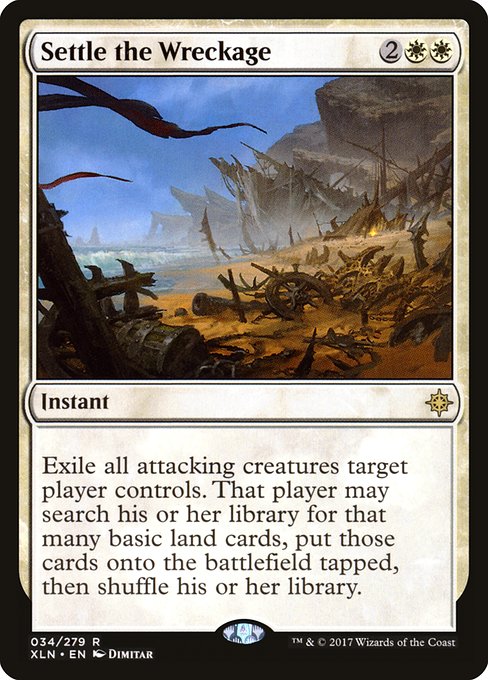
Yes, Settle the Wreckage is back, and Standard players are going to notice. White decks have always wanted efficient ways to punish opponents for overextending, and completely exiling an opponent’s attacking creatures can swing a game immediately.
The obvious downside is that your opponent gets lands, but against an aggressive deck that trade can still be extremely favorable. If your opponent has committed their entire hand to the battlefield and you remove their board, giving them a few lands isn’t necessarily going to save them. If Standard becomes more aggressive after [The Hobbit], Settle the Wreckage gets even better.
Tribal strategies also have some interesting tools to work with. The Great Goblin could give Goblin decks additional reach and help them avoid running out of gas after flooding the battlefield with creatures. I don’t know if it immediately pushes Goblins into tier-one territory, but I wouldn’t be surprised if players start testing Rakdos Goblins.
Thranduil's Company could similarly give Elf strategies another tool while potentially fitting into creature-based landfall decks. That’s what makes the card interesting to me: it doesn’t necessarily need to be restricted to one archetype. If it can provide meaningful mana development while supporting multiple strategies, it has several avenues to find a home in Standard.
Where Does This Leave Standard?
After looking through [The Hobbit], my biggest takeaway is that I don’t think we’re getting another set that completely invalidates everything that came before it. Instead, we’re getting a collection of cards that can strengthen several existing strategies while potentially opening the door for a few new ones.
That’s actually a good thing. Standard doesn’t need every new set to completely reset the format. What it needs is new cards that give players reasons to experiment, and The Hobbit does that.
Izzet and Jeskai players are getting new tools, white-based strategies are getting additional interaction, green creature decks have new options, and red decks are getting additional threats and ways to generate resources. Equipment decks and tribal strategies like Elves, Goblins, and Dwarves also have enough support to get brewers interested.
The big question is which of these cards actually survives contact with the existing Standard metagame. That’s where theory ends and Magic begins. A card can look incredible during spoiler season and then completely disappear once people start casting the efficient removal and threats that already define the format. On the other hand, the card nobody expected can suddenly become a four-of.
The Hobbit has a lot to offer Standard players, but I’m not looking at this set as a reason to throw out everything we’re currently playing. I’m looking at it as a toolbox. There are cards here that can improve existing archetypes, cards that could revive strategies that have fallen behind, and cards that could potentially create something completely new. That’s exactly what I want from a Standard set.
For me, though, Head of the Hunt is the card I’m most excited about. The comparison to Kalitas, Traitor of Ghet isn’t meant to say the cards are identical. It’s meant to highlight the type of effect we’re getting. Kalitas was powerful enough to see play in Modern because turning opposing creatures dying into Zombies while shutting down opposing graveyard recursion was an incredibly powerful way to generate value.
Head of the Hunt has that same kind of feeling to me. It’s a creature that can turn the natural exchanges of a game of Magic into additional resources for you, and that’s exactly the type of card I want to test in Standard.
Beyond that, Bilbo, Thief in the Night looks like it can slot directly into spell-heavy strategies, The Arkenstone provides consistency for legendary creature decks, Smaug the Magnificent gives aggressive red decks another powerful threat, Radagast of Rhosgobel could give creature decks an entirely different way to play their turns, and The Queen of Dale could become a serious problem for decks that rely heavily on noncreature spells.
I don’t expect The Hobbit to completely break Standard, but I do expect it to change the format and in all honesty, sometimes that’s all a set needs to do.
So get those wildcards ready, start brewing, and don’t be surprised if one of these Middle-earth legends ends up becoming the next Standard staple.
Until next time Planeswalkers, Hero out!
Premium
Enjoy our content? Wish to support our work? Join our Premium community, get access to exclusive content, remove all advertisements, and more!
No ads: Browse the entire website ad-free, both display and video.
Exclusive Content: Instant access to all exclusive articles only for Premium members, at your fingertips.
Support: All your contributions get directly reinvested into the website to increase your viewing experience!
Discord: Join our Discord server, claim your Premium role and gain access to exclusive channels where you can learn in real time!
Special offer: For a limited time, use coupon code L95WR9JOWV to get 50% off the Annual plan!
My name is The MTG Hero. I have played Magic for over 15 years. I am a consistent high Mythic ranked player. Follow me on Twitch and subscribe on YouTube!