In this episode, we’re fusing Death’s Shadow with the Warp package, creating a relentless, recursive engine that turns low life totals into high-octane victories.
Hey everyone, welcome back to Fun & Jank Episode 61! I’m your host, Plum, and we are diving deep into the shadows today.
I had such a blast with last week’s Lightning Shadow brew that I just couldn’t put the archetype down. I spent a good chunk of my off-stream time tinkering with different ways to break Death’s Shadow in Historic, and while experimenting with some old shells, I stumbled onto a wild realization.
We’ve been trying so hard to make Bog Brew Witch work on stream, right? We had a Phoenix airship list, and some Golgari mill versions, but I kept looking at Abiding Grace as a way to rebuy our 1-drops. While that was “cute,” it lacked the punch I wanted. Then it hit me: why am I trying to drain people for 4 with a freakin Festering Newt, when I could be hitting them for 12?
I pivoted 180 degrees and realized that the Warp package I was testing along side Witch, specifically those pesky Cantors of the Refrain, doesn’t just provide recursion; it provides the perfect engine to fuel a Death’s Shadow deck that simply refuses to stay dead. This was also a package I hadn’t gotten around to brewing with yet so I was excited to play with it.
The “Cantor package” found in this deck consists of four primary cards that create a relentless, recursive engine. By leveraging the Warp mechanic—which allows you to cast cards for an alternate, often cheaper cost in exchange for exiling them at the end of the turn—you can repeatedly trigger graveyard recursion and buff your creatures.
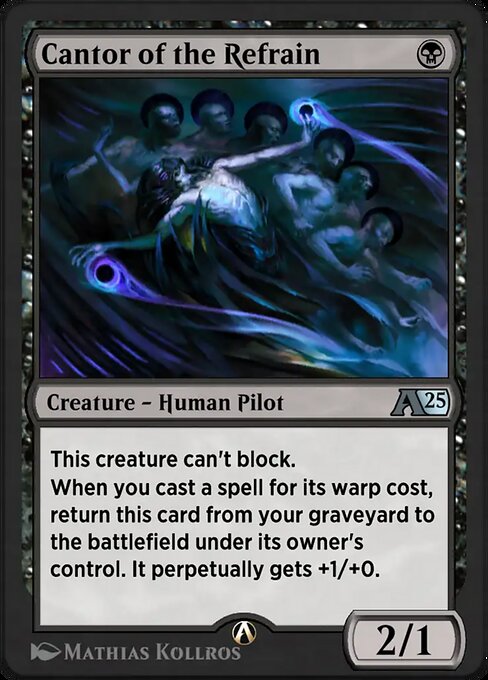
1. Cantor of the Refrain
Role: The core recursive threat.
Mechanism: It is a 2/1 that can’t block, but whenever you cast a spell for its Warp cost, Cantor returns from your graveyard to the battlefield.
The Scaling: Every time it returns, it perpetually gains +1/+0, meaning it gets deadlier as the game goes on.
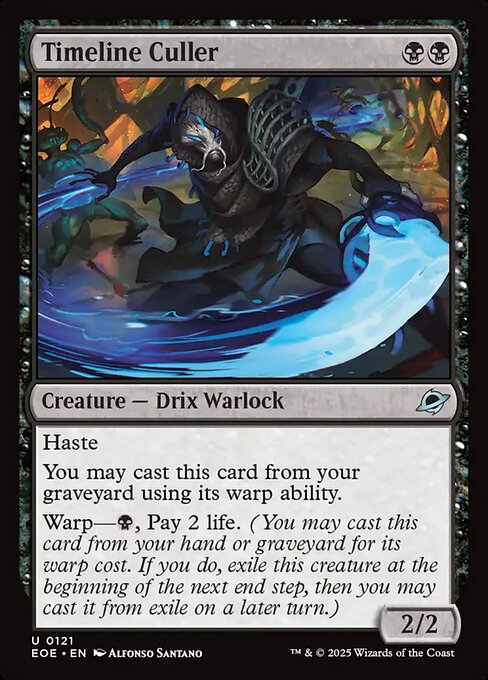
2. Timeline Caller
Role: A low-cost Warp trigger that enables aggression.
Mechanism: It is a 2/2 with Haste.
Death Shadow Synergy: Its Warp cost involves paying 2 life, which serves as a vital tool for intentionally lowering your life total to grow your Death’s Shadows.
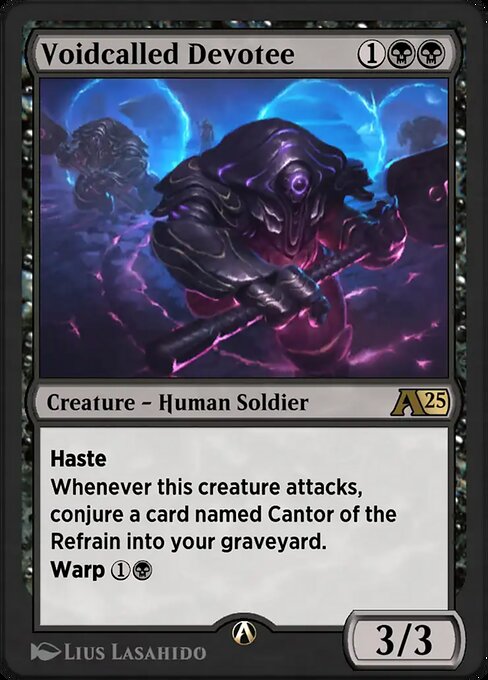
3. Voidcalled Devotee
Role: The deck’s primary recursive engine and arguably its most powerful card.
Mechanism: A 3/3 with Haste that Conjures copies of Cantor of the Refrain directly into your graveyard when it attacks.
Interaction: Warping it into play provides immediate pressure while simultaneously setting up multiple Cantor triggers from the graveyard.
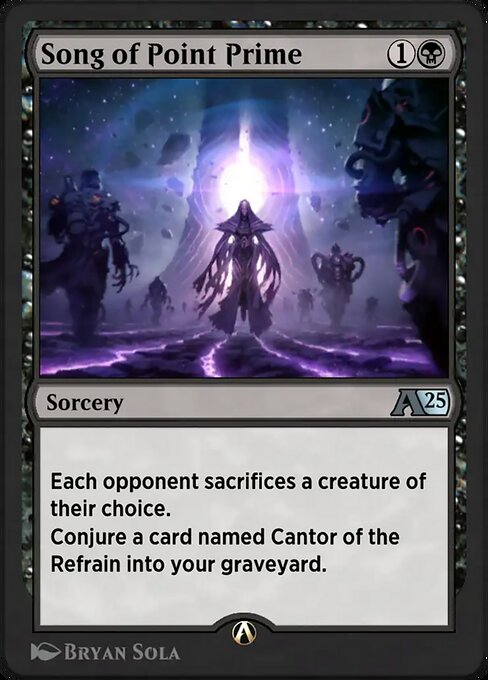
4. Song of Point Prime
Role: Removal that advances your synergistic game plan.
Mechanism: It functions as a removal spell while also Conjuring a Cantor of the Refrain into your graveyard.
Consistency: This ensures you always have Cantors ready to be reanimated, even if you haven’t drawn any or if your opponent has cleared your initial board.
Once I had Shadow and the “Cantor” package together, the deck needed some connective tissue, the stuff that keeps us alive while we’re also busy punching ourselves in the face. Let’s look at the list we ended stream with.
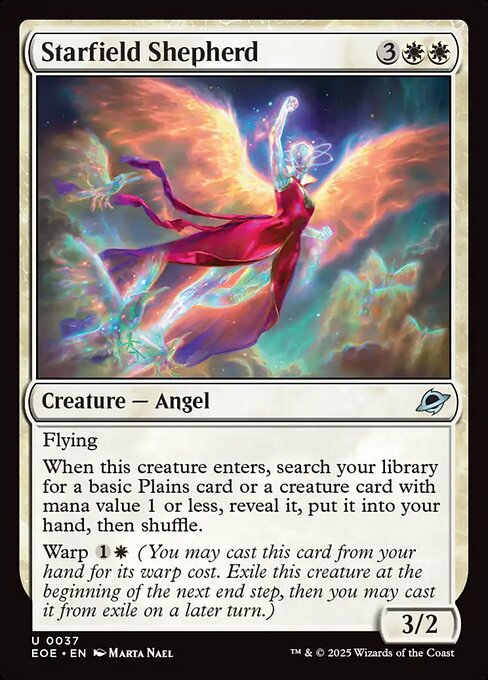
The first auto-include was Starfield Shepherd. If you’ve played Historic for more than five minutes, you know how good Ranger-Captain of Eos is. Shepherd is our version of that, but with a “Warp” flavored twist. Not only does it fetch our 1-drops, but its ability to trigger the Warp mechanic means it’s the ultimate enabler for bringing back our Cantors while grabbing exactly what we need for the situation.
Speaking of grabbing what we need, the Shepherd meant we could run a tiny, high-impact Toolbox Package:
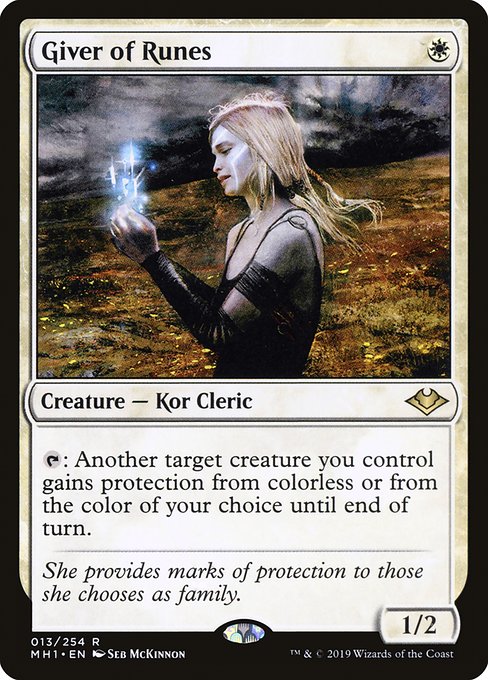
Giver of Runes: Our MVP for protection. Keeping a 10/10 Death’s Shadow on the board is a lot easier when Mom is there to give it protection from the opponent’s best removal.
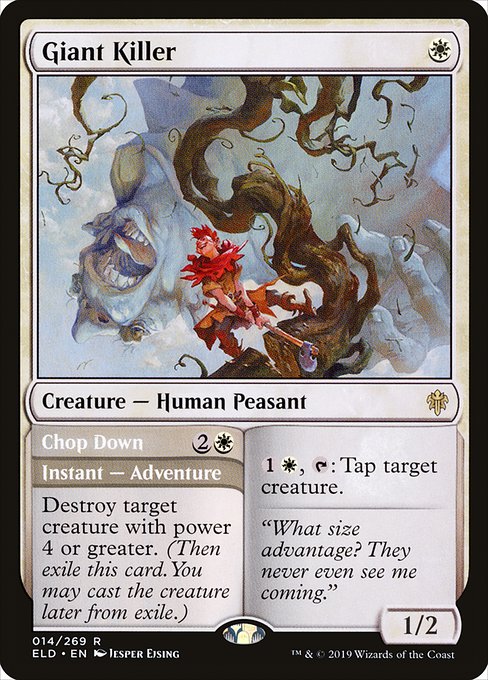
Giant Killer: Sometimes you just need to chop down a massive Eldrazi or a Primeval Titan. Having this tutorable on a stick (well, a creature) is vital.
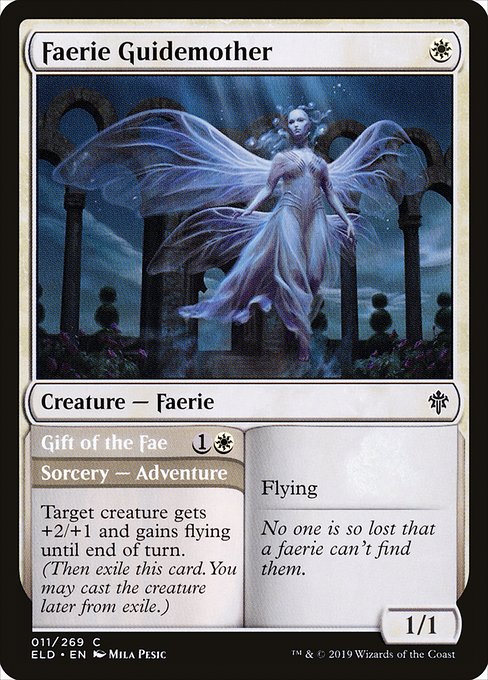
Faerie Guidemother: This is our “secret reach.” There’s nothing quite like the feeling of an opponent feeling safe behind a wall of ground blockers, only for us to tutor up the Guidemother and give our Shadow flying for the win.
Building the Skeleton: Support and Flexibility
Once I had the “Shadow” and the “Warp” package together, the deck needed some connective tissue—the stuff that keeps us alive while we’re busy punching ourselves in the face.
The first auto-include was Starfield Shepherd. If you’ve played Historic for more than five minutes, you know how good Ranger-Captain of Eos is. Shepherd is our version of that, but with a “Warp” flavored twist. Not only does it fetch our 1-drops, but its ability to trigger the Warp mechanic means it’s the ultimate enabler for bringing back our Cantors while grabbing exactly what we need for the situation.
Speaking of grabbing what we need, the Shepherd meant we could run a tiny, high-impact Toolbox Package:
Giver of Runes: Our MVP for protection. Keeping a 10/10 Death’s Shadow on the board is a lot easier when Mom is there to give it protection from the opponent’s best removal.
Giant Killer: Sometimes you just need to chop down a massive Eldrazi or a Primeval Titan. Having this tutorable on a stick (well, a creature) is vital.
Faerie Guidemother: This is our “secret reach.” There’s nothing quite like the feeling of an opponent feeling safe behind a wall of ground blockers, only for us to tutor up the Guidemother and give our Shadow flying for the win.
Orzhov Charm
I also couldn’t stay away from Orzhov Charm. After using it in last week’s Lightning Shadow brew, I realized it’s arguably even better here. It’s the ultimate utility spell for this list:
It kills almost anything, and the life loss, usually a downside, actually helps us grow our Shadows.
It can bounce our own creatures to save them from a board wipe or removal.
This is the big one. Bringing back a Giver of Runes or a Death’s Shadow at the end of our opponent’s turn is a massive tempo swing that they usually don’t see coming.
Building the Skeleton: Support and Flexibility
Once I had the “Shadow” and the “Warp” package together, the deck needed some connective tissue—the stuff that keeps us alive while we’re busy punching ourselves in the face.
The first auto-include was Starfield Shepherd. If you’ve played Historic for more than five minutes, you know how good Ranger-Captain of Eos is. Shepherd is our version of that, but with a “Warp” flavored twist. Not only does it fetch our 1-drops, but its ability to trigger the Warp mechanic means it’s the ultimate enabler for bringing back our Cantors while grabbing exactly what we need for the situation.
Speaking of grabbing what we need, the Shepherd meant we could run a tiny, high-impact Toolbox Package:
Giver of Runes: Our MVP for protection. Keeping a 10/10 Death’s Shadow on the board is a lot easier when Mom is there to give it protection from the opponent’s best removal.
Giant Killer: Sometimes you just need to chop down a massive Eldrazi or a Primeval Titan. Having this tutorable on a stick (well, a creature) is vital.
Faerie Guidemother: This is our “secret reach.” There’s nothing quite like the feeling of an opponent feeling safe behind a wall of ground blockers, only for us to tutor up the Guidemother and give our Shadow flying for the win.
The Orzhov Swiss Army Knife
I also couldn’t stay away from Orzhov Charm. After using it in last week’s Lightning Shadow brew, I realized it’s arguably even better here. It’s the ultimate utility spell for this list:
The Removal: It kills almost anything, and the life loss—usually a downside—actually helps us grow our Shadows.
The Rescue: It can bounce our own creatures to save them from a board wipe or a Leyline Binding.
The Reanimate: This is the big one. Bringing back a Giver of Runes or a Death’s Shadow at the end of our opponent’s turn is a massive tempo swing that they usually don’t see coming.
Between the recursive nature of the Warp creatures and the flexibility of the Charm, We’re a grindy, mid-range machine that can also become incredibly aggressive by dropping Shadows early.
We’ve leaned heavily into removal that trades blood for tempo.
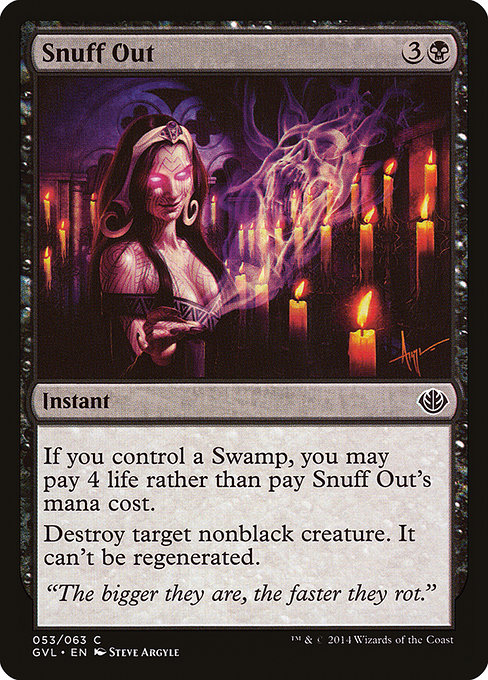
Snuff Out: This card is absolutely disgusting in this shell. Being able to tap out for a threat and still have “free” removal that simultaneously pumps our Shadow by +4/+4 is the kind of efficiency that wins games. It’s the reason we make sure to have a Swamp early.
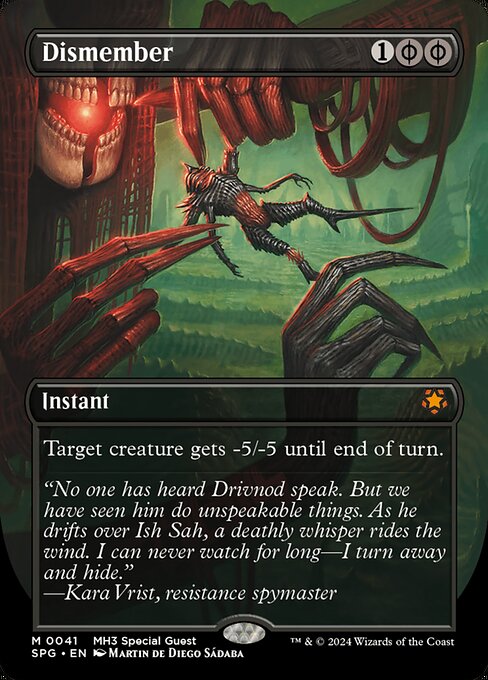
Dismember: The classic. It’s flexible removal that can be cast for one mana and 4 life. Against decks like Wizards or Mono-Green, being able to snipe a key creature while growing our board is our bread and butter.
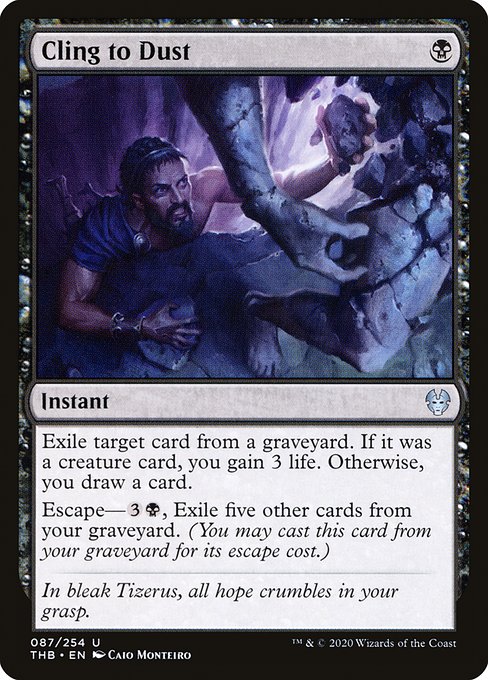
Cling to Dust: This is our utility player. Sure its a bit of maindeck graveyard hate, but more importantly, it’s a repeatable way to spend mana and draw cards. In a pinch, we can even use the secondary mode to gain life if we’ve accidentally walked too close to the edge.
Thoughtseize: Don’t think I need to mention why this is good.
Mana Base
You’ll notice the mana base looks a little different than your standard Orzhov deck. Although we don’t have access to a fetch/shock manabase, our lands still paly a big role in lowering our life total.
MDFC’s: These spell-lands are vital. They give us late-game recursion and protection, but playing them as untapped lands for 3 life drops our life total fast for Shadow.
Silent Clearing: The Horizon lands are perfect here. They fix our colors, they ping us every time we use them, and when we’re flooded, we can cash them in for a fresh card.
Gameplay
The gameplay with Warp Shadow is a constant puzzle. Unlike last week’s Lightning Shadow, which felt like a “protect the queen” deck, this version plays like a relentless wave. Although you can for sure turn creatures sideways and outrace, this deck is especially strong in the mid to late game where our recursive engines can take over.
The scariest part of the gameplay was the risk management. There were several moments where I had to decide: “Do I Warp this Timeline Caller and go to 4 life, or do I play it safe?” Against Auras, we had to go to 2 life to make our Shadow big enough to block their lifelinker. There’s a temptation to keep Warping just to see the Cantors get bigger, but you have to keep an eye on that life total. It’s a deck that rewards knowing exactly what’s in your opponent’s deck.
Closing Thoughts
Looking back at the 4-1 run, I was very surprised that Shadow was able to do solid work against the format yet again. This deck feels like the ultimate expression of “high risk, high reward.” We hit basically every major archetype in the format: we out-raced Wizards, out-grinded the Eldrazi titans, and even managed to beat Auras at their own “one big threat” game.
What really surprised me was how the Warp package fixed the classic Death’s Shadow problem. Usually, if your Shadow gets pushed or exiled, you’re left twiddling your thumbs. With this list, the Cantors just keep coming. They provide this inevitable, scaling pressure that forces your opponent to waste their best removal on 1-mana recursive creatures, leaving the door wide open for the Shadows to finish the job.
I’ve already started working on another version with a blue splash for Riddler and Consign to Memory in the sideboard, but we’ll save that for another time. The main deck feels hot. It’s mean, it’s synergistic, and it catches people completely off guard. If you’re tired of playing the same old Boros Midrange or Eldrazi lists and you want to feel a little bit of that adrenaline that only comes from winning a game at 1 life, give Warp Shadow a spin.
Thanks for reading!
As always, feel free to comment and leave any questions you have below. And make sure to come back next week for even more Fun & Jank!
If you want to see these decks in action, come hang out with me on stream where we test, refine, and have a ton of fun together.
Happy Brewin’!
Premium
Enjoy our content? Wish to support our work? Join our Premium community, get access to exclusive content, remove all advertisements, and more!
No ads: Browse the entire website ad-free, both display and video.
Exclusive Content: Instant access to all exclusive articles only for Premium members, at your fingertips.
Support: All your contributions get directly reinvested into the website to increase your viewing experience!
Discord: Join our Discord server, claim your Premium role and gain access to exclusive channels where you can learn in real time!
Special offer: For a limited time, use coupon code L95WR9JOWV to get 50% off the Annual plan!
Plum is the creator of the Jank Tank.
He started playing at the ripe old age of 12 and immediately fell in love with the infinite possibilities that deck building could lead to.
He truly understands that jank is a mindset, and spends most of his free time brewing and concocting new and exciting deck lists to help inspire and promote creativity within the MTG community.