I’m your host Plum, and this week we’ll be talking about a classic eternal staple getting some new light in the Historic Format. We also happen to have gotten a couple fun additions to the card pool thanks to the recent update to the Arena Cube giving us fun new toys like Hymn to Tourach and Urza’s Bauble.
Who knows how long cards of that power level will stay around untouched, but I am beyond hyped to play with them while we can, and I already started playing Urza’s Bauble in one of today’s brews.
But before we jump into the decklists and start breaking them down, we need to talk about a particular land package and why I believe its remarkably strong in Historic right now.
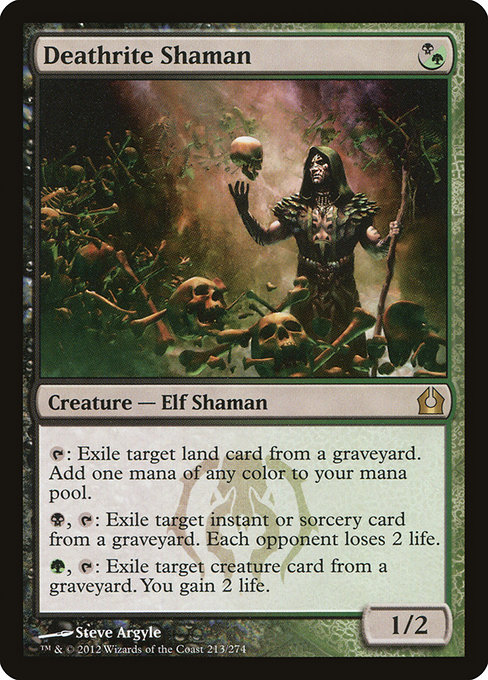
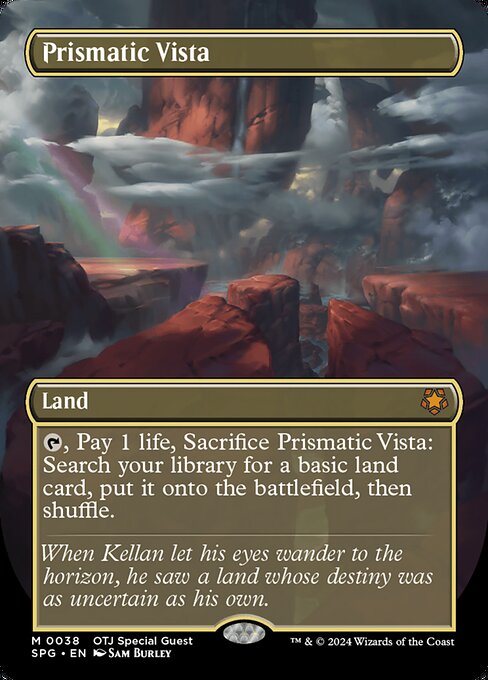
With the release of The Hobbit, we now have this new “engine” of Elven Passage, Prismatic Vista, and Deathrite Shaman. Because Historic lacks traditional fetch lands, Deathrite Shaman has historically lacked the reliable turn-one mana dork mode that makes it a multi-format powerhouse in addition to its other abilities.
By maxing out on Prismatic Vista alongside Elven Passage, we get an incredible total of eight basic-land fetches to consistently feed Deathrite Shaman on turn two.
There is a catch, though. Elven Passage needs us to behold an Elf in order for the land we fetch to enter untapped. Deathrite Shaman conveniently happens to be an Elf, but four copies aren’t enough to make Passage reliable on their own.
Luckily, Historic gives us some interesting ways to increase that Elf count without actually turning these decks into Elf decks.
If we can solve that problem, we suddenly have access to eight reliable fetches that can put lands into the graveyard on demand, fix our colors, enable Revolt, and, most importantly, consistently feed Deathrite Shaman as early as turn two.
So let’s move into a couple of different brews taking advantage of fetch lands in Historic and look at the kinds of synergies and consistency they can add to shells that normally don’t have access to them.
Firstly, I’m not the only person testing this land package. ZapYourTumor from the MTGA: Eternal discord has been cranking out brew after brew featuring these cards and seeing what works and what doesn’t.
You can see some examples above, and as you can tell, he’s been quite busy.
This leads me to our first brew, what I’m calling 4c Elven Midrange. Taking inspiration from ZapYourTumor, I designed this list around maximizing card quality while abusing the 8-fetch manabase.
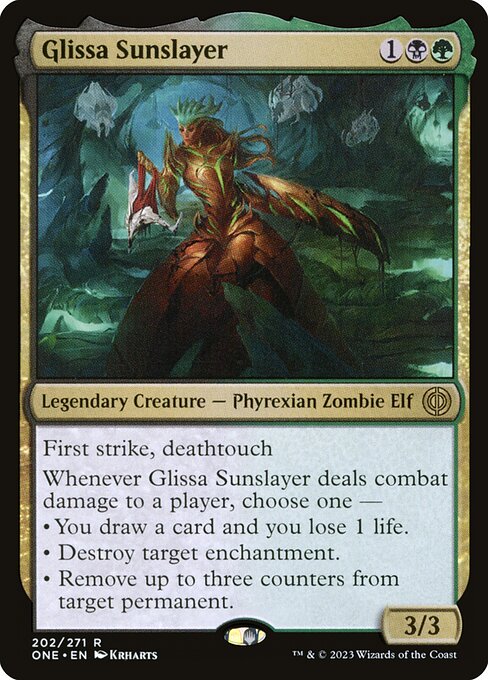
Initially I was playing the package in a basic jund shell playing some out-of-the-box elves to support it like Emeritus of Abundance or Glissa Sunslayer. Bloodbraid Elf has always been a reliable and powerful card in midrange piles, and it continued to impress here. But these other creatures were subpar inclusions that I tried only because I needed the additional elf density at the time.
Then ZapYourTumor posted a Sultai list that took the idea in a much more interesting direction.
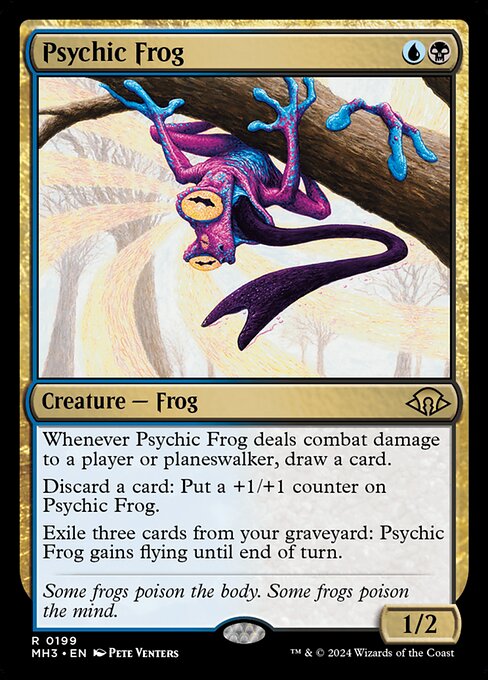
His build featured both Psychic Frog and Hydroponics Architect, and Architect immediately made a ton of sense. The card has already proven itself to be an incredible source of card advantage in Timeless, where traditional fetch lands give you consistent access to the Islands it creates. Now, with eight fetches available in Historic between Prismatic Vista and Elven Passage, we can start taking advantage of that same engine here.
Being in Sultai also means we get to play arguably the best midrange creature available in the format: Psychic Frog.
That’s where I think this package starts to show its real potential. We’re getting access to Timeless-quality one-drops like Deathrite Shaman and Hydroponics Architect, except we’re playing them against the considerably lower power level of Historic. Compared to more traditional midrange shells like UB Frog or Jund Goyfs, getting this much value out of our one-mana plays can give us a huge edge as the game develops.
But the part of ZapYourTumor’s list that really caught my attention wasn’t the creatures. It was the decision to stop relying on creatures for our Elf count altogether.
Elvish Elegy and Nameless Inversion are both Kindred Elf (or changeling) spells, meaning we can behold either one to Elven Passage and have our fetched basic enter untapped. That gives us additional Elf density without forcing more mediocre Elf creatures into the deck.
Elegy is particularly nice here, helping us dig for additional lands while also finding creatures and other Kindred cards. Nameless Inversion is admittedly not the most efficient removal spell we could be playing in Historic, but it makes up for some of that lost efficiency through utility. It can function as removal, occasionally act as a pump spell, and, most importantly for this shell, counts as another Elf for Passage. That’s a trade I’m much happier making than playing creatures like Emeritus simply to hit an arbitrary Elf count.
ZapYourTumor was also playing Leovold, Emissary of Trest, which immediately stood out as another upgrade. If we’re looking for an actual three-mana Elf, Leovold offers considerably more upside than something like Glissa or Emeritus while fitting naturally into the kind of disruptive midrange game we’re already trying to play.
At this point, I had most of the pieces I wanted, but the question was how greedy we could get with them.
I tested out his Sultai build, and although Hydroponics Architect and Psychic Frog were incredible, I found that the deck sometimes struggled to actually close out games. It could generate a mountain of cards, but between the slower clock and the amount of incidental life loss we were taking along the way, there were plenty of games where all that value didn’t necessarily translate into a win.
At the same time, there were parts of my original Jund build that I really missed, mainly Barrowgoyf, Kolaghan’s Command, and Bloodbraid Elf. Those cards gave the deck some of the closing power and raw midrange pressure that I felt the Sultai version was lacking.
So I thought to myself: why can’t we just jam the two decks together?
Sultai gave us the incredible card advantage of Hydroponics Architect and Psychic Frog, along with the blue cards needed to really grind into the late game. Jund gave us Barrowgoyf as a massive stabilizing threat, Kolaghan’s Command for additional interaction and recursion, and Bloodbraid Elf to apply pressure while generating even more value. If we throw in some of the other stapes like Push, Abrupt Decay, and even Treasure Cruise, we can can really get something cooking.
Put the strongest pieces of both together, and we end up with an amalgamation of two different midrange decks, and she’s a reaaaaalll beauty.
Gameplay
Now, looking at this decklist on paper, I wouldn’t blame you for questioning whether this is an actual deck or just a collection of midrange cards I really wanted to play.
Thankfully, after taking it onto the ladder, the deck felt considerably more cohesive than it looks. If you’re not familiar with my stream, I take whatever we’re brewing and run it through a “league” similar to MTGO. I play five games of Ranked Historic Best-of-3 to give us a taste of how the deck performs.
This deck slapped. We took it to a clean 5-0 on stream, taking down Burn twice alongside Affinity, Mono-White Lifegain, and Jund.
The biggest improvement was simply our ability to close games.
Going up to four copies of Barrowgoyf gave us a much higher density of legitimate threats while also providing some desperately needed lifegain. We’re already filling our graveyard naturally between eight fetches, Elvish Elegy, Psychic Frog, and the usual interaction, so Barrowgoyf gets huge without us having to do much extra work. That combination of pressure and lifegain was particularly noticeable against Burn, where stabilizing with a Barrowgoyf could completely change the direction of a game.
Then there was Bloodbraid Elf, which might have been my favorite card in the entire deck.
Our cascades were admittedly pretty disgusting throughout the run, but even accounting for some fortunate hits, Bloodbraid felt incredible every time we cast it. We hit everything from Fatal Push to Barrowgoyf, and even got to live the Jund dream of cascading directly into Kolaghan’s Command.
It turns out free spells are still pretty good.
Kolaghan’s Command itself was another welcome addition from the Jund half of the deck. The flexibility is exactly what a pile like this wants, and being able to recur one of our threats while simultaneously interacting with our opponent gave us yet another way to grind through longer games.
The funniest part, though, was that adding an entire fourth color really didn’t feel that greedy.
Between Prismatic Vista, Elven Passage, Deathrite Shaman, and the fixing provided by our lands, getting access to red for Bloodbraid Elf and Kolaghan’s Command was rarely an issue. We’re certainly stretching the mana base, but during these games I never felt like the red splash was costing us more than the cards it unlocked were giving back.
And that’s before we even get to the original reason we’re playing this mana base.
Deathrite Shaman and Hydroponics Architect were absurd.
Having eight fetches fundamentally changes how reliable both cards feel in Historic. Deathrite actually gets to function as a mana dork with regularity instead of sitting around waiting for somebody to put a land into a graveyard, while Architect turns those same fetches into a repeatable source of card advantage.
There were multiple games where we got to lead on Architect, attack the following turn, and immediately fetch up the Island it created. Other games had Deathrite accelerating our curve, stabilizing our life total, or slowly burning the opponent out once we no longer needed the extra mana.
That’s a pretty absurd amount of utility to be getting out of our one-drop slot.
The Elf requirement still asks us to make a few concessions. Nameless Inversion isn’t exactly premium Historic removal, and there are certainly more individually powerful cards we could play over some number of Elvish Elegies. But its important to remember those cards aren’t here in isolation.
There are still some questions I didn’t get to answer during this run. We never faced UB Frog or another counterspell-heavy deck, so I’m particularly curious how the deck holds up against the other major midrange shells when they can fight us on the stack.
But against everything we did face, the deck had game.
We even got to put it directly against Jund, which felt like an appropriate test for this Frankenstein’s monster of a midrange deck. That match turned into exactly the kind of drawn-out value war you’d expect, and despite Jund having some incredibly powerful recursion engines of its own, we were able to keep pace and eventually grind through it.
Apparently, the secret to out-valuing Jund is simply playing Jund with an extra color.
Now, I could probably spend the rest of this article showing you how I tweaked numbers and tried different flavors of four-color midrange, but I think there’s a much more interesting question to answer.
What else can we do with eight fetches in Historic?
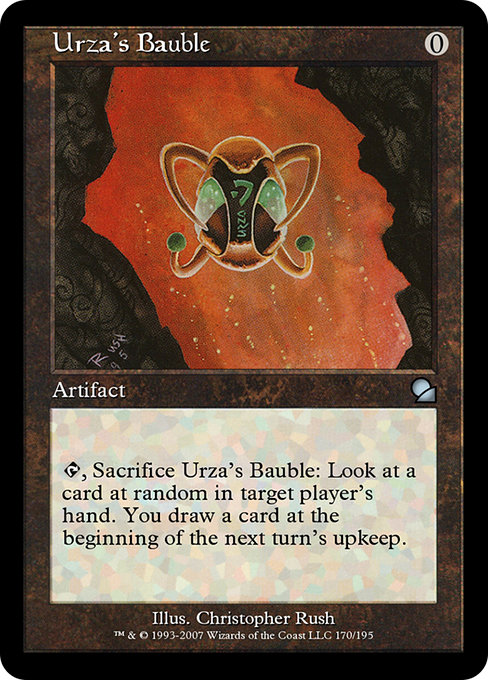
Thanks to the recent Arena Cube update, we also happen to have access to Urza’s Bauble for the time being. And while I’m certainly happy to throw a free cantrip into just about anything, Bauble gives us another resource that Historic has traditionally lacked: a zero-mana permanent that can sacrifice itself.
Combine four Baubles with four Prismatic Vistas and four Elven Passages, and suddenly we have twelve permanents that can sacrifice themselves essentially for free.
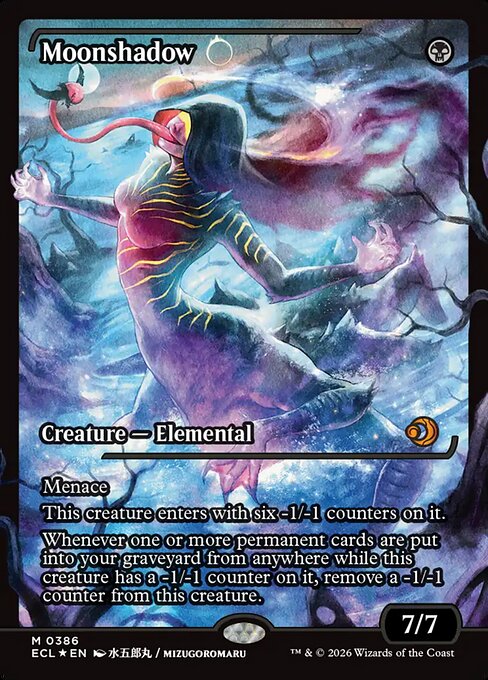
We’ve played around with Moonshadow in the past, but Historic has always lacked the density of cheap, disposable permanents needed to really make these kinds of cards consistent. There was fun engines we tried like Mesmeric Orb, but they weren’t great. Now, between our eight fetches and Urza’s Bauble, we have twelve cards that can put themselves into the graveyard without asking us to spend additional mana.
That doesn’t just benefit Moonshadow, either.
Stalactite Stalker grows whenever we Descend, Super Shredder can quickly accumulate counters as our permanents hit the graveyard, and Obsessive Pursuit gives us yet another payoff for sacrificing a bunch of permanents in the same turn.
Meanwhile, Deathrite Shaman fits naturally into everything we’re already doing. Our eight fetches keep lands stocked in the graveyard, allowing Shaman to ramp us when necessary while also giving this much more aggressive shell access to incidental lifegain, graveyard hate, and most importantly, those last few points of damage.
We still need to support Elven Passage, so Elvish Elegy and Nameless Inversion make another appearance. Neither is the most individually powerful card we could be playing, but they give us enough Elf density to make Passage work while contributing to the rest of the deck. Elegy triggers Descend and helps dig through the deck, while Inversion doubles as an Elf and a flexible piece of removal.
From there, I didn’t want to overcomplicate things.
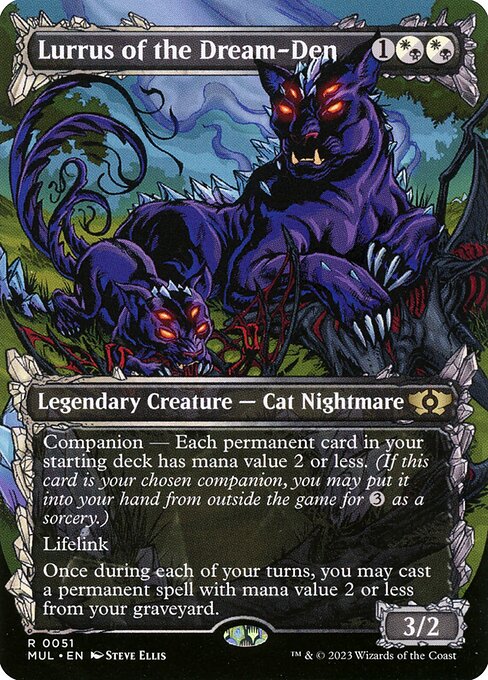
We’re essentially playing a low-to-the-ground Mono-Black aggro deck with Thoughtseize, Fatal Push, and Dauthi Voidwalker, staying cheap enough to keep Lurrus of the Dream-Den as our companion.
The real experiment is simply seeing what happens when we take the Deathrite Shaman fetch package out of a greedy midrange pile and put it into a deck that cares about the fetches themselves.
And, as it turns out, we can do some pretty disgusting things.
Gameplay
This deck wasn’t quite the clean 5-0 machine that our four-color pile turned out to be, but its best draws were considerably more explosive.
And despite the results, I came away from the games feeling pretty strongly that there’s something here. We had a few lackluster hands and some rough games, but the actual engine felt powerful whenever the pieces came together.
One game probably demonstrates the ceiling better than anything else.
With Super Shredder and Obsessive Pursuit on the battlefield, we were able to sacrifice Bauble, both Clues from Pursuit, and a fetch land in the same turn. Those sacrifices dumped four counters onto Shredder, Pursuit gave it lifelink, and suddenly our little two-drop was swinging for lethal while gaining ten life in the process.
That’s the kind of turn that simply wasn’t realistic before we had this density of free sacrifice effects and it wasn’t an isolated interaction.
Stalactite Stalker impressed me quite a bit throughout our games. Eight fetches already give us an extremely easy way to trigger Descend, and Bauble makes that even easier. There were multiple games where simply playing Magic, cracking our lands and Baubles as we normally would, turned Stalker into a legitimate threat without requiring us to build around it any further.
Obsessive Pursuit was another standout for similar reasons. Getting three sacrifices in a turn sounds like a meaningful hoop until your deck contains fetch lands, Bauble, and the Clue Pursuit makes itself. Suddenly, throwing three counters and lifelink onto one of our evasive threats becomes remarkably easy. Between Moonshadow, Stalker’s menace, and Dauthi Voidwalker, a surprising number of our threats were difficult to block profitably. Once the sacrifice engines started piling counters onto them, the deck could close games extremely quickly.
Deathrite Shaman also continued to impress outside of the midrange shell. Here, we don’t necessarily need it to ramp us into a turn-two three-drop every game. Sometimes it’s effectively a Mono-Black Grim Lavamancer, turning all those fetch lands we’re already sacrificing into extra damage while incidentally hating on graveyards or gaining life when necessary.
And I think that’s the important takeaway from this deck.
The eight-fetch package doesn’t have to lead us toward four-color value piles or Hydroponics Architect. In this shell, the fetches themselves are part of the payoff. Every Vista and Passage can feed Deathrite Shaman while simultaneously growing Moonshadow, triggering Descend for Stalactite Stalker, adding counters to Super Shredder, or helping turn on Obsessive Pursuit.
The list certainly isn’t finished. Some hands were absolutely disgusting while others struggled to get going, and I wasn’t particularly happy with the sideboard by the end of our games. Historic is fairly grindy and combo-heavy right now, and I think I’d rather dedicate more of those slots toward cheap disruption for those matchups instead of the assortment of removal I started with. But those are problems with this particular 75, not with the engine itself.
Even Nameless Inversion performed better than I expected, Stalactite Stalker consistently impressed me, and Obsessive Pursuit was remarkably easy to enable. We didn’t even get to loop Urza’s Bauble with Lurrus, and the deck was already capable of some absurd turns. So while this version needs more testing, I think we’re starting from a very promising place.
Closing Thoughts
Prismatic Vista has been sitting in Historic for a while now, but four fetches simply aren’t enough to build around in the same way that eternal formats can. Elven Passage effectively doubling that number gives us something Historic hasn’t really had before: enough fetch-land density for putting lands into the graveyard to become a reliable part of deck construction.
Obviously, these aren’t Polluted Deltas and Verdant Catacombs. We’re limited to basics, and Elven Passage asks us to jump through the additional hoop of beholding an Elf if we want that land untapped. But as both of these decks demonstrated, that hoop might be easier to clear than it initially looks.
Deathrite Shaman, Elvish Elegy, and Nameless Inversion gave both decks enough Elf density to make Passage surprisingly reliable without forcing us into a traditional Elf shell. Once we’ve paid that deckbuilding cost, we’re free to take the eight-fetch package in some fun directions.
I’m hoping I can continue finding fun shells to try out this package in as I think the opportunity cost to play it is rather low for such a high ceiling.
Thanks for reading!
As always, feel free to comment and leave any questions you have below. And make sure to come back next week for even more Fun & Jank!
If you’re interested in more fun content, come join me on stream and help brew our next deck!
Happy Brewin’!
Premium
Enjoy our content? Wish to support our work? Join our Premium community, get access to exclusive content, remove all advertisements, and more!
No ads: Browse the entire website ad-free, both display and video.
Exclusive Content: Instant access to all exclusive articles only for Premium members, at your fingertips.
Support: All your contributions get directly reinvested into the website to increase your viewing experience!
Discord: Join our Discord server, claim your Premium role and gain access to exclusive channels where you can learn in real time!
Special offer: For a limited time, use coupon code L95WR9JOWV to get 50% off the Annual plan!
Plum is the creator of the Jank Tank.
He started playing at the ripe old age of 12 and immediately fell in love with the infinite possibilities that deck building could lead to.
He truly understands that jank is a mindset, and spends most of his free time brewing and concocting new and exciting deck lists to help inspire and promote creativity within the MTG community.