Welcome back to Episode 90 of Fun & Jank! I’ve been quite the busy bee brewing since the release of The Hobbit. This latest set actually gave us a new 2-Card infinite combo in the format, and it happens to have a tribal synergy to boot!
Historically, tribal strategies, especially Elves, have oscillated between going wide with traditional lord effects and bursting out fast lethal turns via Craterhoof Behemoth or all-in mana engines like Priest of Titania and Elvish Archdruid. However, tribal builds frequently struggle against heavy point-and-click removal and sweepers. Decks like these often need a secondary angle of attack that forces an answer from the opponent to keep up with the rest of the Historic Format.
Enter a brand-new infinite engine made possible by The Hobbit’s Elven Raft-Steerer. By leveraging this interaction alongside tutoring engines and recursion, we can power up a traditional tribal creature core with a infinite combo.
The Combo
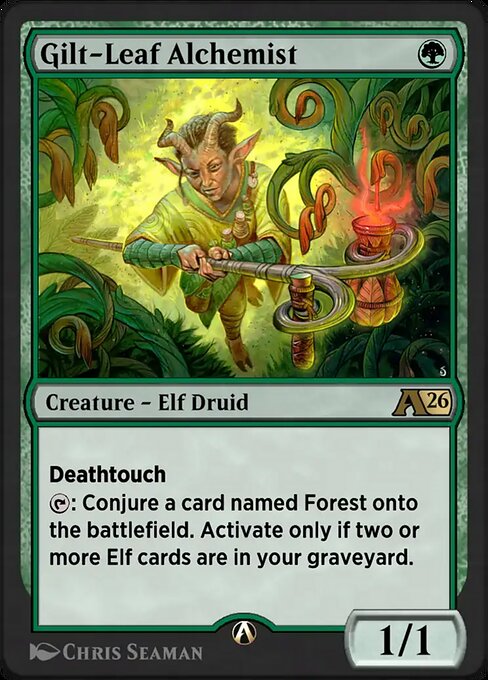
The combo between the two cards shown above generates an infinite amount of green mana by conjuring an infinite number of Forests on the field at instant speed.
Gilt-Leaf Alchemist: A one-mana 1/1 with Deathtouch that possesses a unique activated tap ability: Conjure a card named Forest onto the battlefield, but only if you have two or more Elf cards in your graveyard.
Elven Raft-Steerer: A three-mana 3/2 Elf with a Landfall trigger. Whenever a land enters the battlefield under your control, you choose one: tap a target creature an opponent controls, or untap a creature you control.
How the Loop Works
Fulfill the graveyard threshold requirement by having at least two Elf cards in your graveyard.
With both Gilt-Leaf Alchemist and Elven Raft-Steerer active on the battlefield, tap Gilt-Leaf Alchemist to conjure a Forest onto the battlefield.
The newly conjured Forest triggers Elven Raft-Steerer’s Landfall ability.
Target Gilt-Leaf Alchemist with the Landfall trigger to untap it.
Repeat steps 2–4 infinitely.
The result is an arbitrarily large count of basic Forests entering the battlefield. Because those conjured Forests enter untapped (or can be tapped for mana before untapping Alchemist), you generate infinite Green mana at instant speed. Furthermore, if you have more than one Elven Raft-Steerer, you can use the alternative trigger to tap down every single blocker your opponent controls during their turn.
Initial Challenges
This is a relatively cheap combo with only two cards, an although that’s pretty exciting, there’s a couple things we need to figure out in terms of deck building.
Gilt-Leaf Alchemist is a completely dead activation if you do not have two Elves in your graveyard. In a standard go-wide strategy, your creatures are meant to stay on the battlefield, not populate the bin. Relying on an opponent’s removal spells to turn on your combo key is unreliable against non-interactive or fast linear strategies. Therefore, the deck must naturally sacrifice, discard, or mill its own Elves into the graveyard without giving up card advantage.
On top of that, As a creature-based combo, drawing the wrong half of the deck leaves you with either a small 1/1 Deathtoucher or a fragile 3/2 with no land triggers to exploit. The deck requires robust search engines to pull key creatures straight into play or directly to hand.
Those hurdles led me to what I believe to be the simplest, and easiest, home for this combo: Elves!
Besides the obvious tribal synergy, the natural construction of an Elves deck gives us a solid win condition and Plan-B all in one.
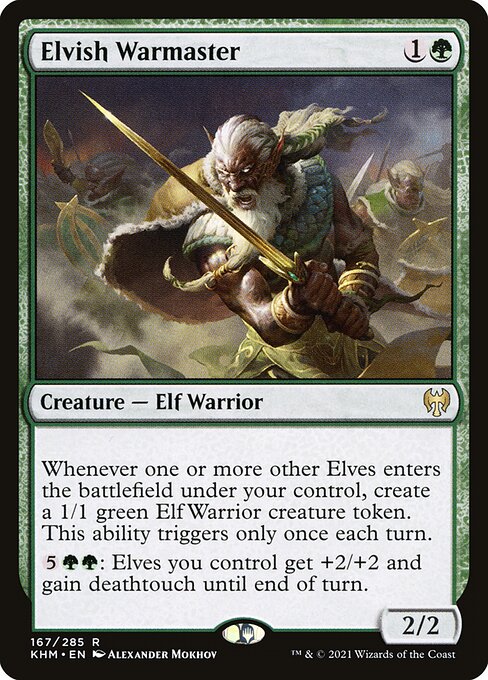
Elves naturally runs cards like Elvish Warmaster (which pumps the team) and Craterhoof Behemoth (which flattens the opponent instantly). Having infinite mana instantly converts these to OHKO in most instances. But what’s nice about this plan is that if your opponent loads up on interaction (e.g., Rest in Peace ), you can pivot cleanly to standard Elvish swarm tactics, dropping lords and smashing through with raw board presence.
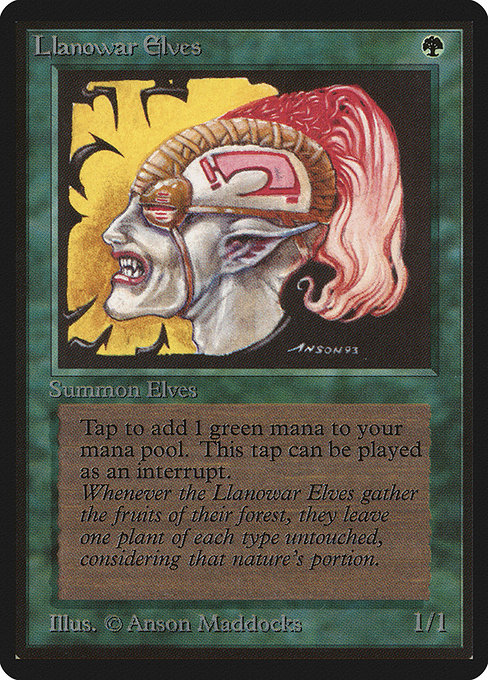
My original list ran standard 1-mana dorks (Llanowar Elves, Elvish Mystic), Priest of Titania for explosive mana scaling, Elvish Warmaster as a token generator and mana sink, and Formidable Speaker to pitch Elves into the yard while searching for combo pieces. I also happened to be testing if access to 8 Fetches (Vista and Passage) made Deathrite Shaman worth running.
This is also where I tried out Malevolent Rumble as a solid piece of glue for the list. It helps dig four our elves while also dumping some into the yard for Alchemist’s ability.
During initial testing we ran into a few things that I want to make note of.
1.) Sweepers like Wrath of the Skies, Divine Purge, and Toxic Deluge tore through the initial board setups. Sideboard answers like Heroic Intervention helped, but holding up spell mana disrupted our curve.
2.) I loved that Deathrite Shaman was online so easily as a mana dork, but I missed access to more utility lands.
3.) Formidable Speaker proved to be an absolute MVP. Being able to discard an Elf directly to turn on Alchemist while fetching Raft-Steerer or Craterhoof seamlessly bridged the mid-game combo assembly.
I really enjoyed the deck and I definitely felt that we had something sweet in the wroks based on the initial version. I just needed to take a step back and evaluate our other options for tutors and ways to assemble the combo a bit easier.
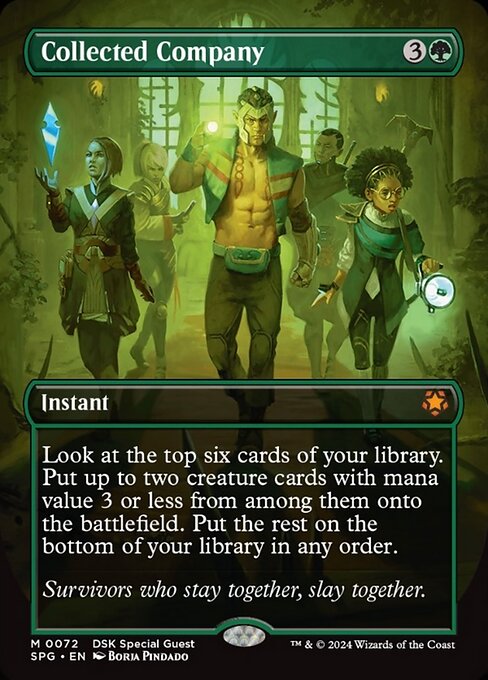
Pros: Instant speed, utilizes Convoke with our go-wide creature token generation, puts pieces directly onto the battlefield.
Cons: High mana cost when our board state is minimal or post-sweeper.
Formidable Speaker:
Pros: Is an Elf itself, fills the graveyard threshold via its discard trigger, searches up Raft-Steerer or Craterhoof directly. Also untaps Priest of Titania for big mana.
Cons: Requires steep mana investment to chain and puts the card into hand rather than play.
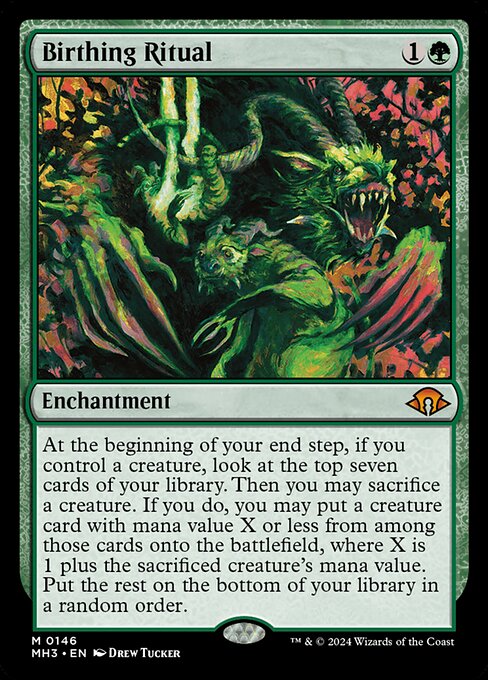
Birthing Ritual & Malevolent Rumble:
Pros: Birthing Ritual provides non-stop end-step selection by converting low-end Elves into combo pieces. Malevolent Rumble digs 4 cards deep, grabs a creature or land, and puts an Eldrazi Spawn + extra cards into the graveyard to instantly fuel Alchemist.
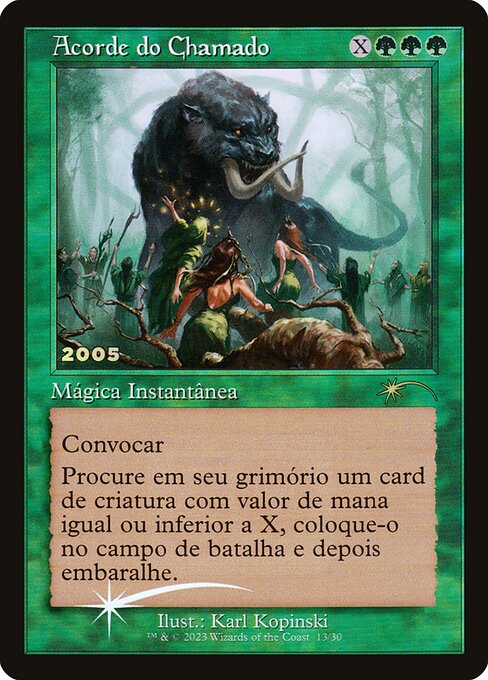
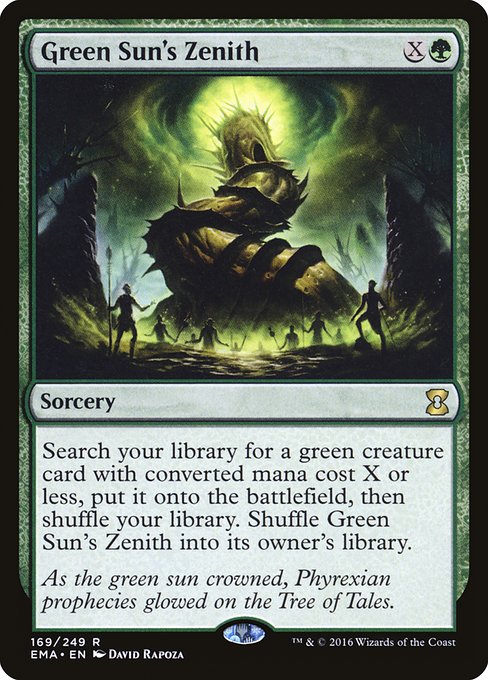
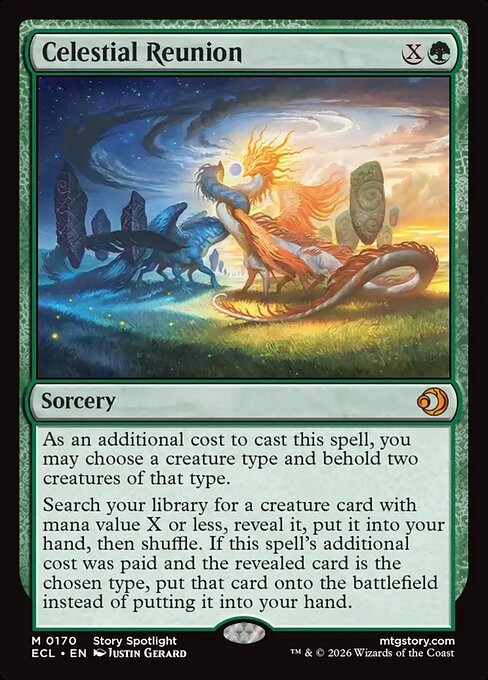
Celestial Reunion / Green Sun’s Zenith:
Pros: Excellent targeted selection.
Cons: GSZ cannot target non-green creatures directly (e.g., Elven Raft-Steerer). Reunion is much worse after board wipes or when top-decked on an empty board.
So I ended up trying a bunch of these in different combinations. Celestial Reunion was actually incredibly strong and seemed to be tailor made for this deck, but it didn’t directly find Craterhoof nor help us drop Elves into the graveyard for Alchemist. It may be a card I revisit in a future version though.
With every variation I tried, Formidable Speaker was always gas. I started including it in every shell along side the basic combo package of Alchemist + Raft-Steerer and was happy to see it every time I drew it. And although the direct tutors like Chord and Reunion were pretty good, it was hard to squeeze in additional pieces to get Elves in the yard reliably. Which led me to finally testing out Birthing Ritual alongside Malevolent Rumble.
We made a few core adjustments that I felt took the deck in a positive direction in terms of power and consistency.
1.) I added Deathrite Shaman back in with 6 fetches. It gave us a mana dork with extra utility in the form of gravehate and lifegain.
2.) Ditching Collected Company for Birthing Ritual and Malevolent Rumble allowed us to cut both dig for combo pieces and fil the yard at the same time. Birthing Ritual turns spent creatures like Earthbended lands or used mana dorks into Formidable Speaker or Elven Raft-Steerer at the end of turn while guaranteeing Elves hit the yard for Alchemist.
3.) With the inclusion of Ritual I also added in a couple Disciple of Freyalise (also an elf!) to get some nice synergy with being Earthbended. I actually think I’d like to find a way to squeeze in more if possible, but thats for another version.
Gameplay
(this is gameplay of the most recent version of the list)
Against midrange, your biggest obstacle is navigating heavy interactive packages like targeted discard and cheap removal. Playing blindly into open mana will get your combo pieces picked apart, so patience is key. Focus on developing early mana engines like Priest of Titania or generating hand advantage with Formidable Speaker to force your opponent to spend their removal on setup pieces. Once their resources are stretched, you can drop Gilt-Leaf Alchemist and Elven Raft-Steerer in a single turn, ideally holding up instant-speed protection like Heroic Intervention to lock in the engine in games two and three. Even playing carefully, this archetype seems tough to beat. Jund ate us alive on stream in two matches.
Against aggro and creature-based strategies, your priority shifts to walling off early attacks and stabilizing before transitioning into a lethal turn. Cards like Deathrite Shaman and Gilt-Leaf Alchemist act as incredible defensive tools early on, with Alchemist’s deathtouch body naturally dissuading high-power attackers from swinging in. Once you stabilize the board and untap with a healthy mana engine, you can pivot almost instantly from a defensive stance into a game-ending Craterhoof Behemoth drop or an infinite Elvish Warmaster activation.
Facing off against other combo decks really just relies on the sideboard to win. Our deck isn’t faster than Ruby Storm or Samwise in game one, and since we lack interaction, we have a tough time against Yawgmoth as well. Most of our initial games were won strictly because my opponent didn’t know what I was trying to do before it was too late.
Closing Thoughts
Overall, I think Gilt-Leaf has a lot potential for the future, but it doesn’t seem to have all the pieces it needs right now. Moving away from the randomness of Collected Company and leaning into the precision of Birthing Ritual and Malevolent Rumble was the turning point for this deck. It solved our graveyard threshold issues for Gilt-Leaf Alchemist while giving us consistency. However, the fact is we’re still just playing an Elves list. And Elves is bad in Historic lol.
Heavy midrange strategies packed with discard and instant-speed removal like Jund remain a tough nut to crack, and linear combo decks will still out-pace us in Game 1 if we don’t find our pieces fast. Is it nice that we have a good back up plan? Sure. But again, the Plan-B of just being a basic Elves deck isn’t really that strong of gameplan in general right now. Flexibility is nice, but the angles we have access to aren’t quite strong enough at the moment.
We definitely took a few beatings on stream, but I enjoyed both brewing and playing this one. And it’s always a treat to see my opponents take a few seconds to read my cards as they try to figure out what I’m doing.
Thanks for reading!
As always, feel free to comment and leave any questions you have below. And make sure to come back next week for even more Fun & Jank!
If you’re interested in more fun content, check out j2sjosh’s article on Historic Pauper for Midweek Magic. The MTG Hero is also messing around with Izzet Spellementals in Standard which you can check out here!
If you want to help me brew, come hang out with me on stream where we test, refine, and have a ton of fun together.
Happy Brewin’!
Premium
Enjoy our content? Wish to support our work? Join our Premium community, get access to exclusive content, remove all advertisements, and more!
No ads: Browse the entire website ad-free, both display and video.
Exclusive Content: Instant access to all exclusive articles only for Premium members, at your fingertips.
Support: All your contributions get directly reinvested into the website to increase your viewing experience!
Discord: Join our Discord server, claim your Premium role and gain access to exclusive channels where you can learn in real time!
Special offer: For a limited time, use coupon code L95WR9JOWV to get 50% off the Annual plan!
Plum is the creator of the Jank Tank.
He started playing at the ripe old age of 12 and immediately fell in love with the infinite possibilities that deck building could lead to.
He truly understands that jank is a mindset, and spends most of his free time brewing and concocting new and exciting deck lists to help inspire and promote creativity within the MTG community.