In this in-depth article, Sierkovitz breaks down all the removal spells in Modern Horizons 3 (MH3) Limited to gain insight into the format, using the power of data!
The new set is upon us and unlike the previous Modern Horizons, this one is going to be on Arena so we have a long summer of premier quality draft ahead. Limited is always defined by the quality of removal. Some sets, removal is bad and doesn’t align well with the threats. Some, like our last set, OTJ, removal is the defining feature and key to success. Knowing how removal looks like lets you plan your draft accordingly, especially since the removal spells are usually high picks so you need to invest some real value into getting them before anyone else in your pod.
There are different types of removal and based on what deck you are playing, some types of it can be more important for you than others. Here, we are going to look at unconditional removal – one that can deal with almost anything, then conditional removal, that can deal with creatures based on their sizing or other characteristics. Tempo removal doesn’t deal with it’s targets permanently but at cost of mana it does remove the momentum from opposing deck and let’s you trade mana for time – needed either to win or to efficiently stabilise. Lastly we have sweepers – those can nullify whatever happened before in the game – as such they are a natural feature of slower decks that want to play longer games because their late game is hard to beat.
Powerful cards to MTG Arena releases on June 11, 2024 for Timeless and Historic formats! Learn all about Modern Horizons 3 and find all our related articles in our hub.
Unconditional removal usually costs more and is important for fast decks to push last damage and slower decks to be a catch-all answer to hard-to-deal-with threats late in the game. It looks particularly important in some of the MH3 matchups – you won’t kill a 7/7 Eldrazi with a burn spell. And with how MH3 is designed, those 7/7 Eldrazi can appear on the opposing side of the battlefield quicker than you think. In that situation, you better be ready to deal with it.
Black is the king of unconditional removal and MH3 is no different.
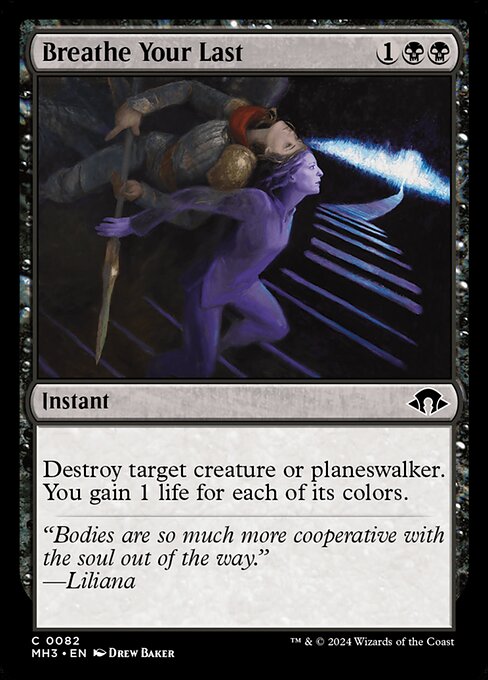
Before I got to play in the Early Access and the prerelease I was a bit low on the new Murder variant, Breathe Your Last, but the more I think about it, the more important this card seems if you are a deck that is heavy in black. Not only you will have to deal with the large Eldrazi, but some of the other colors can get access to surprisingly large threats very early. The life gain is just and extra, you will still feel great if you hit an 8 mana devoid creature and gain 0. Black creatures don’t get access to the large creatures so having one copy of it may be your easiest to access insurance against being overrun.
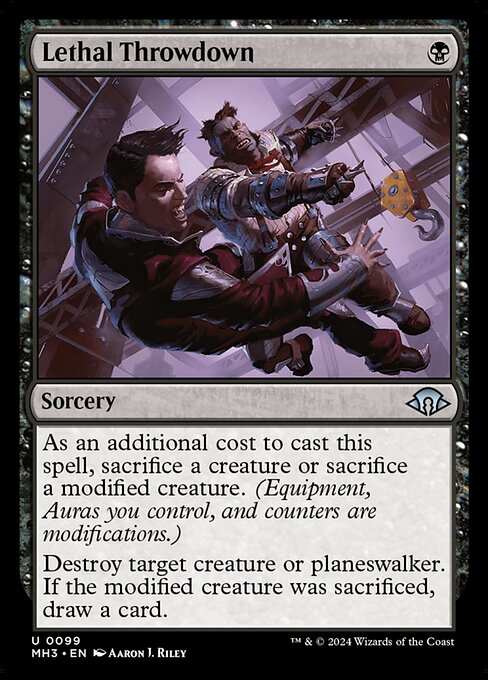
Easiest to access but not the only. Lethal Throwdown is definitely not as powerful and it is an uncommon, so you will see fewer of those in your drafts, but if you play a go-wide deck, it might be efficient enough. And sometimes you might even get a card from it to sweeten the deal. Yes, sacrificing a modified creature is usually sub-optimal, but there are a couple of cases where you actively want to sacrifice a modified creature. One good option if using an Obstinate Gargoyle as your sac fodder once it persisted. -1/-1 counter counts as a modification, and reusing your 1/1 flyer that already did something to kill something and draw a card for one mana looks tempting. Otherwise, any small creatures with Bestowed large creatures on them might do well.
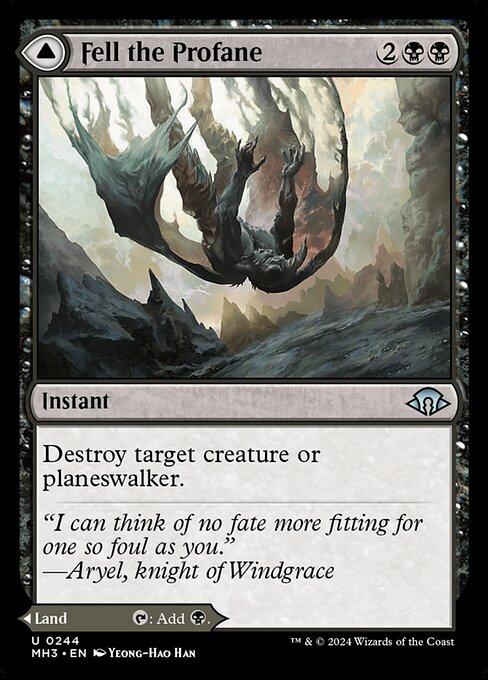
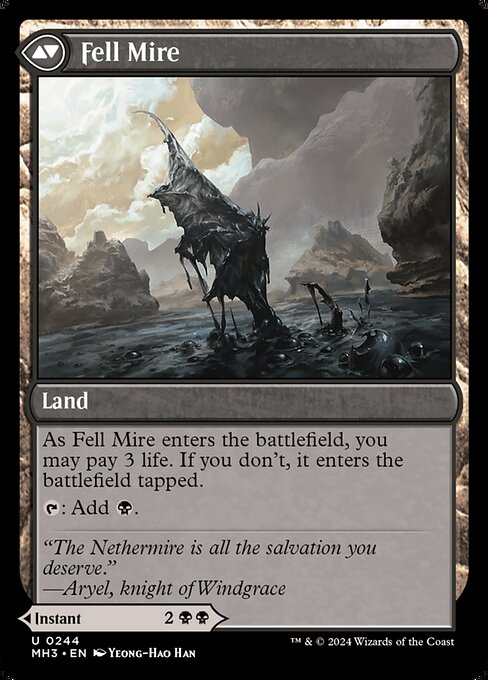
Fell the Profane looks like an excellent card. 4 mana for an instant speed unconditional removal is only slightly below rate, and the option of playing it as a land is a great modality. Generally I suggest using the Modal Double-Faced Cards (MDFCs) as a replacement for a land, but in this case, I would play Fell the Profane as a straight spell, because I am planning to cast it >80% of the time as a spell and use the land functionality only in emergency situations. This should be a premier black uncommon and you should pick it early.
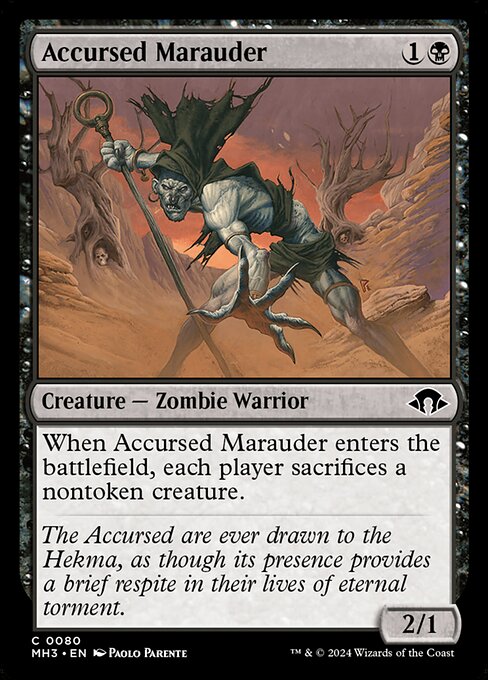
Accursed Marauder is not your typical removal. Yes, it will kill something unconditionally, but in order to snipe something really good, you need to work around it a bit. It is an edict type of spell, but your opponent won’t have the luxury to sacrifice a token creature. Marauder looks interesting, but it will need a deck that supports it. There might be even some little combos that go with it. Essence Reliquary let’s you return a creature back to your hand – with the Marauder trigger on stack, you can start going through your opponents creatures one by one without putting the Marauder in harm’s way if your board is empty. Without the combos, Marauder might be a useful tool in decks that plan for a longer game – a great way of trading early drops and removing momentum from your opponent. Still, a card that shouldn’t be a priority.
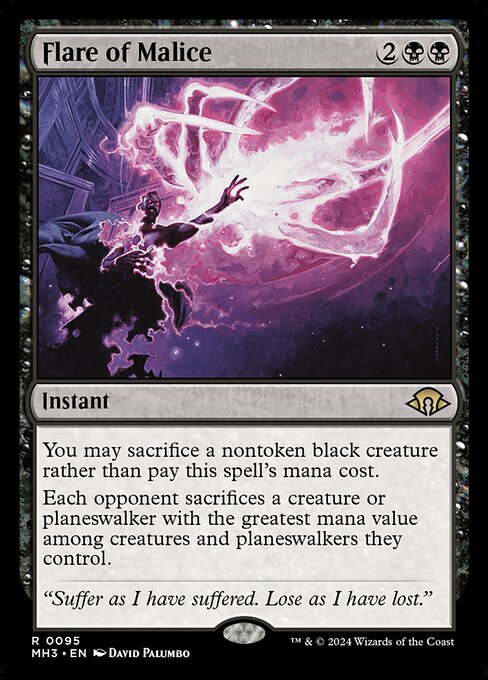
Flare of Malice is an edict on steroids. Not only it kills the most expensive creature your opponent controls, but frequently it will do it for free. You probably don’t want to sacrifice your creature proactively in order to kill something unless you have a very good reason, but firing it off in response to opposing removal to gain 4 mana sounds like a great idea, and who knows, sometimes it may even fizzle some additional effect from your opponent for that extra value we all crave.
White is typically the second color where unconditional removal lives. But this time we are offered only slim pickings. We are far away from 7-8 different Oblivion Ring type effects we had in OTJ.
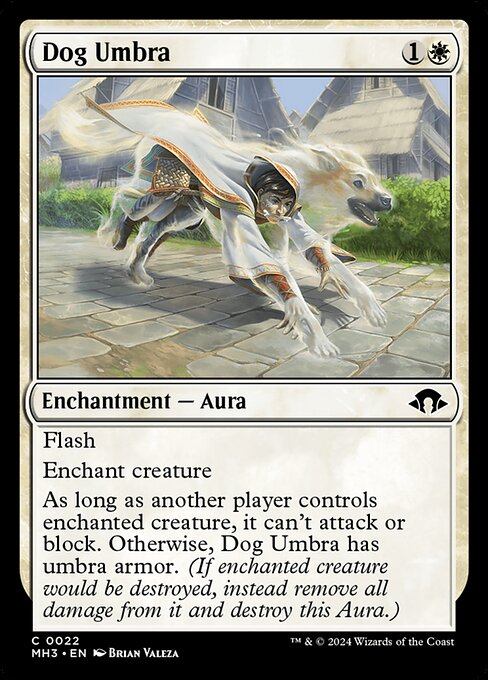
Dog Umbra is a play on a Pacifism. It does come with all the drawbacks of it, leaves a body behind that can be used in some way, doesn’t turn off activated abilities and triggers. And that is normally a no-no for me. But this one is doubling as an instant speed combat trick that can save your creature and gives it modified status. Not sure if that is enough to make it good. But given the shortage of unconditional removal and abundance of large creatures – maybe we will have to play it. I would still want to make sure that the Umbra part of it is relevant to include it in my deck. Pacifism against dumb big Eldrazi and a decent combat trick against aggro decks might just be enough.
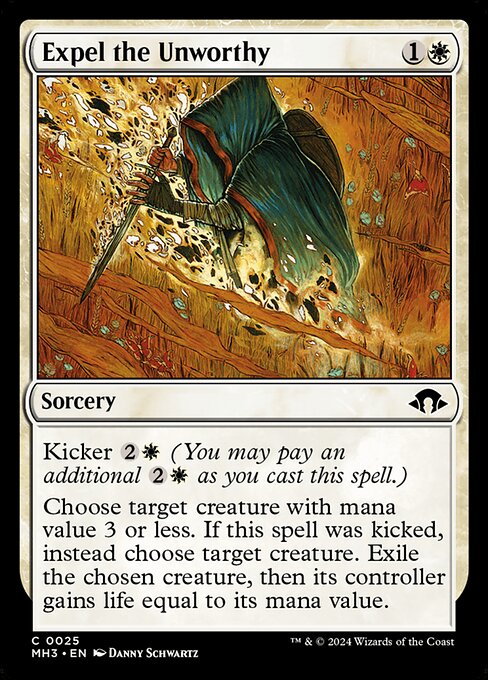
Expel the Unworthy is a conditional spell at its face value. But pay the Kicker cost and you can kill anything. But the opponent gains a sizeable chunk of life. This makes it a no-no in an aggro deck. Trading a 2-3 drop for 2-3 life to the opponent means that the momentum you gain through removal might not be enough to find lethal later. And killing a large creature for 6-8 life donation will almost assuredly put the opponent out of reach. If there is a spot for Expel it is the slower, controlling decks. Those don’t care that much about opponent gaining life – if you survive till late game you are favoured anyway. 2 mana removal is a great way to survive to late game and the upside of having a universal removal spell later in the game is nice to have. Still – some questions remain. Can a 2 mana sorcery speed removal with downside be efficient in a high power set?
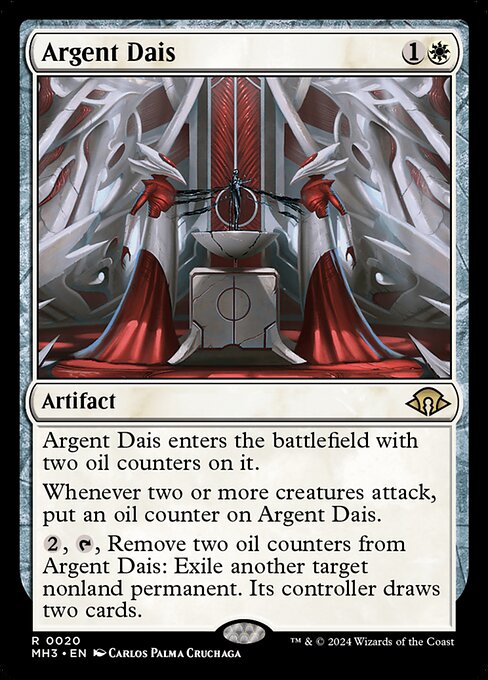
Argent Dais is a weird one – you almost want to kill your own stuff with it rather than opponent’s creatures. Still, I had to note it’s existence. I should probably also note I don’t advise playing it in your decks.
Blue has a playable unconditional spell this time.
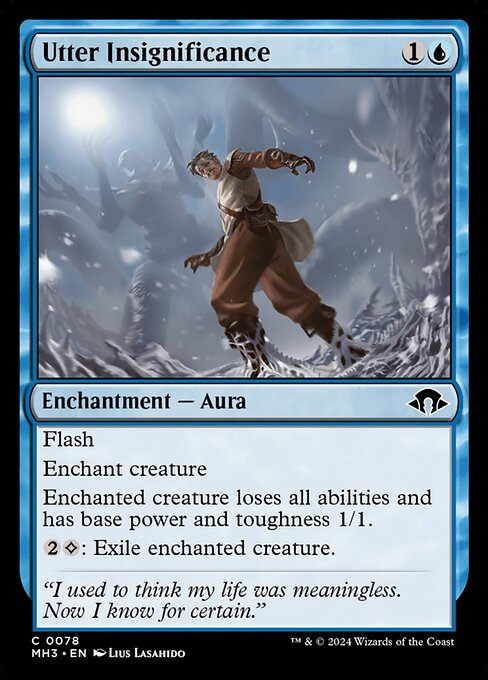
I normally hate this kind of Aura. Turning opposing creature into a 1/1 is not really what I want to be doing. But the exile clause on Utter Insignificance is a good way of ameliorating this issue. Especially in a set where unconditional removal is hard to come by. The colorless cost in the exile ability is not nothing – make sure you have ways of paying it. This card presents an option to reuse it – you can bounce it back to your hand with the activation on stack and the target will still get exiled. Unfortunately, there is no instant speed bounce effects in the set apart from Ugin's Binding – aa mythic. But, as with the Accursed Marauder you can build an Essence Reliquary lock making your all of your opponent’s creatures utterly insignificant.
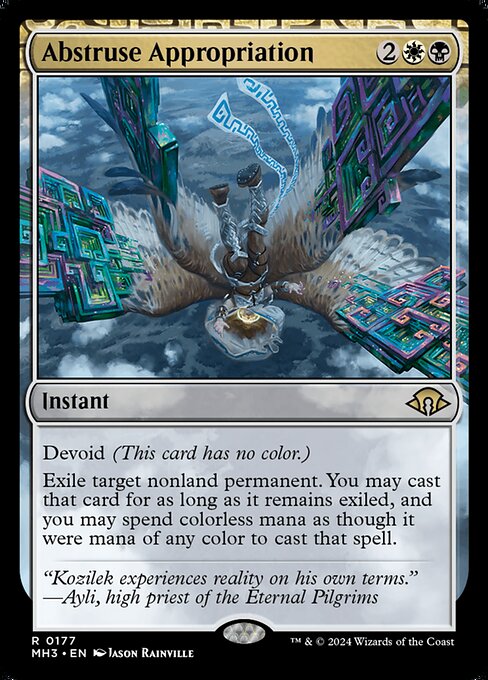
And that’s all the unconditional removal in the set barring one rare. And it is a good one.
Getting rid of anything at instant speed is a really good rate. But wait, there is more. You get to recast the permanent you targeted at any stage of the game. you will need to have the right mana to do so – either by having the right colors or by having access to colorless mana in your deck. Still, large fraction of the time you will be able to cast the removed permanent and that makes Appropriation into a bomb category. Not far off Fractured Identity, which was one of the best cards in OTJ despite UW deck being subpar. This is a reason to be WB in MH3 and probably a good splash in other decks too – with the tons of Landscape lands floating around, it should be no problem to splash it into your deck and so you should.
Unconditional removal in this set looks both lacking and needed – this will make it interesting to see how it plays out. Will it make it a heavily contested and needed part of the draft experience or will we just ignore it and build decks that pass each other like two ships in the night, casting their large haymakers in hope that ours will be bigger or that we manage to win aggro games before the 7/7s start hitting the board?
Conditional Removal – Damage
Damage removal is typically the domain of red. All the burn spells size accordingly to their cost, covering the range from 1-2 damage to 5-6 damage. On top of that we normally get some black -X/-X spells, some green fight spells where efficiency depends on your creature sizing. Occasionally we get white damage spells, usually they deal with attacking or blocking creatures. But as we already determined, MH3 is not your average removal set. Yes, we do span a whole range of damage spells but in a weird way. Most removal deals either 3 or 4 damage, with very little coverage for any other values. Possibly a Shock level spell is just not efficient enough in a set where a 2 mana 3/3 is a common.
How does the damage align with creature sizing?
This graph shows how do the different value removal spells align with the creature sizing in the format. But you will be pushed to find the right spell for the right category. With no X/1 hate, no 2 damage spell, the 3 damage seems to be the key statistic and, compared to the recent sets, a 3 damage spell deals with a lot. 80% of creatures at common die to Wither and Bloom, at least on paper. 4 damage spells kill 93% of common creatures and a chunk of higher rarity ones too, but that is more within typical values for other sets.
If you want to look at the differences between sets – here is a graph showing efficiency of different categories of damage-based removal across the recent sets for common creatures.
You can see that – especially looking at the 3 damage and the few most recent sets, that MH3 is very different. Of note – there is a large chunk of X/1, probably because the main token generating mechanics make 0/1 and 0/0 creatures, so an X/1 will frequently have to trade with a real card.
As I said, damage based removal is mainly red. I divided it into 3 loose categories for the red cards. Firstly we have clear damage spells.
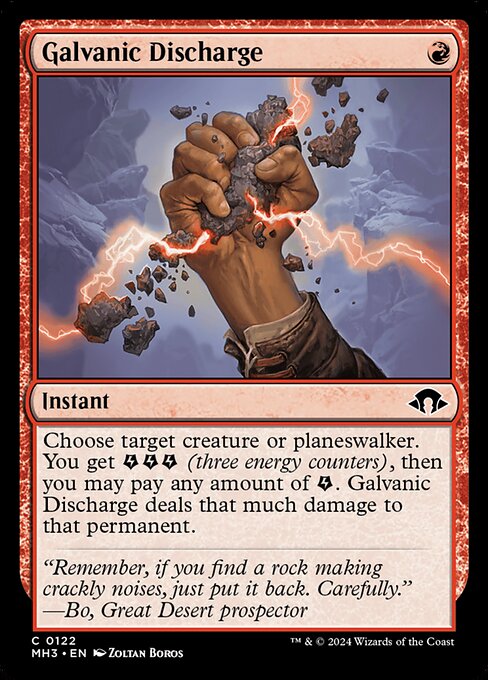
Galvanic Discharge is the premium common removal in red. It will be at least a 3 damage spell for 1 mana, and at instant speed, which is already great. But it can be so much more. You can save some of that energy if your target has less toughness, and reuse it for something else. But in dedicated energy decks, if can also tap into the leftover energy pool to kill something much bigger for just one mana. Look, I am not telling you will be killing Emrakul left and right with it, but it is on the extreme side of the card’s range. If you do it – please tag me in the screenshot 🙂
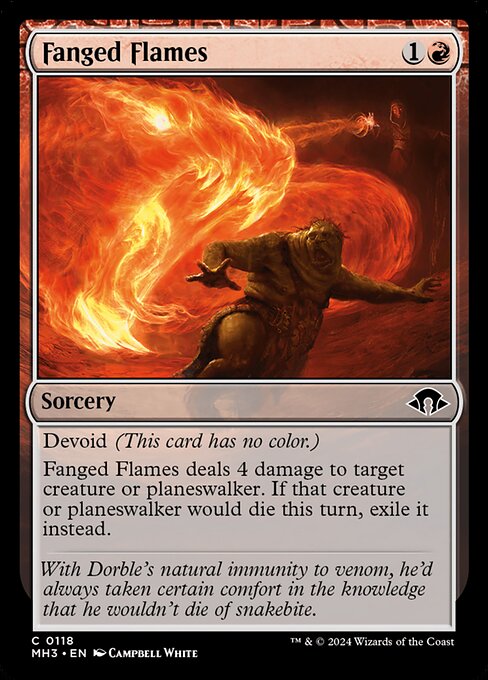
Fanged Flames is not bad either. 4 damage is fixed, but the exile clause is nice to have. The devoid part is probably mainly for protection from red in constructed, but may come to be important in limited from time to time. Unfortunately it is a sorcery – so it will be hard to get a 2-for-1 with this card. Still, a solid removal spell and a great way to survive till late game.
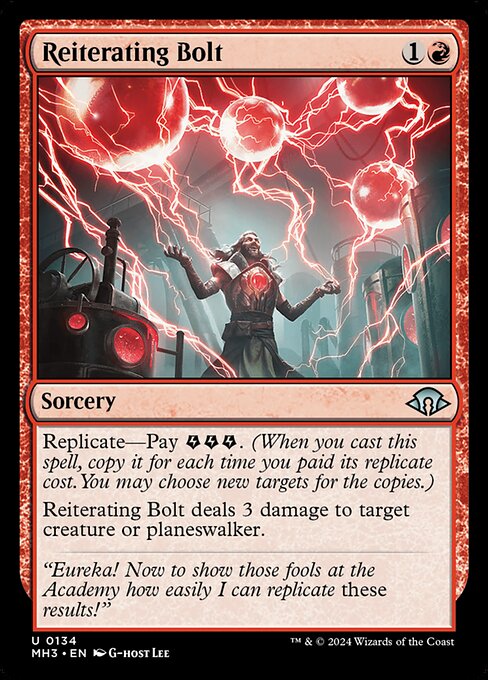
Reiterating Bolt, on its face value is a worse Fanged Flames if you don’t produce a lot of energy. But if you do it becomes a premium. Even if it doesn’t produce energy itself, 2 mana for dealing 2×3 damage is solid. Mind, if you are targeting a 6 toughness creature, that is still worse than doing the same using Galvanic Discharge. But if you can kill multiple targets – Bolt is better by some margin, despite the sorcery speed. Still, I would pick it lower than Galvanic Discharge and in most non-energy decks also lower than the Fangs.
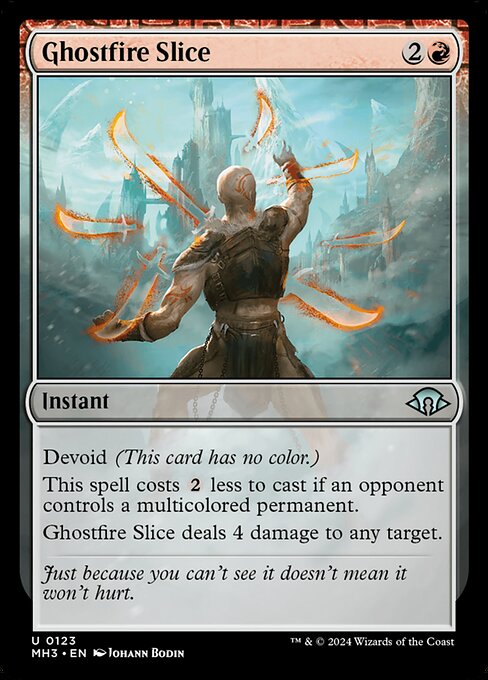
Ghostfire Slice looks the best of the lot. Being able to go face is such an advantage. I ended multiple of my prerelease games with a Slice to the face, and more than once it cost me a whole one mana. With aa couple of those in your deck you can really go aggressively, knowing you have ways of ending the game even when opponent stabilises the board. The discount won’t happen every time, but with so many multicolor creatures at common, a collection of signposts and MDFC flip sides, we have 17 multicolor permanents at common and uncommon in the set so you should see those regularly. And all the cards in question are rather aggressively slanted – so the mana discount becomes very important. You should have more time against the slower devoid Eldrazi decks. And even at 3 mana – the deal is solid, given the instant speed. Premium uncommon it seems to me.
The other group of red damage spells are on a stick – they are creatures that in different ways deal damage to some target.
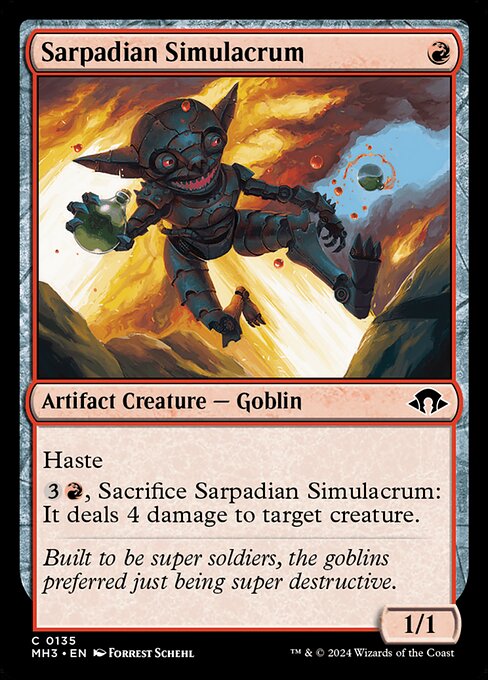
Sarpadian Simulacrum is an interesting card. In the early game it can be a small creature that does its 2-3 damage before becoming obsolete, later it becomes a clunky removal, but can double down as an artifact on board to fuel BR artifact synergies. I doubt it is playable outside of BR and WR decks but in those two where being aggressive and having artifacts is key, it might be just good enough as a filler card.
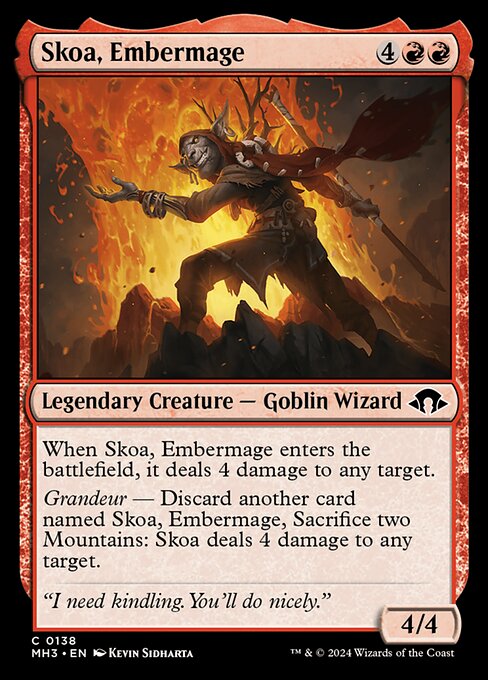
Skoa, Embermage is the first common legendary creature since Chandler and Joven, the iconic duo from Homelands. If anything only this makes it a big deal, especially in the very exclusive Pauper Commander circles. But aside from that claim to fame, we get a solid creature. 4/4 body is respectable and tagging a burn spell that deals 4 damage on top of it seems good. And if you draw multiples, you can always Grandeur them to finish the opponent off. 6 mana is still a lot but 1-2 at the top end of your otherwise aggro low cost deck might be OK.
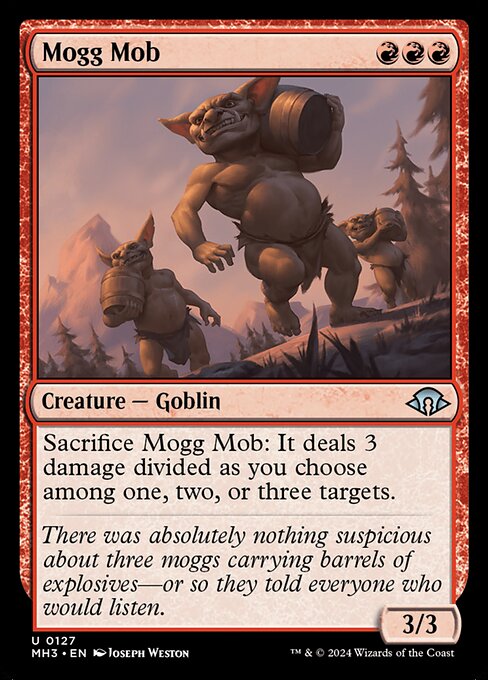
Mogg Mob is a pun on the Mogg Fanatic, a 1 mana version of this creature from Tempest. Unfortunately the mana cost of RRR is prohibitive, but if you end up mono-red or close to it, you may just get away with it – Arc Lightning is a powerful card, and having it on a 3/3 body is an upside if the cost is not a problem. But in most decks casting it will not be reliable enough to put it in your deck.
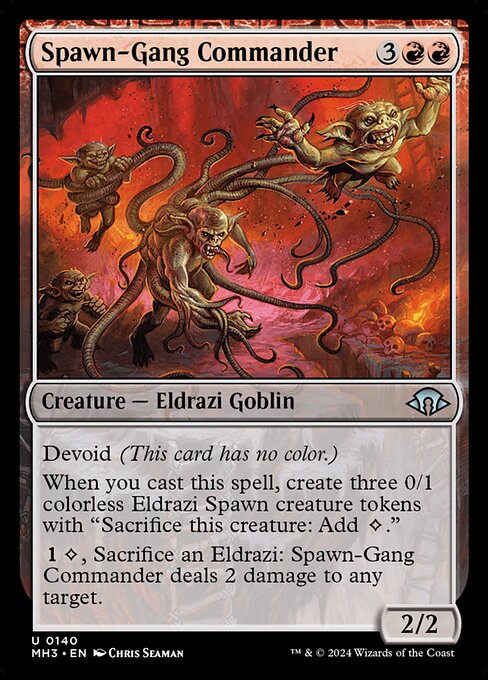
Spawn-Gang Commander is another flashback to the goblins of yore. Siege-Gang Commander was first printed in Onslaught, way before the 17Lands.com era, but reprinted in Dominaria, where, based on the small sample size compared with the current ones – mind, it was the top card for all the set. Now we are getting a good impression of it at uncommon. Yes, MH3 is a high power level set compared to Dominaria. Yes, the colorless mana in the activation cost is harder to pay. And 0/1 is not really a 1/1. But the Spawns have additional advantages, which you can utilise and there is plenty of spawn-makers around. Commander should be a solid if not great in the format, just by the sheer rate.
Last red damage removal is a build-around card that looks pretty sweet and promising.
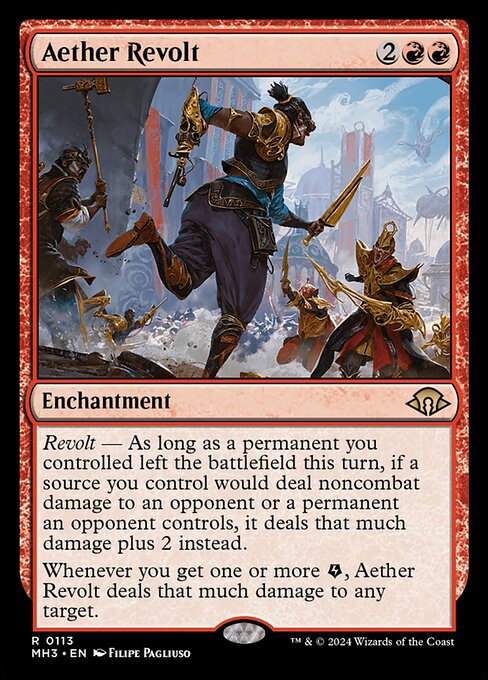
Aether Revolt is one of the couple of dozen or so cards that have the same name as a Magic set, but that is not why it is here. Still a nice Easter egg – each MH set has at least one of those. Aether Revolt pays homage to a set that had Energy as its main mechanic. Revolt makes you deal damage to anything anytime you gain energy. There will be many games where you just go face, but sometimes you will need to use it to kill some creatures. And, if you cracked a land this turn, traded a creature, etc. it will do an extra 2 damage, which is pushing it over the line for me in terms of how much I want to build around it in draft. Card looks solid in a deck that can support gaining energy several times each game, or has some sort of reproducible energy generator. In those decks it will be great, is probably just an F-grade card anywhere else. So it does act as a reward for identifying the Energy lane. Especially if you are the only energy player in the pod.
Black also has some of the damage based removal, but unlike red, that deals damage, normally most of that type of removal in black gives creatures -X/-X. This makes it slightly different, especially with instant speed spells as mid-combat black spells can deal favourably with larger creatures if blocks align well – think blocking a 5/5 with a 3/3 and reducing the 5/5 to a 2/2. But in this set we don’t have a lot of damage based black removal.
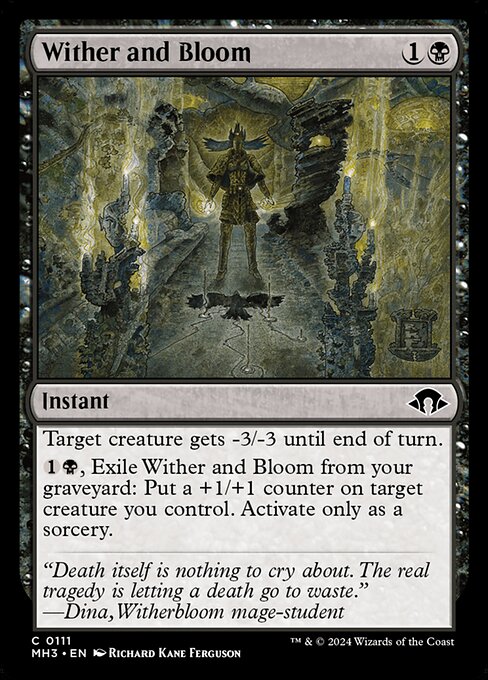
Wither and Bloom is a prime example. 2 mana, instant giving -3/-3 and after the first use still has a potential to do something extra later in the game. 2 mana for a +1/+1 counter is not a great rate but with some cards, especially in BG colors, this one counter can turn into some card draw, token generation or graveyard recursion. Card looks great but only against a sub-set of decks. It doesn’t align all that well against big Eldrazi which is something to keep in mind. My guess is, you want to have a good mix of conditional and unconditional removal in your black decks, so a 2nd or 3rd copy of this is less of a priority.
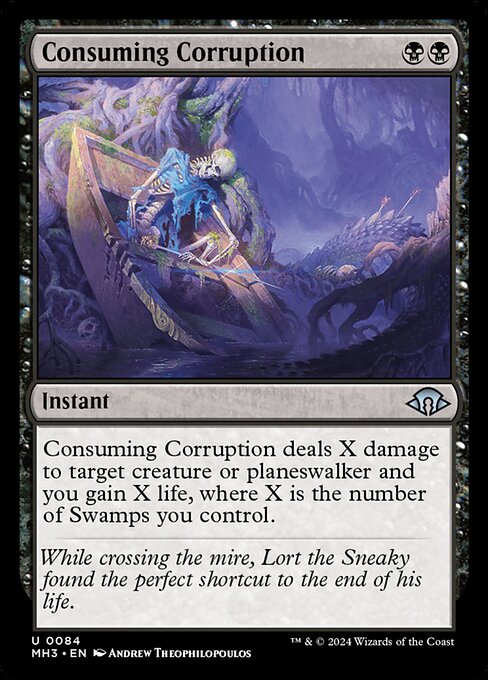
Consuming Corruption is an interesting one. And the interesting part is of course, can you be close to mono black in this format? If you manage – you get an exceptional rate of removal that scales with the game. But even in a 10 swamp deck it might be just a regular 3 damage for 2 mana even on turn 5-6, which is less impressive. Treat it more like a build around rather than a staple.
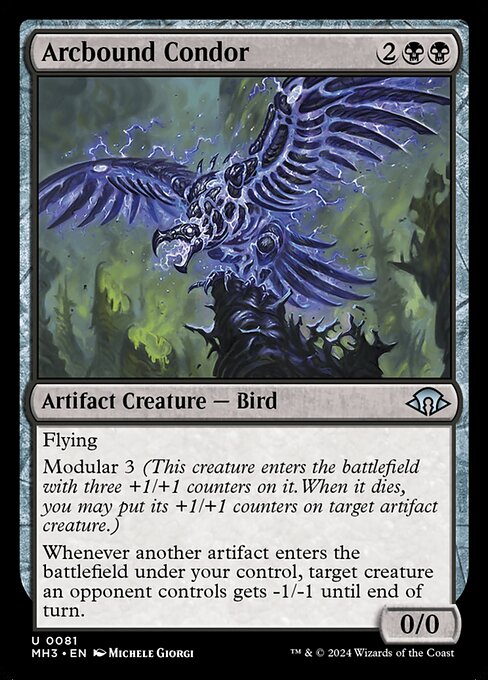
Arcbound Condor is a black card, but realistically it is designed for Rakdos Artifact decks. Outside of those it looks less impressive. And Rakdos looks like the weaker of the color pairs, which may harm its win rate. If you are in Rakdos, though, Condor should do some lovely things for you. Especially with 30% of creatures at common having 1 toughness.
White normally has some damage spells but frequently they target attacking and blocking creatures. In MH3 we do have one of those but we also have a direct damage spell in white.
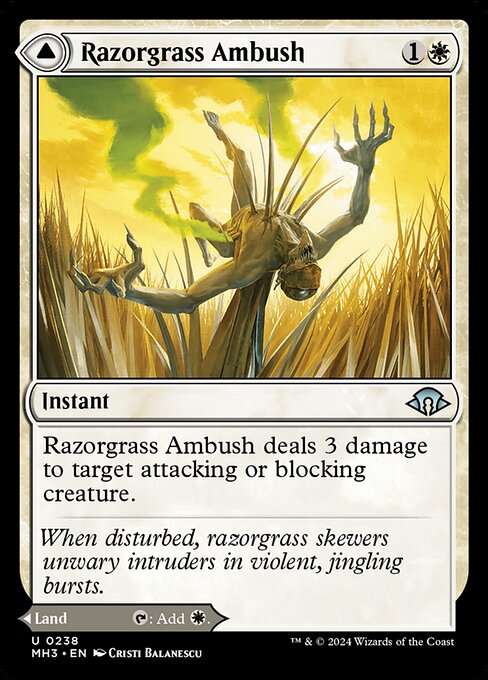
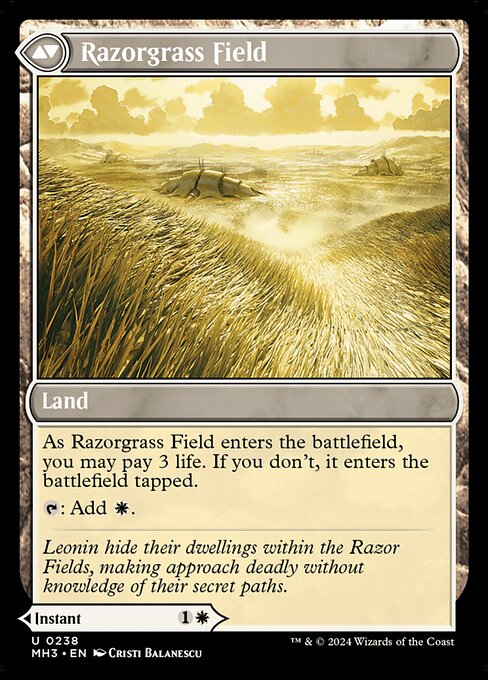
Razorgrass Ambush is under normal rate for that type of spell, but having a land on the other side is something that changes the evaluation of the card greatly. I would still play it as a land in a deck and cast it in situations where I must do it or when my mana is already good. I expect to play it as a land more than 50% of the time for it to be good.
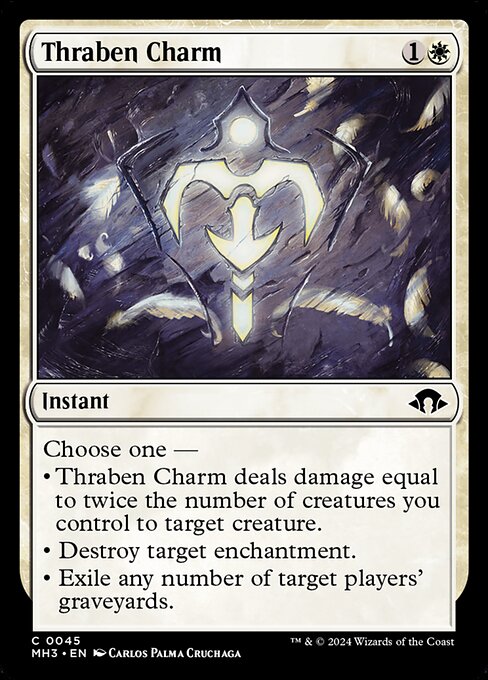
Thraben Charmis my candidate for a sleeper card in the first days. It can deal copious amounts of damage in a right deck – only 3 creatures on board and you can take out a 6/6. Just be careful with playing it into open mana – opponent can blow it out with a removal spell in the right moment. And on top of the removal spell the other two functionalities can come in handy, especially with enchantment creatures and auras in the set.
Green fights and bites as its damage spells and MH3 is no different. We get 3 of such spells.
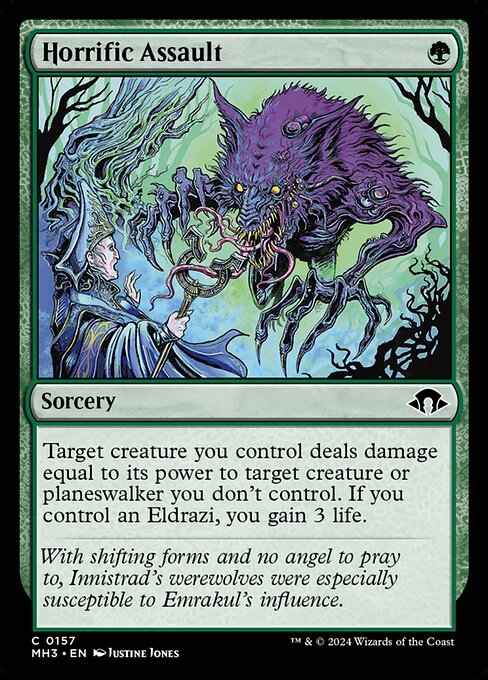
Horrific Assaultlooks great. The one mana cost on a bite spell is something we have seen recently and the card was great. Here we have it with an additional upside of sometimes gaining life. I expect this to be one of the premium green commons. All green archetypes look like being capable of having large creatures with Bestow, Eldrazi and counter synergies, so it should be capable of killing large threats for cheap. And yet again – play carefully with that card. One mana doesn’t mean you can’t get punished for playing it at the wrong moment.
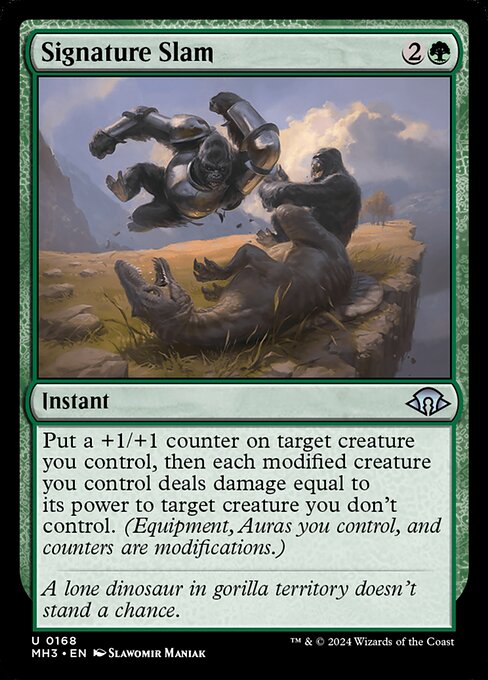
Signature Slam is an upgrade on Clear Shot. Not only it leaves a counter behind, but you can also play around removal if you are in a dedicated modified deck. This means the card will be a premium, but mark that leaving 3 mana open is a cost in itself. Don’t forget that you can fire it off on your turn – you might not get a 2-for-1 as easily, but sometimes it is worth trading value for security.
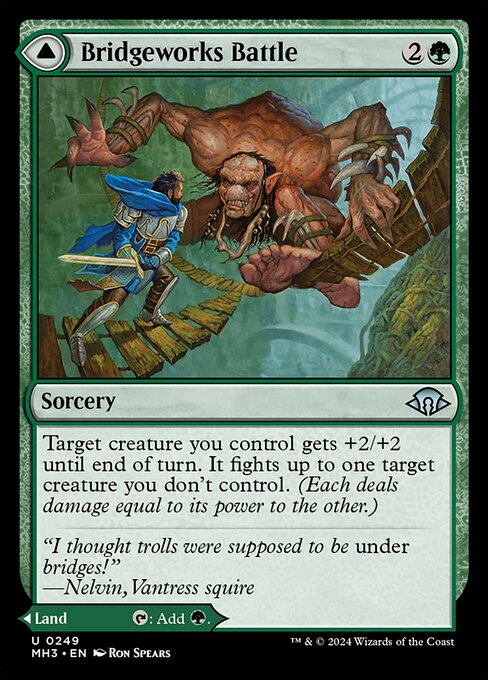
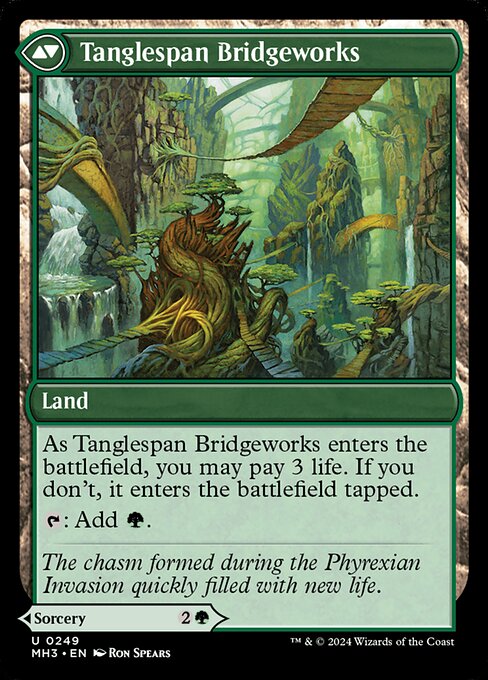
Bridgework Battle is one of the better monocolored MDFCs in the set. Good rate, good effect and the potential to help you with mana if needed. You will always play it in your green decks and you probably want to cast it as a spell good 70% of the time so adjust your mana base accordingly.
There are still few multicolor spells that can deal conditional damage. And most of them look pretty good.
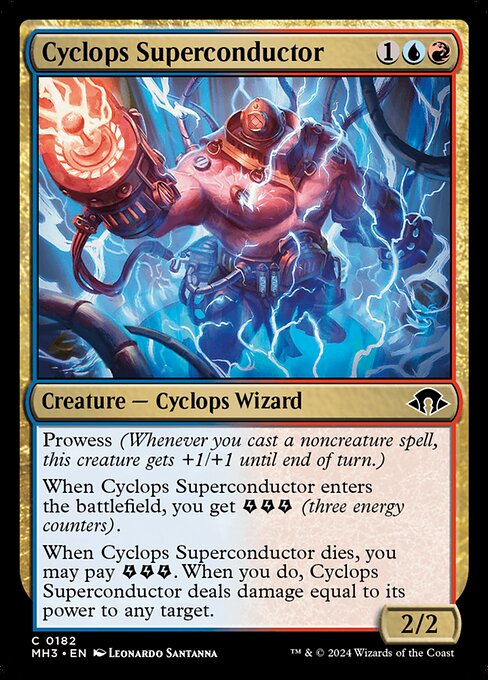
Cyclops Superconductor is one of the signpost commons for the set. A 2/2 that dies into 2 damage for 3 mana is not amazing but the Prowess bonus that will let you increase its output is a nice thing to have. Death triggers are notoriously hard to get compared to how it plays out in our heads. But the upside is, if you can’t profitably deal damage with it, you just netted 3 Energy from it which is also fine in some decks. My guess is that UR spells deck will not be the best thing in MH3. Its best enablers, like Galvanic Discharge, will be heavily contested by any other red deck, and that means to get a quorum of Energy spells you will need to dig into replaceable level cards, which is problematic. And that will have impact on how good Superconductor is.
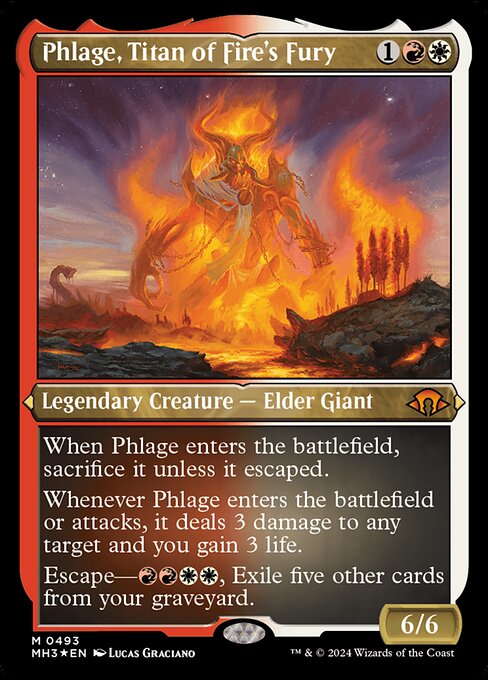
Phlage is an easy bomb. A slightly more expensive, sorcery speed Lightning Helix is great in a set where 3 damage kills 4 out of 5 common creatures. And getting that again, but this time attached to a 6/6 body that recasts it yet again on attacks is amazing. Especially in a set that has around 22 fetch-lands being opened in each draft pod. You can pick them and use them to get the WWRR mana needed to recast Phlage for its escape cost and fuel your graveyard to fulfil the card exile clause. Truly a bomb and I wouldn’t hesitate first picking it.
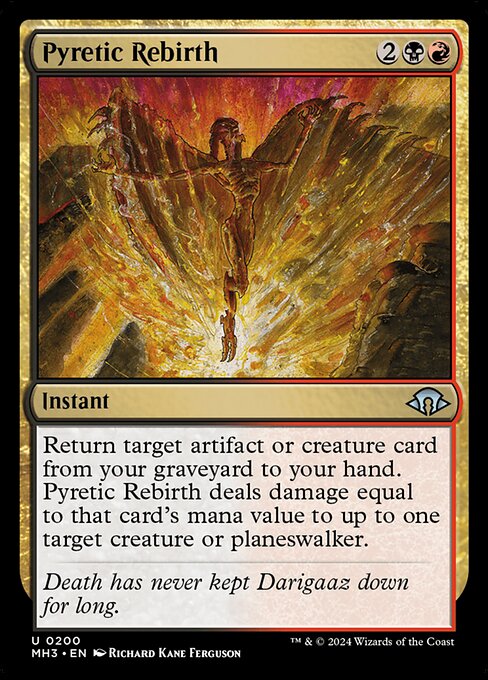
Pyretic Rebirth is an interesting one. As much as I m not high on RB in the format, this card has my interest. There are several cards with Affinity that cost much more than you want to pay for them – with things like Refurbished Familiar or Frogmyr Enforcer you get a solid removal spell. But in the same way as with the death trigger – filling your graveyard is harder than it plays out in our head where we always have 3-4 creatures for Rebirth to pick from. In reality you will have games where the card rots in your hand with no good targets for recursion because there is nothing in your graveyard or because they wouldn’t kill anything and a 4 mana Raise Dead is definitely something you don’t want to cast.
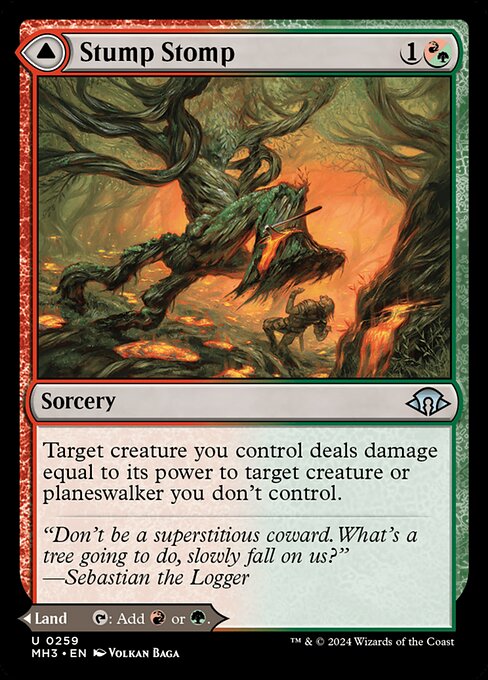
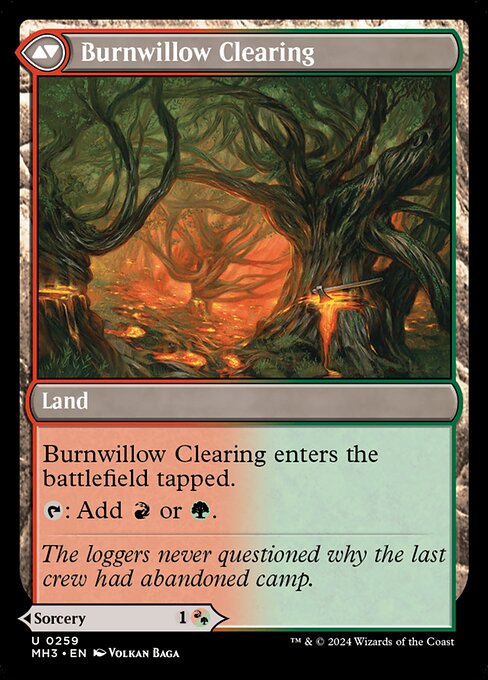
You learned today already that bite spell for 1 man is a great deal. How about a bite spell for 2 mana? There I would like to have a bit more. But with Stump Stomp I do get much more in Burnwillow Clearing. As with previous ones, getting a land on the back is a big game. And like Fell the Profane or Bridgework Battle, Stump Stomp is one of the better MDFCs in the set – again something I would like to cast more often than play as a land. High priority if I am playing RG deck – also because I want to have good mana in my Eldrazi decks in case I want to go full Temur, which I expect happening a lot.
Conditional Removal – Misc
Some spells kill creature under some conditions that are not linked to toughness depletion. Those can be pretty powerful – we have seen a lot of such spells in our times dominating constructed formats. Think of the two classic examples in Cut Down and Fatal Push. MH3 has a small collection of such spells. How do they line up with the set composition?
The main four conditional removal spells are a rollercoaster of great and rubbish.
Devourer of Destiny is not cheap. But you get a lot for the investment. 7 mana for a 6/6 80% of a Meteor Golem? Count me in. And with the opening hand bonus? The catch is of course the double colorless mana in the cost. Colorless ≠ generic mana. You can’t just tap a forest to pay the cost, you need source that produces specifically colourless mana. Luckily there is plenty of those in the set across the Landscape lands and Spawns, but you need to play it in the right deck, most likely RG or UG. In there this will be among your most powerful cards.
Null Elemental Blast is my prediction of a card that will be most overplayed related to how strong it is. Not only hard to cast, but also not powerful – there is only a handful of multicolor cards. And some cards that do have a multicolor cost also have Devoid, making them immune to Null Elemental Blast. Card looks like a sideboard option at most but you should probably think of it as a constructed card, not a draft card.
Fowl Strike looks pretty bad on rate. I would default it to sideboard grad and only play it if you really want to put +1/+1 counters on your creatures. And even then it is a filler. I have to admit – Looney Tunes-style art is something else but that doesn’t mean I have to play the card.
Ajani Fells the Godsire reminds me of Elspeth Conquers Death. And at uncommon, this is a large compliment. Yes, only hits 40% of the creatures on base rate, but it does hit all the relevant, or at least large, ones. And with so much modification going on, creatures who are not fulfilling the base criteria will also get killed by this Saga more often than not. Withering Chrysalis is technically a 2 power creature, but let’s be reasonable, it will grow sooner or later and that’s when you can nab it with AFtG. And the other chapters are non-zero too. ?If you can get something amazing from the last chapter we are talking a B+/A- grade card here. But because so much power of it is locked in chapter 1 – it will never be lower than a B / B-.
Last conditional removal, but certainly not least. Ko-Co scales with the game and most of the time you cast it will be a removal with some Spawns tagged onto it. But there are other functionalities which is a nice upside. I had the pleasure of playing it already in an Eldrazi deck and card is just great. Refilling on your Spawns with any Spawn synergies is backbreaking and means your spell costs much less than you thought. Of course, the same rules apply here as they applied to Devourer – you need to be able to get double colorless mana easily, otherwise you have no business playing it.
Tempo Removal
Tempo removal is different from all we talked about before. Instead of trading cards and mana for safety, in Tempo removal you trade cards and mana for time. Tempo Removal doesn’t take care of its targets permanently. But sometime a turn or two is all you need to close the game or to stabilise. Decks that use tempo removal the best are usually aggressive decks that rely on evasion, or control decks that don’t have the access to best removal colors and use tempo to gain enough time to clog the board with large creatures. Tempo removal is usually blue but sometimes white cards fulfil that role too.
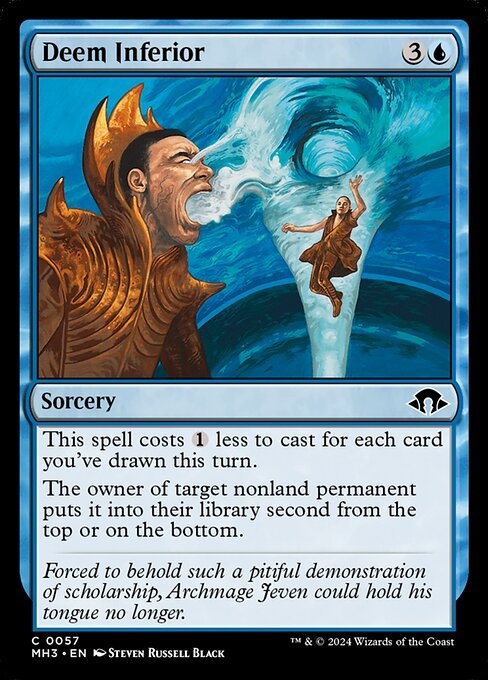
Despite sounding like it is not that great to new players, actually tempo removal can be very powerful. Usually it either costs less or gives you some other advantages that are tricky to grasp. Let’s look at Deem Inferior. It will cost 1-2 mana more often than you think. It robs your opponent of a creature they already invested mana in. It robs them of one draw step eventually or, if they want to prevent it, it straight kills its target. And it will be going much later in draft than an unconditional spell will – so you can dedicate your early picks to efficient threats and bombs rather than picking your Wither and Blooms. This card looks great to me and I very much look forward to putting it in my Sneaky Snacker decks. But any blue deck could probably use it. My tip for the top win rate blue common.
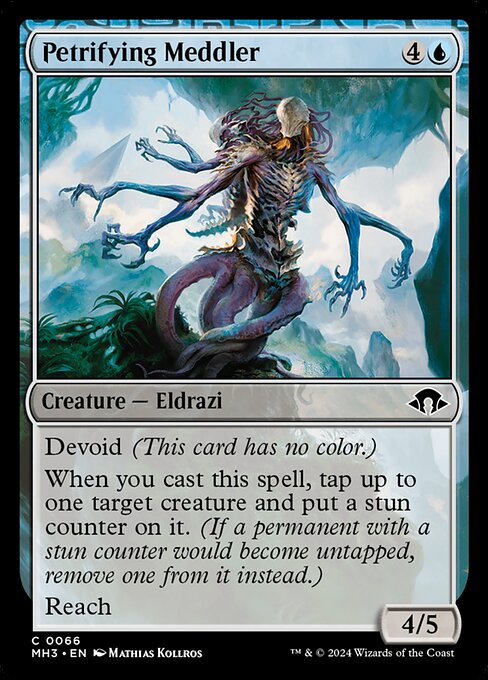
Unless Petryfying Meddler takes this spot. 5 mana is a lot but freezing something for a couple of turns and leaving this impressive body behind sounds great to me. 4/5 is good statline in a set where all damage removal spells end at 4 damage. If you remember Kaldheim, you might recall how backbreaking chaining a couple of Berg Striders was and this one is just plain better in every aspect.
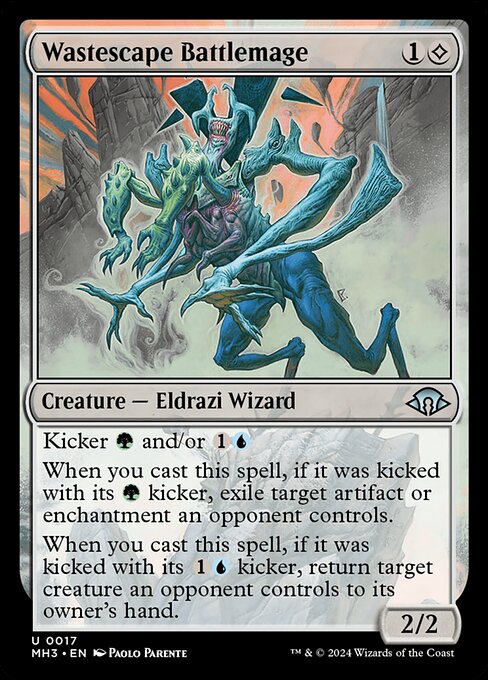
Waterscape Battlemage is a nice throwback to the Battlemage cycle from Planeshift. 4 mana – it becomes a Man-o'-War, but it makes an equally good impression of Reclamation Sage – in a set with Bestow and Artifact creature and Equipment theme – nothing to frown about. Battlemage is good because of that versatility. Of course if you play UG deck that relies heavily on colorless mana – otherwise the card gets significantly worse. You really have to be able to use all the modalities well – green kicker, blue kicker and being able to cast it as a two drop reliably.
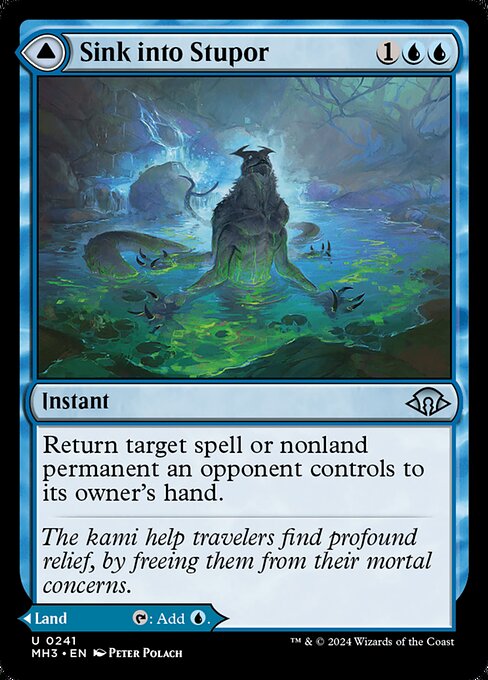
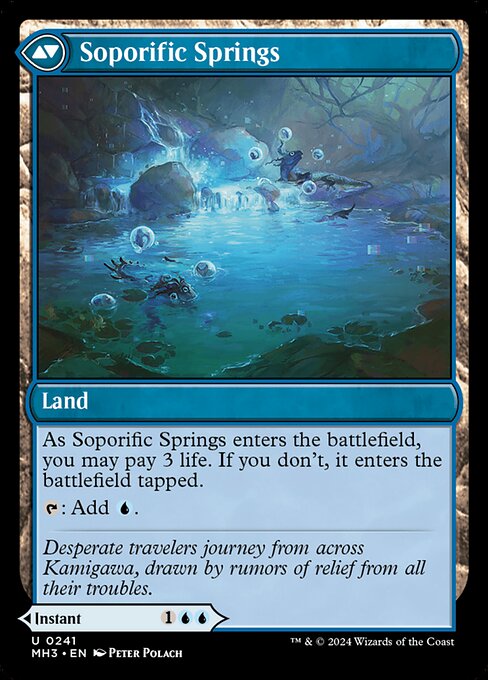
Sink into Stupor is another of the MDFCs. This one is very under rate – 3 mana for a bounce spell / remand without the draw is not great but again – land on the other side says – that is fine. This one you probably want to aim at casting 25% of the time or so. So it should go into your land slot with the spell side as an option. Keep in mind, the UU in the cost means you will definitely need to be heavily blue if you ever dream of casting this spell. Still – a likely auto-include in decks with blue as the main color.
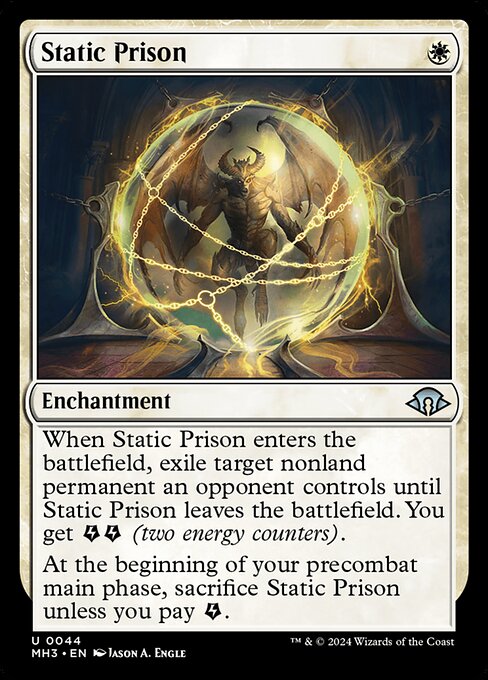
Static Prison is priced ultra-competitively. But it comes with a cost. If you don’t win the game in time you gain, you spent a card to buy a couple turns but not much more. There are two roads to it. One – win instantly. If you are aggressive, getting rid of a pesky blocker for 2 turns might just be enough to kill your opponent. You have to have an advantage on board, though, and a clear plan of winning. Alternatively, you can be really good in generating Energy and turn the temporary prison into something more permanent. Either way – you need to have this solid plan. Cards like this were routinely played in decks that are not suitable for them. Control decks are the worst offenders – you don’t want to put this in a deck that only wants to but time. With spells like this you don’t steal opponents draw step nor mana – after Static Prison goes, they just get the creature back, moreover, sometimes they get another ETB from it. This is a disaster for controlling decks. Unlike a card like Deem Inferior where the re-spending of mana and sacrificing a draw step from the opponent is enough to get some value. Be careful with this card and think hard if you want to play it in your deck or does it go against your plan.
Sweepers
The last category of spells is the most dreaded one. Sweepers can negate all you have been doing so far with one card, leading to backbreaking game momentum shifts. Good news to all you sweeper haters – MH3 doesn’t have many of them. And trust me – 6000 words in, I am also celebrating.
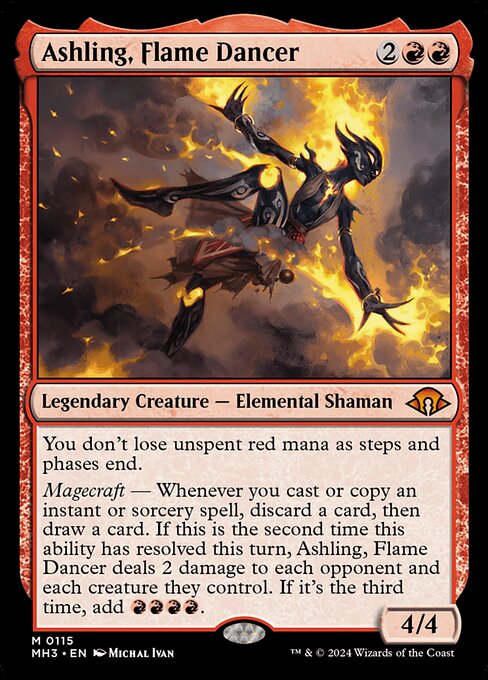
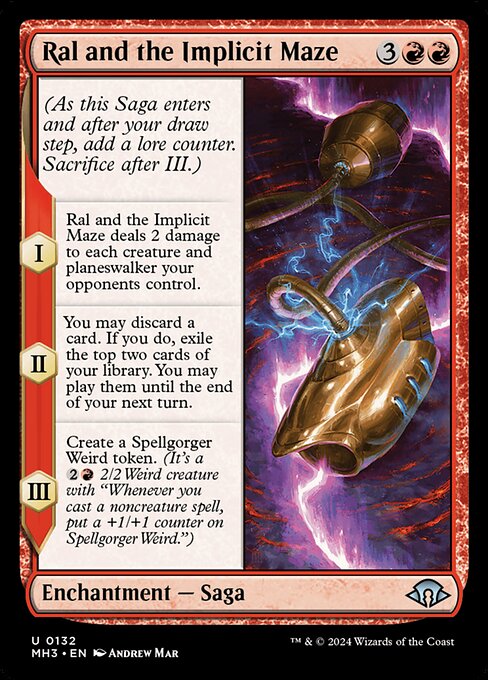
Two of the sweepers are mini ones – they both can deal 2 damage to all creatures, with a twist – only to the ones controlled by your opponent. Ashling requires jumping through some hoops to achieve it. Casting 2 spells a turn is not something happening routinely, but the card is so powerful on face value, you’d play it, especially in UR decks, anyway. Ral’s saga – well here we get the one sided Pyroclasm up front and follow it with some really nice chapters – drawing 2 cards is nice and ability to cast them turn later, when you get your Spellgorger Weird token with a ton of available mana, is premium. The biggest problem with the weird was casting it on turn 3 and hoping for no removal. You will play both of those cards in most of your red decks, with the difference that dealing 2 to all is an integral part of Ral saga and just a rarely used bonus with Ashling.
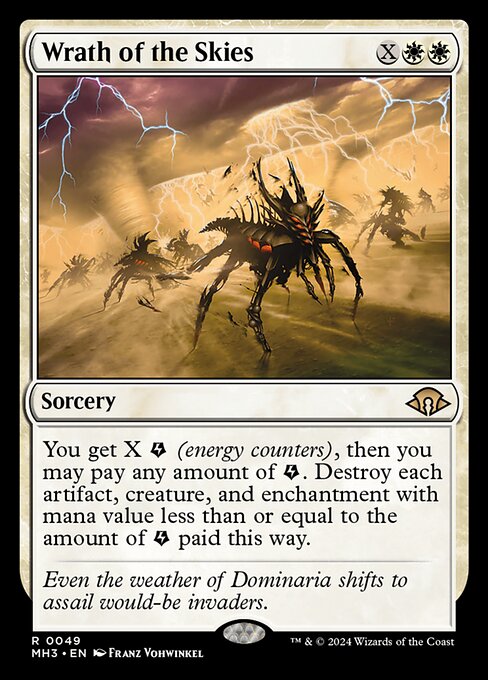
Wrath of the Skies is the wrath for the set. Can scale with the game, can be cast ahead of mana curve if you have other Energy generators. It can just kill all, but if your deck is right and board state allows, can be used selectively. And the fact it gets Artifacts and Enchantments too is a big bonus. Card is great, the only question is – is there a good home for it? White looks more aggressively slanted, but with so much power – maybe Wrath can make a space for itself despite not being the most synergistic. Don’t forget – sometimes you can just make a ton of energy and kill all the tokens and that is also fine.
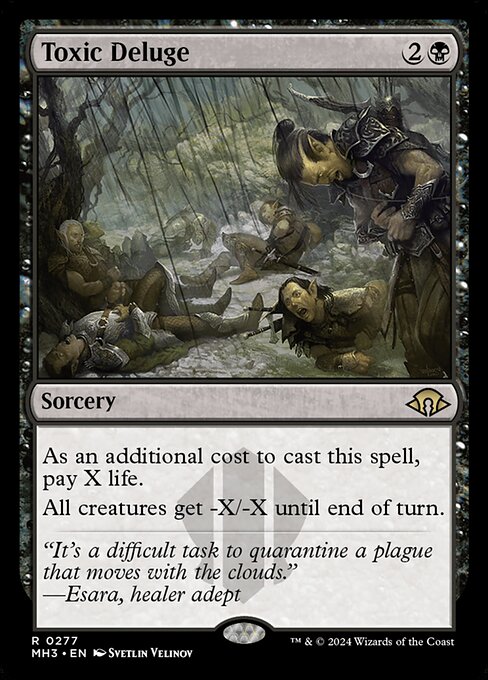
Toxic Deluge is a reprint, that, if your life total allows, lets you wrath for just 3 mana. You will need to build the deck in a way that lets you survive till the late game but if you do – this is very mana efficient as a way of stabilising the board. Be wary though – in some games it will be completely dysfunctional – as you will not have enough life to use it. It is a part of the range and your job as a deckbuilder is to make sure it is a very small part of the range, not the large one.
Conclusions
Hope this helps you with the first days of the format. The set looks great and I had fun in my pre-release and early streamer event with a variety of diverse decks – and variety of removal spells in them. This is a good prognostic for the summer.
If you want to learn more about the new format – check out the Draft deck skeleton stream from me and some of the brightest minds in Magic – we look at the set and based on our fundamentals try to figure out how we would build the decks using some realistic assumptions. A lot of info there!
Premium
Enjoy our content? Wish to support our work? Join our Premium community, get access to exclusive content, remove all advertisements, and more!
No ads: Browse the entire website ad-free, both display and video.
Exclusive Content: Instant access to all exclusive articles only for Premium members, at your fingertips.
Support: All your contributions get directly reinvested into the website to increase your viewing experience!
Discord: Join our Discord server, claim your Premium role and gain access to exclusive channels where you can learn in real time!
Special offer: For a limited time, use coupon code L95WR9JOWV to get 50% off the Annual plan!
I am a limited player, who mainly skips playing in order to analyse the limited data using 17Lands.com. I run a podcast: Magic Numbers, where I try to use data to let you improve your limited game play, find out which heuristics work out and which common ideas are not well supported by data.